
Senate education committee hears bill to set new math standards, training and screening; committee delays action
Get AI-powered insights, summaries, and transcripts
Subscribe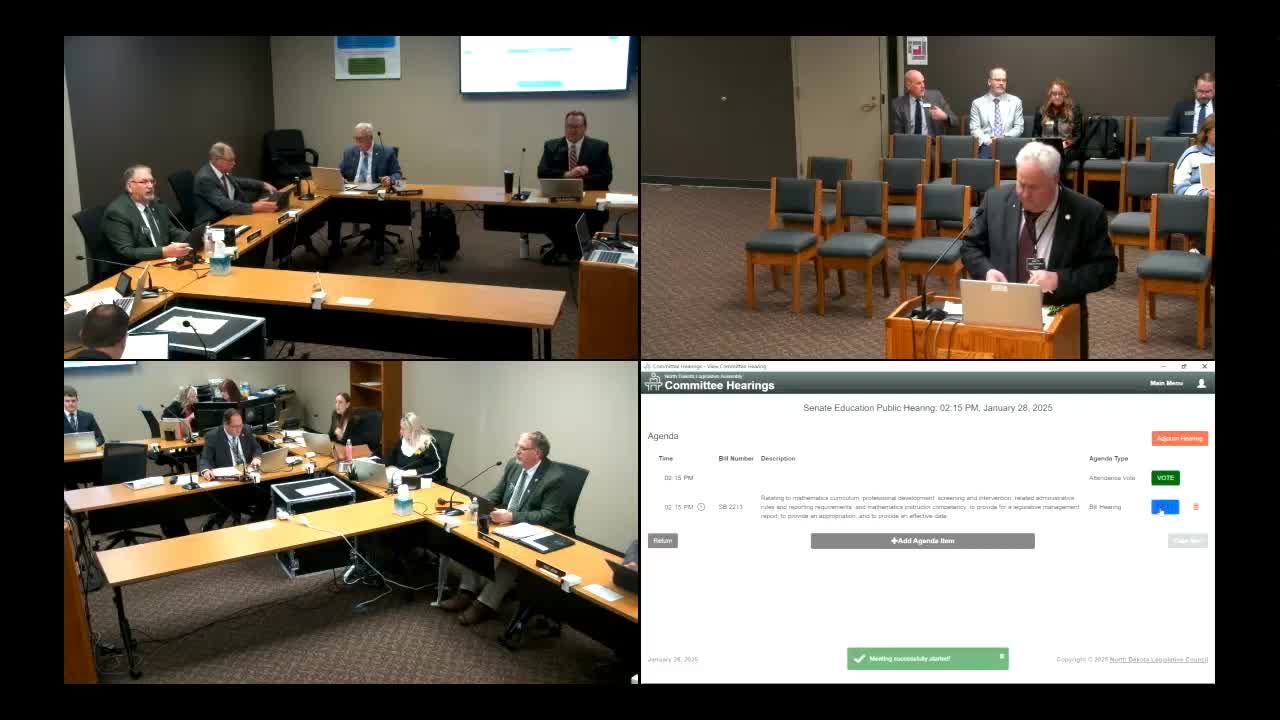
Summary
Senator Don Schaible, District 31, introduced Senate Bill 2213 at a Senate Education Committee hearing to require statewide curriculum alignment, teacher competency standards, screening and intervention in mathematics and to appropriate $1,200,000 for implementation.
Senator Don Schaible, District 31, introduced Senate Bill 2213 at a hearing before the North Dakota Senate Education Committee, outlining a proposal to revise math curriculum, require instructor competency and screening, create intervention plans for students with math deficiencies, and appropriate $1,200,000 for professional development and coaching. Chairman Beard presided over the hearing, which included testimony from school leaders, state education officials and licensing staff.
Supporters said the bill mirrors the state’s recent “science of reading” reforms and responds to declining math proficiency. Anne Ellefsen, director of academic support at the Department of Public Instruction, told the committee that North Dakota’s National Assessment of Educational Progress results fell from 48% proficient in grade 4 in 2013 to 40% in 2022, and from 40% to 28% in grade 8 over the same period, and that the bill’s curriculum alignment, formative screening and targeted interventions are intended to reverse those losses. Ellefsen described prior pilot work — the Greater Math in North Dakota grant (eight districts initially, seven continuing) and follow-up professional learning called North Dakota Effective Math Instruction — as informing the bill’s design.
Senator Schaible said the measure was intended to mirror the science of reading approach: "Section 1 pertains to grades 6 through 12. Section 2 pertains to grades 1 through 8," he said, and described requirements for professional development, mastery assessments and local intervention plans. The bill includes a July 1, 2027, later implementation date for some provisions.
District leaders and education groups offered mixed testimony. Kevin Howards read concerns from Mandan district officials who said the bill creates duplicative professional development and reporting requirements for districts that have already identified gaps and invested locally. The Mandan testimony said the district spent about $120,000 of local and ESSER funds over three years on professional development and an evidence-based program, and that Mandan’s proficiency moved from below state average to above it at elementary grades. Amy Kopas, director of the North Dakota Council of Educational Leaders, said the council supports the bill generally but requested an amendment to allow districts that have demonstrated mastery or improvement on state assessments to avoid repeating training already shown to be effective.
Becky Pitkin, executive director of the Educational Standards and Practices Board (the state licensing agency), provided neutral testimony and asked the committee to clarify language in section 1 about what "beginning mathematics instruction" means for secondary teachers. Pitkin noted existing licensure safeguards: teacher candidates already must demonstrate math competency via Praxis core tests or alternate evidence, and preparation programs include math methods coursework and content requirements that largely align with the concepts listed in section 3 of the bill.
A representative of New Classrooms (a national nonprofit) urged the committee to consider requiring or funding high-quality, personalized diagnostic and supplemental tools that identify each student’s current skill level and provide individualized pathways across grade levels, arguing that cumulative learning gaps in math make grade-level-only approaches insufficient for students far behind.
Committee members asked several clarifying questions about exemption language, measurement of teacher mastery, and whether professional development could be based on growth rather than a flat state-average cutoff. Kopas said mastery-based or growth-based language could be drafted to exempt experienced teachers who already demonstrate competency. Ellefsen and other witnesses said the administrative rules process could allow districts to count prior professional development (for example, going back to 2018) toward the bill’s requirements.
The committee closed the hearing on Senate Bill 2213 and chose not to act immediately, saying members wanted time to consider proposed amendments and additional questions. No formal vote on the bill occurred at the hearing.
The hearing record included references to House Bill 1388 as the statute that previously established the state’s approach to the science of reading and to the North Dakota Century Code (referred to in testimony) regarding existing teacher qualifications and reporting requirements. The Department of Public Instruction and regional education associations will participate in rulemaking and implementation if the bill moves forward.