Get Full Government Meeting Transcripts, Videos, & Alerts Forever!
Get email alerts on the Education Freedom Act topic
No spam. Unsubscribe anytime.
Senate Finance Advances Education Freedom Act with $145M–$148M in Scholarships, $2,000 Teacher Bonus
Summary
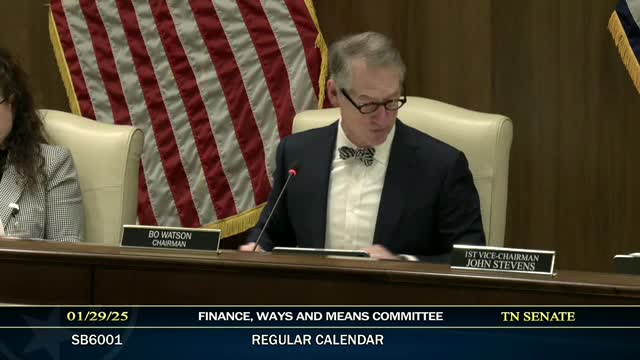
The Senate Finance, Ways and Means Committee on Thursday recommended Senate Bill 6001, the Education Freedom Act of 2025, to the calendar after extended debate over scholarship eligibility, funding sources and protections for local districts.
The Senate Finance, Ways and Means Committee on Thursday recommended Senate Bill 6001, the Education Freedom Act of 2025, to the calendar after more than two hours of debate about funding sources, eligibility and local impacts.
Leader Senator Jack Johnson, sponsor of the measure, told the committee the bill creates three main elements: a facilities fund for local education agencies funded by 80% of sports-wagering privilege tax revenue; a one-time $2,000 teacher bonus for an estimated 86,000 recipients; and an education scholarship program authorizing 20,000 scholarships equal to the state portion of per-pupil funding.
The sponsor said the facilities fund is intended for capital and maintenance grants and that the fund would be funded by the sports-wagering privilege tax. He said the council’s projected amount for 2025–26 was “just over $77,000,000,” but the committee adopted language to protect lottery-funded programs; as amended the committee’s approach set aside an amount to shore up lottery shortfalls first and left roughly $63,000,000 from the gaming revenue available for the facilities grants in the current projection.
On the teacher bonus, Johnson said the one-time payment would cost about $198,367,600 including employer taxes based on 86,000 eligible recipients.
On scholarships, Johnson described a 20,000-scholarship program, each scholarship equal to the state portion of TISA per-pupil funding (he cited a projected $7,296 figure), which he estimated at roughly $145,920,000 plus $2.7 million in administration for a total of $148,620,000. He also said $144,200,000 toward that program was already included in last year’s budget and explained a "funding floor" provision intended to prevent districts from receiving less state funding than in the prior year.
Committee members asked detailed questions about eligibility, access and long-term fiscal exposure. Senator Brenda Yarbrough offered a draft amendment clarifying "hold harmless" mechanics for local districts; she explained it would treat students who receive scholarships as if they remained in the public system for funding calculations and said genuinely protecting districts would require substantially more state funding. Yarbrough withdrew that proposed amendment after discussion.
Opponents and skeptical members focused on who would benefit from the scholarships. Senator Raum Lamar and others asked whether the program would mainly subsidize families already in private schools; committee staff and the sponsor cited fiscal estimates showing a portion of scholarships could be used by students already in private schools, but the sponsor said the program’s intent is a universal parental-choice scholarship, with half the scholarship slots prioritized in year one for lower-income households (thresholds were described as up to 300% of the federal free-and-reduced-price lunch income level for that priority tranche).
Committee members pressed for clarity on whether eligibility equates to access; the sponsor confirmed the bill does not require private schools to accept scholarships. Department testimony clarified there is no mandate forcing private schools to participate.
Several members raised long-term budget questions. Senator Joe Yarbrough and others asked how the program could grow beyond the initial 20,000 slots; the sponsor and committee leaders pointed to a statutory growth mechanism (5,000 additional scholarships after 75% utilization) but emphasized future expansion is subject to appropriation by future legislatures. The committee also discussed modeling from other states and uncertainties about private-school capacity.
After debate the committee voted to recommend SB 6001 as amended for passage to the calendar with a roll-call tally recorded by the clerk (committee recommendation: 8 ayes, 3 noes).