Get Full Government Meeting Transcripts, Videos, & Alerts Forever!
Get email alerts on the K 12 Budget And Programs topic
No spam. Unsubscribe anytime.
Superintendent Walters outlines budget requests for teacher pay, literacy programs and $3M for classroom Bibles
Summary
At a House Appropriations and Budget hearing, Superintendent Walters detailed requests including teacher signing bonuses, expanded literacy programs tied to a $60 million federal grant, continuation of paid maternity leave and a $3 million one‑time request to place Bibles in classrooms; lawmakers pressed on audits, program metrics and training.
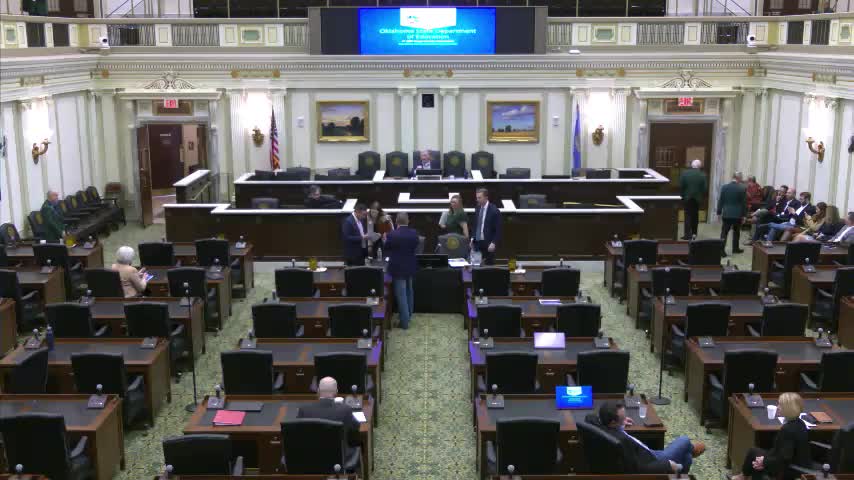
Superintendent Walters told the House Appropriations and Budget Committee during a budget and performance hearing that the State Department of Education’s budget request emphasizes teacher recruitment and retention, statewide literacy initiatives and several targeted new asks, including $3 million to place Bibles in classrooms.
The request matters, Walters said, because Oklahoma serves a large student population and continues to recover from pandemic learning loss: “We have just under 700,000 students enrolled in Oklahoma public schools,” he told the committee. He also noted the state has about “just over 47,000 teachers” and 542 school districts.
Walters said the department used signing bonuses to fill critical shortages last year, awarding “just under $16,000,000 to 522 certified teachers in critical shortage areas,” targeted to reading, English and special education and prioritized toward low‑performing, high‑poverty and rural districts. He described a separate rural program that brought 65 certified math and science teachers into small districts and credited such efforts with helping reverse a decade‑long decline in teacher numbers.
The department highlighted retention programs as well: the Oklahoma Teacher Empowerment program — enabling districts to designate lead or master teachers and add salary supplements — is now active in multiple districts, Walters said, and a teacher induction program (mentoring for first‑year teachers) returned using ESSER funds with reported retention above 90 percent for participating teachers.
Literacy and tutoring initiatives were central to the presentation. Walters said the department launched a high‑dosage tutoring program that reached “over 400 students in 23 districts” with 70 tutors and that 94 percent of students participating “saw improved and maintained reading fluency.” The department funded a statewide screener (referred to in the presentation as "Mirror") that districts can use weekly to monitor reading and to assign virtual tutors. Walters told lawmakers the department won “the second largest literacy grant in the country this year. It is a 5 year 60000000 dollar literacy grant,” and said 25 districts will receive subgrants under that federal award.
Todd Lofton, the department’s chief academic officer, described teacher training tied to the science of reading and to LETRS (Language Essentials for Teachers of Reading and Spelling). Walters and Lofton gave completion figures during questioning: “2,226 educators have completed the LETRS training,” and the department later reported “5,300 teachers that have fully gone through our Science of Reading Academy” with “1,800 currently in the program.” Lofton described LETRS as a nationally recognized, multi‑year certification; Walters explained Science of Reading Academies are typically completed in a year and LETRS is a longer certification.
On budget asks, Walters outlined several specific requests and cost details: a $3,000,000 request in fiscal year 2026 to place classroom Bibles (he described that amount as a maximum and said bids would determine final cost); $300,000 for standards implementation tied to forthcoming social studies and science standards; funding to cover state and federal required assessments; continued funding for the Strong Readers Act; continuation of paid student teaching; and additional security and recruitment funding including $500,000 to offer concealed‑carry training and signage to districts and $1,000,000 for law‑enforcement and veteran recruitment into classrooms. Walters said the state previously allocated $100,000,000 for the school resource officer (SRO) program and that $50,000,000 is available for allocation next school year.
Walters also requested a supplemental for the flexible benefit allowance to cover rising personnel and health‑care costs. He cited a rise of roughly 1,500 certified staff between January and October and an average 5 percent increase in health care costs, saying that produced “about a $10,000,000 increase for fiscal year 2025” in the benefit cost that the legislature currently funds for teacher benefits.
Lawmakers pressed on several topics. Multiple members asked for program metrics and replication costs; Walters agreed to provide cost‑per‑pupil and other details to committee members. Several members raised concerns about recent federal single‑audit findings, turnover and record‑keeping at the agency; Representative Fugate summarized the federal auditor’s findings as including deficiencies in timely reporting, written procedures and staff turnover. Walters responded that the agency inherited problems from his predecessor, defended current staff and said the department has been working to streamline operations and remove ineffective positions, but he did not provide new corrective‑action documentation during the hearing.
Committee members also questioned the $3 million Bible request. Walters said the request is to place Bibles in classrooms “in its historical context” alongside foundational documents such as the U.S. Constitution and Declaration of Independence and described the King James version as the most commonly cited historical text in American speeches and documents; he said districts would have local control over classroom materials. Several members suggested donated copies or free digital versions could serve the purpose; Walters said the department prefers a formal procurement to ensure durable classroom sets and transparency.
Other details Walters supplied to the committee: paid maternity leave payouts totaled about $5,400,000 for 849 applications in the last year (the program originally received $2,300,000), and the department said it can cut up to $1,500,000 from its own administrative budget through consolidation. Walters said the department’s aim is to preserve and direct the vast majority of education funding to local districts — “99% of your education funds go directly to districts,” he said.
The hearing ended with committee members asking for follow‑up materials, including cost breakdowns for the Bible request, per‑pupil costs for tutoring programs, and additional documentation on literacy and training metrics. Several lawmakers expressed support for expanding physical education and for continued investment in literacy and teacher retention while reserving judgment on discretionary items until supplemental detail was supplied to the committee.