Get Full Government Meeting Transcripts, Videos, & Alerts Forever!
Get email alerts on the Appropriations And Budget topic
No spam. Unsubscribe anytime.
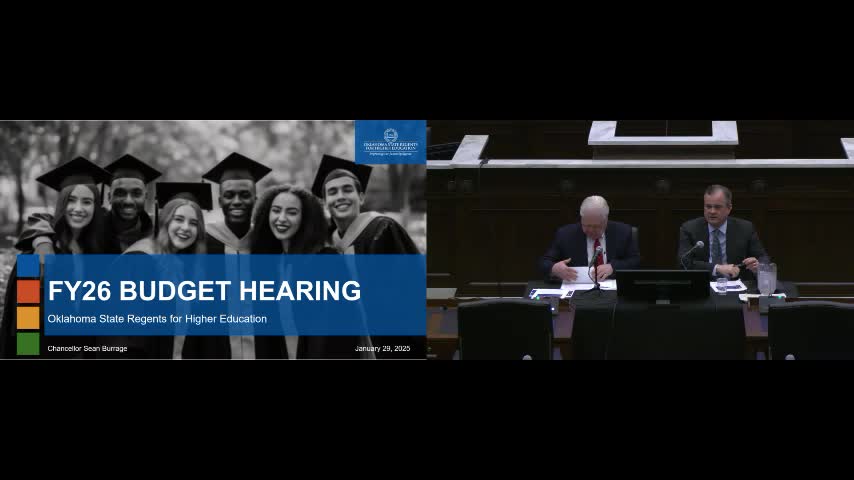
Oklahoma State Regents ask Legislature for $95M increase, detail campus-specific requests
Summary
Chancellor Burridge presented the Oklahoma State RegentsFY26 budget request highlighting workforce priorities (nursing, STEM, teacher prep), a $95 million systemwide ask and separate institution-specific allocations; legislators pressed for details on concurrent enrollment, teacher recruitment and campus capacity.
Chancellor Burridge told a legislative panel the Oklahoma State Regents for Higher Education are asking the Legislature to approve an additional $95 million for fiscal year 2026, a 9.3% increase above the current FY25 appropriation, and presented a package of systemwide and institution-specific requests aimed at boosting workforce-related programs and addressing deferred maintenance.
Why it matters: The regents framed the request around state workforce needs in STEM, nursing and teacher preparation, and sought to make previously off-budget campus allocations more transparent. Lawmakers pressed the regents for enrollment, cost and program details as they weigh priorities against constrained state revenue projections.
Burridge, who recently took the chancellor post, opened by thanking lawmakers for recent investments and said, "The numbers are the numbers," referencing Board of Equalization estimates that could reduce available state funding for FY26 while stressing the regentsconstitutional duty to present system needs. He said the FY26 request was developed prior to his arrival but that he "wholeheartedly support[s] and endorse[s] it." He also said the regents will require colleges and universities to submit their composite financial index when seeking tuition or fee increases.
The presentation included these principal system requests (figures as given by the chancellor): an additional $19.4 million to support production of graduates in STEM and other critical fields; $10 million to expand nursing education capacity; $12.6 million for adult degree-completion initiatives; $5.5 million to implement the Strong Readers Act at 22 educator-preparation programs; and $3.76 million to fully fund concurrent enrollment tuition waivers. Burridge also described a $43.7 million request for institutional excellence and student success (including $25 million in performance-based institutional allocations and $12.5 million for student-success supports), $2 million to modernize the regentsdata platform, $3.5 million for a collaboration/consolidation incentive fund, and $3.5 million for fiscal and cybersecurity efforts.
Campus-specific allocations: Burridge said the regents included institution-specific requests this year to increase transparency about dollars previously provided outside the regentsbudget process. He cited totals of $301 million (earlier in his remarks) and later referred to $296 million targeted for institution-specific allocations, then listed amounts that sum to $295 million: $75 million each for the University of Oklahoma and Oklahoma State University, $55 million for the 11 regional universities (collectively), $10 million for two-year colleges and $80 million for 10 constituency agencies (including OU and OSU health sciences centers, OSU Vet Med, cooperative extension, OU Law, OU-Tulsa, OSU-OKC, OU/OSU IT and the OU Geological Survey). The transcript shows those differing totals; the exact reconciled total was not specified in the hearing.
Deferred maintenance and timing: The chancellor said deferred maintenance statewide totals roughly $1.9 billion. For FY26 the regents asked that the remaining $101 million (part of previously planned funding) be made available in FY26 rather than spread over three years to increase buying power against inflation.
Concurrent enrollment: Lawmakers pressed for detail on concurrent enrollment. The regents reported they allocated $20,492,168 for the current year and that concurrent enrollment head count rose about 10.8% year over year to 16,972 students (from 15,385). Burridge and staff said the $3.76 million increase requested for FY26 largely would baseline the program and cover anticipated growth and per-credit costs; staff said FY16 concurrent-enrollment funding was roughly $3 million then, rising to about $20 million today.
Teacher preparation and workforce pipeline: Burridge credited the "Inspired to Teach" program with a reported 30% increase in first-year enrollment in teacher-preparation programs and said he hopes continued investment and teacher-pay improvements will further increase enrollment. Lawmakers asked whether the program is driving the increase and whether the state will need to accelerate funding; Burridge said the program appears to be a primary driver and that regents are monitoring stipend and scholarship needs.
Out-of-state recruitment and capacity: Burridge warned that growth and incentives in neighboring states (notably expanded Texas programs) could reduce out-of-state enrollments that currently help Oklahoma recruit workforce-ready graduates. He said OU and OSU remain competitive but noted capacity constraints often come down to dorm beds and lab space; both research universities are adding capacity, he said.
What the hearing did not record: no formal votes or motions were taken in the session. The transcript did not include a single reconciled figure for the institution-specific allocations (see discrepancy noted above), and several lawmakers asked for per-student and FTE breakdowns; Burridge said the regents would provide those figures on request.
Ending: Burridge closed by reiterating a focus on accountability and transparency and offering staff contact information for follow-up. The committee opened questions after the presentation and then adjourned.