Get Full Government Meeting Transcripts, Videos, & Alerts Forever!
HHS outlines budget request and program changes: LIHEAP moves to year‑round, childcare expansions and IT costs draw scrutiny
Summary
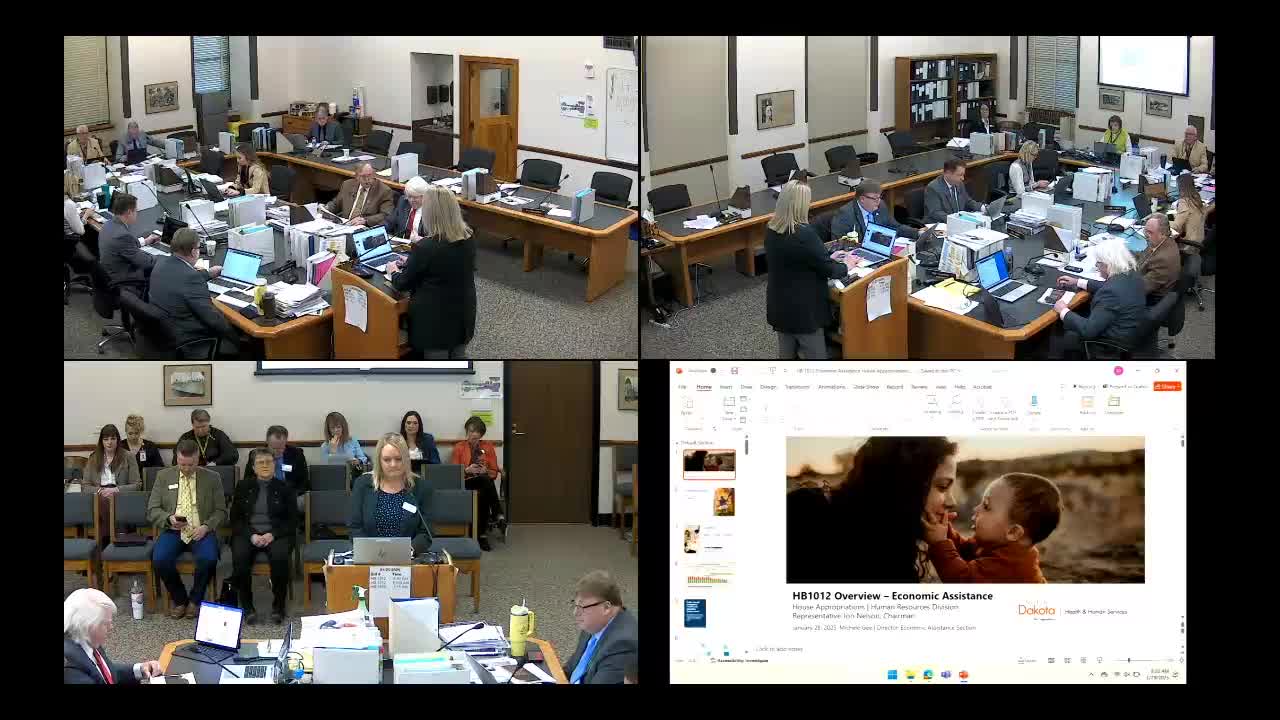
Chairman Nelson convened the Appropriations – Human Resources Division hearing where Michelle Gee, director of the Economic Assistance Section at the North Dakota Department of Health and Human Services (HHS), summarized program operations, recent policy changes and the division’s budget request.
Chairman Nelson convened the Appropriations – Human Resources Division hearing where Michelle Gee, director of the Economic Assistance Section at the North Dakota Department of Health and Human Services (HHS), summarized program operations, recent policy changes and the division’s budget request.
Nut graf: Gee said the department is asking the committee to fund continuing costs for major federal‑state programs — SNAP (Supplemental Nutrition Assistance Program), TANF (Temporary Assistance for Needy Families), LIHEAP (Low Income Home Energy Assistance Program), Child Care Assistance and housing‑stability grants — and to absorb substantial ongoing maintenance and operations costs for the state’s integrated eligibility system (Spaces). The discussion covered program performance metrics, staffing, quality control, outreach and specific policy changes including converting LIHEAP to a year‑round benefit and continuing child‑care enhancements from House Bill 1540.
Major budget and IT note: Gee told the committee the Economic Assistance (EA) section’s budget request includes a large increase in IT maintenance and operations tied to the Spaces integrated eligibility system. “The 51,000,000 is primarily to support our integrated eligibility system,” Gee said, describing the figure as a maintenance and operations cost rather than a new one‑time purchase. Committee members asked for a full breakout and offsets before approving the change.
LIHEAP: year‑round, energy‑burden target and service network
Gee described LIHEAP’s October–May 2024 heating season statistics and program changes. In 2024 the program served 14,000 households with an average payment of $794 per household and worked with roughly 230 service vendors and 258 fuel vendors (about 450 vendors total). She said the division will convert LIHEAP to a year‑round program this summer so households are not required to reapply each October and to reduce the seasonal spikes that have strained the eligibility system. Gee said the program will target an energy burden of 6% or less of household income (effective October 2024) and confirmed LIHEAP eligibility is set at 60% of state median income, which is a federal threshold. "We are supporting affordable housing by limiting energy burden to 6% or less of the household's total income," Gee said.
Gee said LIHEAP pays based on the actual cost of a household’s heating bill (rather than a flat per‑household rate) and that services including furnace repair or replacement and weatherization are available without the 6% cap. She noted LIHEAP is currently 100% federally funded, with a 5‑year liquidation period for grants; historically the…
Already have an account? Log in
Subscribe to keep reading
Unlock the rest of this article — and every article on Citizen Portal.
- Unlimited articles
- AI-powered breakdowns of topics, speakers, decisions, and budgets
- Instant alerts when your location has a new meeting
- Follow topics and more locations
- 1,000 AI Insights / month, plus AI Chat