Get Full Government Meeting Transcripts, Videos, & Alerts Forever!
Get email alerts on the Economic Assistance topic
No spam. Unsubscribe anytime.
HHS outlines budget request and program changes: LIHEAP moves to year‑round, childcare expansions and IT costs draw scrutiny
Summary
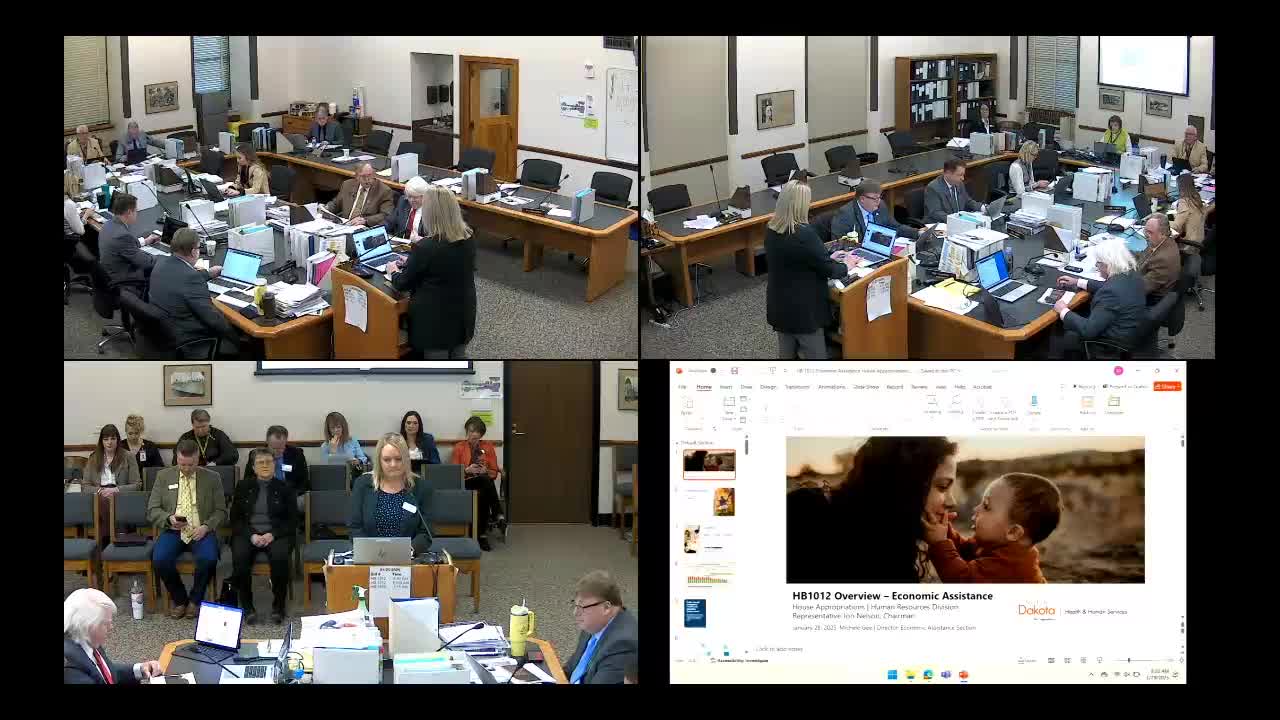
Chairman Nelson convened the Appropriations – Human Resources Division hearing where Michelle Gee, director of the Economic Assistance Section at the North Dakota Department of Health and Human Services (HHS), summarized program operations, recent policy changes and the division’s budget request.
Chairman Nelson convened the Appropriations – Human Resources Division hearing where Michelle Gee, director of the Economic Assistance Section at the North Dakota Department of Health and Human Services (HHS), summarized program operations, recent policy changes and the division’s budget request.
Nut graf: Gee said the department is asking the committee to fund continuing costs for major federal‑state programs — SNAP (Supplemental Nutrition Assistance Program), TANF (Temporary Assistance for Needy Families), LIHEAP (Low Income Home Energy Assistance Program), Child Care Assistance and housing‑stability grants — and to absorb substantial ongoing maintenance and operations costs for the state’s integrated eligibility system (Spaces). The discussion covered program performance metrics, staffing, quality control, outreach and specific policy changes including converting LIHEAP to a year‑round benefit and continuing child‑care enhancements from House Bill 1540.
Major budget and IT note: Gee told the committee the Economic Assistance (EA) section’s budget request includes a large increase in IT maintenance and operations tied to the Spaces integrated eligibility system. “The 51,000,000 is primarily to support our integrated eligibility system,” Gee said, describing the figure as a maintenance and operations cost rather than a new one‑time purchase. Committee members asked for a full breakout and offsets before approving the change.
LIHEAP: year‑round, energy‑burden target and service network
Gee described LIHEAP’s October–May 2024 heating season statistics and program changes. In 2024 the program served 14,000 households with an average payment of $794 per household and worked with roughly 230 service vendors and 258 fuel vendors (about 450 vendors total). She said the division will convert LIHEAP to a year‑round program this summer so households are not required to reapply each October and to reduce the seasonal spikes that have strained the eligibility system. Gee said the program will target an energy burden of 6% or less of household income (effective October 2024) and confirmed LIHEAP eligibility is set at 60% of state median income, which is a federal threshold. "We are supporting affordable housing by limiting energy burden to 6% or less of the household's total income," Gee said.
Gee said LIHEAP pays based on the actual cost of a household’s heating bill (rather than a flat per‑household rate) and that services including furnace repair or replacement and weatherization are available without the 6% cap. She noted LIHEAP is currently 100% federally funded, with a 5‑year liquidation period for grants; historically the state has not returned ("turned back") LIHEAP funds.
Child care assistance: enrollment, workforce benefit, eligibility and outreach
Gee reviewed changes that followed the 2023 legislative session (House Bill 1540) and more recent program actions. From June–November 2024 the Child Care Assistance Program averaged 6,178 children served per month (3,812 families) and an average payment of $882 per child per month, with roughly 1,032 providers participating monthly. The division implemented a child‑care workforce benefit (June 2024) that covers child care for employees working at least 25 hours per week in a licensed childcare setting; Gee reported that benefit supports 744 working individuals employed by 302 providers and amounts to the equivalent of about $1,400 per worker per month (about an $8 per hour wage effect for those workers).
Eligibility limits and copays: Gee confirmed the Child Care Assistance Program is currently set at 75% of state median income (the federal maximum is 85%). She said families below 30% of state median income have no copay (a change implemented July 2023), and families above that threshold have graduated copays. Committee members pressed for outreach and clarity; Gee said the department has expanded communications support but acknowledged more outreach is needed.
She also summarized policy questions the department is still resolving: for example, whether childcare help can be provided for students pursuing education beyond a bachelor’s degree without state funding; Gee said the department is pursuing clarification from federal officials and will evaluate budget impacts if a state match is required.
Eligibility processing, delays and redesign
Gee walked members through application and review timeliness across programs and the work of the Human Service Zones that process eligibility. She said average processing times have improved since the pandemic unwind (for example, Medicaid processing averaged 20.8 days from July–December), but the agency still misses federal timeliness standards at times. She attributed spikes in untimely processing to seasonal LIHEAP application surges and to the pandemic unwinding workload (132,331 reviews assigned to human service zone staff during the unwind period). "We have seen improvements, especially coming out of that unwind period," Gee said.
The department reorganized eligibility delivery in 2023 (initially a regional model, moved to a statewide model in October 2023) and operates a centralized customer support phone center and a centralized mail/indexing unit that feeds work to eligibility processors. Gee said the combined system processes roughly 16,000–18,000 applications and reviews per month and 60,000–70,000 work items. She described the staffing model: about 350 eligibility workers statewide (including roughly 124 application processors and 156 maintenance processors), a 39‑person centralized customer support team (37 zone staff, 2 HHS staff), and a centralized mail team that indexes incoming documents.
Spaces (integrated eligibility system) and operational impacts
Gee described Spaces — North Dakota’s combined eligibility system and customer self‑service portal — as supporting five programs (SNAP, TANF, Medicaid, LIHEAP and Child Care Assistance) and about 161,000 users. The system integrates with more than 50 external data interfaces (for example, Social Security, IRS, child support and MMIS). Gee said Spaces replaced five legacy systems and that ongoing maintenance and vendor fees are substantial. She explained several federal grants (SNAP infrastructure awards and PDG funds) are being used for specific enhancements, including Sun Bucks improvements and automation of manual processes.
SNAP and Sun Bucks (Summer EBT)
Gee said SNAP served an average of about 26,000 households per month (June–November 2024) with an average household payment of about $376 and roughly $9.9 million in monthly benefit payments flowing to retailers. The division implemented the USDA Summer EBT (Sun Bucks) program in summer 2024 through a data match with the Department of Public Instruction; 38,412 children received $120 each in summer 2024 ($4.6 million), and the division anticipates serving about 44,000 children in summer 2025. Gee said Sun Bucks was implemented to provide benefits to children who lose access to school meals over summer months and that the program uses data matches to limit household‑level applications.
TANF and housing stability
Gee summarized TANF program changes from the 2023 session: benefit increases that roughly doubled prior payments (the first increase since about 2012), removal of a benefit cap triggered by birth of a child, coverage for pregnant women from the start of pregnancy (previously last trimester only), and added earned‑income disregard months as a work incentive. For the housing stability and homeowner assistance programs (Treasury funds carried over from COVID-era allocations), Gee said the department served about 1,049 households per month with rental assistance and averaged payments of roughly $653 per household; the homeowner assistance program served roughly 45 households per month with one‑time awards (average foreclosure prevention payment about $6,067) and roughly $9.2 million in support to homeowners.
Quality control, audits and payment‑error rates
Gee summarized program quality control reviews: LIHEAP uses a state review of 25 cases per month (error rates reported as 4.2% in 2022, 0.85% in 2023 and an interim 3.12% in 2024 through July). Child Care Assistance and SNAP have federal and state review requirements; Gee reported a federal target of 10% error rate for child care and described trends (for example, a 2022 federal error rate of 7.32% for child care, state review at 11.8% in 2023, and 6.75% through 2024 year‑to‑date). On SNAP quality control (active, negative and timeliness error buckets), she said North Dakota has been improving but still monitors CAPER and APT rates closely.
Staffing and operational questions from the committee
Committee members pressed on staffing levels, abandoned calls and average talk times in the centralized call center. Gee acknowledged the customer support center previously used a contracted surge team during the pandemic unwind period; that surge team ended in October 2024 and the division moved to a one‑call resolution model that raises average talk time but lowers transfers to tier‑2 staff. Sarah Zink was identified as the CSC (customer support center) coordinator who oversees that operation.
Policy, decision packages and requested funding
Gee summarized decision packages in the EA request, including: ongoing funding for SNAP and Sun Bucks benefits, a $3.0 million request to continue quality tier (child care provider incentive) payments, $2.0 million to retire mainframe legacy systems, and a $14.5 million one‑time SIF (State Investment Fund) request for an eviction‑prevention and housing stabilization initiative (the committee asked for more detail and Jessica Thomason will present on housing next week). She noted the total EA budget request includes a large transfer of IT budget authority from HHS operating to EA for Spaces maintenance and that members asked the agency to present a line‑by‑line IT breakout and offsets.
What the committee asked for next: committee members repeatedly asked for more granular, auditable breakdowns of IT maintenance costs and for historical offsets to explain why the EA IT line appears to increase so substantially between biennia. Several members said they wanted to see where carryovers and one‑time federal awards are entering the base and how that affects projected under/over budget statuses.
Ending: Gee closed by noting audit findings summarized in her slides were not repeat findings and that staff would follow up with requested reports and additional detail to committee members. Jessica Thomason and Kay Larson were introduced for the next items on the agenda (early childhood topics and childcare initiatives).