
Committee hears bill to put treatment‑court roles in statute; agencies say bill codifies existing practice
Get AI-powered insights, summaries, and transcripts
Subscribe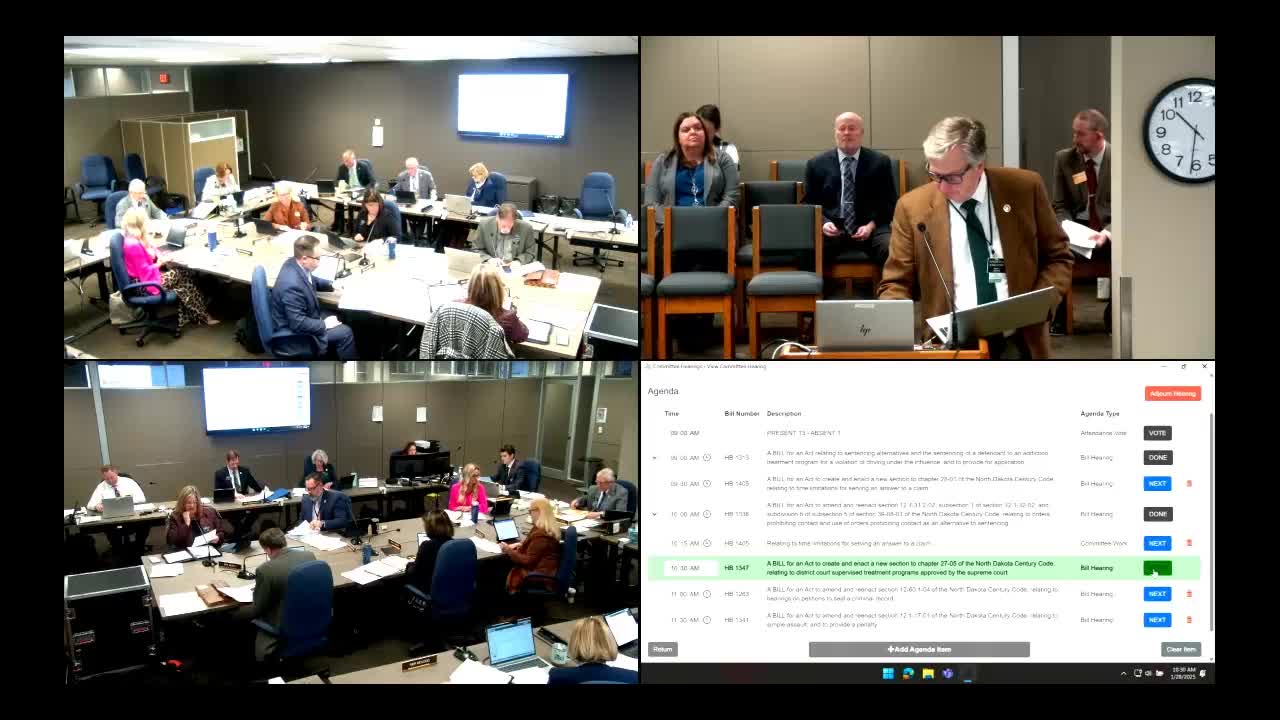
Summary
House Bill 1347 would put into statute the roles of Department of Corrections and Rehabilitation, Department of Health and Human Services and the courts in supervising district court treatment programs; agency witnesses said the bill clarifies existing practice and removes ambiguity about responsibilities and minimum treatment standards.
Representative Bernie Satrim introduced House Bill 1347 to create a statutory framework for district court supervised treatment programs, sometimes called treatment courts or specialized dockets. Satrim described the bill as delineating roles: the Department of Corrections and Rehabilitation (DOCR) would supervise offenders' sentences, the Department of Health and Human Services (DHHS) would oversee treatment services according to its policies, and the district court would provide judicial direction.
Jessica Troelsen, specialized docket manager for the State Court Administrator's Office, testified that North Dakota already operates about 14 adult and juvenile specialized dockets and that the Supreme Court established an interdisciplinary committee and administrative rule (Administrative Rule 60) to vet new dockets. Troelsen said HB 1347 grew from interagency discussions among DOCR, DHHS and the courts to clarify collaborative responsibilities and coordination as the courts expand.
Tom Earhart of the Department of Corrections and Rehabilitation described current DOCR involvement in supervision and case management for participants, noting DOCR provides probation officers and coordinators for multiple treatment courts and has FTEs and grant funding supporting the programs. Pam Segnus of DHHS said treatment provision is currently a mix of private and public providers; she and other witnesses said codifying responsibilities in statute would ensure DHHS can step in if private providers stop offering services and would enable DHHS to ensure minimum clinical standards and contract continuity.
Witnesses and agency staff emphasized the bill is primarily clarifying and codifying roles rather than creating a new program or a new funding obligation; several said no fiscal note was required for the changes as drafted. Supporters cited evaluation evidence — a North Dakota State University evaluation showing reduced recidivism in treatment courts — and urged a do‑pass recommendation.
Why it matters: The bill aims to remove uncertainty about which agency is responsible for treatment services, supervision and program coordination as treatment courts expand, and to ensure continuity of services and minimum clinical standards statewide.
What’s next: Committee testimony was supportive and the committee closed the hearing without recorded opposition; the bill awaits further committee action.