
Court staff opposes extending civil answer deadline from 21 days; bill paused for further amendment
Get AI-powered insights, summaries, and transcripts
Subscribe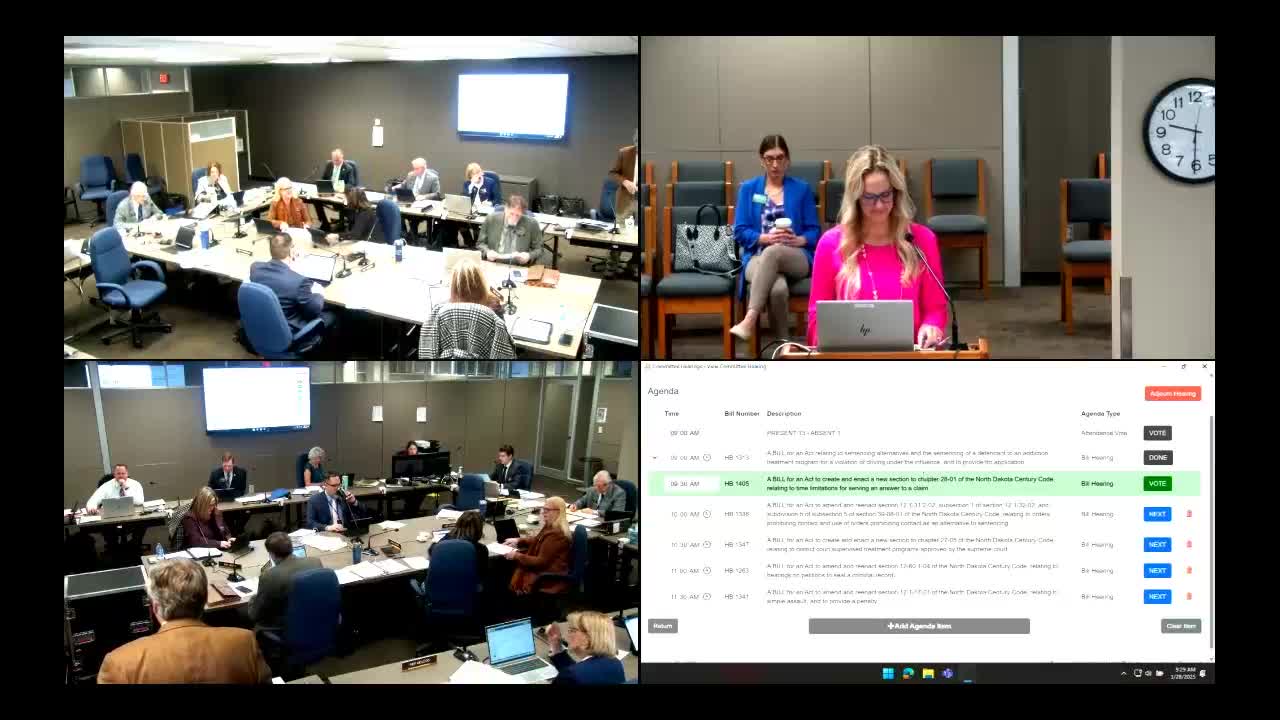
Summary
Representative Laurie Van Winkle proposed extending the statutory deadline to answer civil complaints; State Court Administrator's Office staff and court officials opposed a large increase and recommended keeping the rule‑based 21‑day deadline. Committee discussion produced competing amendment proposals but no final committee vote.
Representative Laurie Van Winkle introduced House Bill 1405, which would change time limitations for serving an answer to a civil claim. Van Winkle said the current 21‑day timeline leaves many defendants — particularly self‑represented people — with inadequate time to find counsel and prepare a response. She said her intent was to give defendants more time and that the draft had been edited by counsel, producing different proposed time frames (45 or 60 days) than she intended.
Sarah Behrens, a staff attorney with the State Court Administrator's Office, testified in opposition. She told the committee that the 21‑day deadline is established in Rule 12 of the North Dakota Rules of Civil Procedure and has worked for decades. Behrens explained that the rule change to 21 days occurred in 2011 to align with federal practice, that many states range 20–30 days, and that doubling or tripling the deadline would delay civil cases and increase burdens on plaintiffs seeking timely resolution. She noted court resources: the Supreme Court's Self‑Help Center provides guides and fillable forms for pro se defendants and that procedural safeguards (e.g., notice before a default judgment and rule 60(b) motions to vacate) exist for defendants who miss deadlines.
Committee members raised concerns on both sides: some members emphasized the intimidation and practical barriers faced by unrepresented defendants, while others noted that plaintiffs also deserve timely resolution and that judges commonly grant short extensions when needed. Representative Van Winkle proposed multiple amendments during debate — at one point moving to change a 60‑day draft to 27 days, later proposing 35 days — and the committee discussed but did not adopt a final amendment during the morning session. The sponsor later rescinded one motion and said she would offer a new amendment; the committee deferred further action because of floor schedule and planned to resume discussion after session.
Why it matters: The bill would alter the statutory time limit to answer complaints, potentially shifting the default timeline for civil litigation and affecting plaintiffs and defendants statewide. Courts and court staff argued the 21‑day rule is embedded in procedural rules and supported by self‑help resources; supporters argued many defendants need more time to secure counsel and prepare responses.
What’s next: The committee discussed multiple amendment proposals but did not take a final vote on HB 1405 during the morning hearing. The chair deferred further action until after the floor session; sponsors signaled intent to propose an amended time frame (discussion ranged from 27 to 35 to 45 days during the hearing).