
House panel advances bill letting judges impose no-contact orders beyond imprisonment for DUI-related treatment sentences
Get AI-powered insights, summaries, and transcripts
Subscribe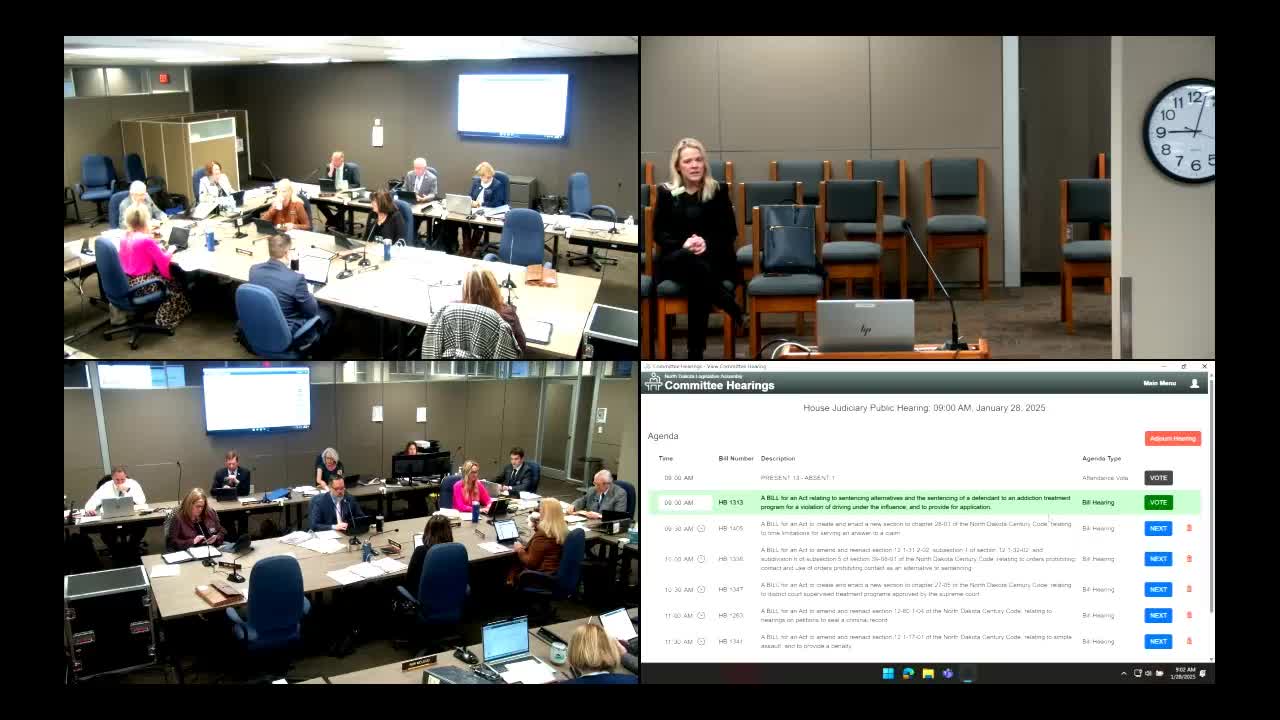
Summary
The House Judiciary Committee voted 14-0 to give House Bill 1313 a "do pass" recommendation after a brief hearing in which sponsor Rep. Bernie Satrim said the bill adds a no-contact order as an explicit sentencing alternative and expands its timeframe beyond a term of imprisonment.
Representative Bernie Satrim, sponsor of House Bill 1313, told the House Judiciary Committee on Oct. 12 that the bill adds a specific no-contact order prohibiting contact with a victim to the statutory list of sentencing alternatives and does not limit that order to the term of imprisonment.
The measure would allow judges to issue a no-contact order as part of a sentence that can apply during imprisonment, probation, parole or other post-sentence supervision. "It adds the letter F on page 2, which is a no contact order prohibiting contact with the victim of the offense," Representative Satrim said when introducing the bill. He said the change was requested by a constituent and described it as a tool to reduce the need for victims to return to court for separate civil relief.
Committee members questioned how the new language interacts with existing cross‑references in the sentencing code. Committee members asked whether the bill simply moved existing text or expanded its scope beyond an order limited to the term of imprisonment. Representative Vetter and others pressed Satrim on the cross‑references; the chair and staff noted the change appeared to replace an earlier subdivision (old f became g) and to broaden the timeframe when a no-contact order could apply.
No members of the public testified for or against HB 1313. After brief committee discussion the chair entertained a motion for a "do pass" recommendation. A committee member moved a due‑pass recommendation; Representative Schneider seconded. The committee took a roll‑call vote. The bill passed the committee 14–0.
Votes at a glance: The committee recorded a roll call with all voting members recorded as "Yes" and the clerk announced "14 to 0. Motion for due pass carries." Representative Schneider was named as the floor bill carrier.
Why it matters: The change would make no-contact orders an explicit sentencing alternative that a judge may impose beyond a period of incarceration. Supporters framed the change as reducing trauma and expense for victims who otherwise might need to seek a separate civil protective order after a criminal conviction.
What’s next: With a committee "do pass" recommendation, a bill carrier will present the bill to the full House for further consideration. No changes to effective dates or implementation details were specified during the hearing.