Get Full Government Meeting Transcripts, Videos, & Alerts Forever!
Get email alerts on the Education topic
No spam. Unsubscribe anytime.
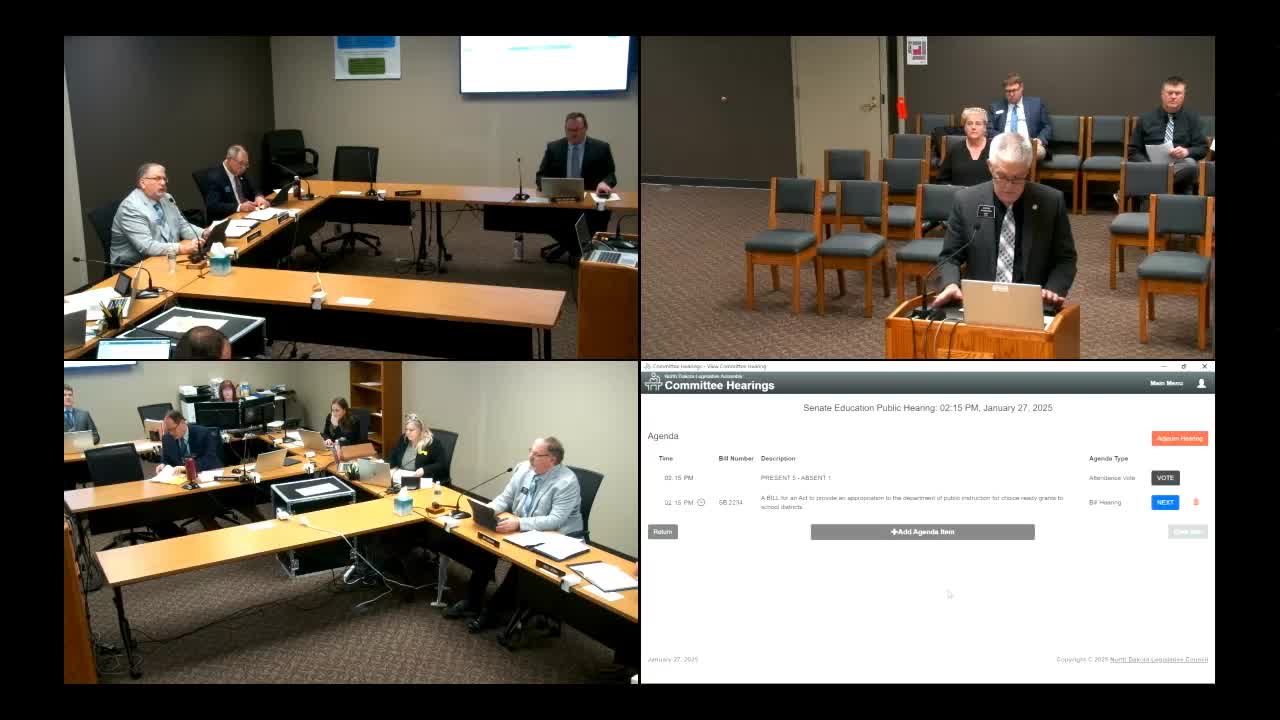
Senate committee hears bill to restore Choice Ready high-school grants; no vote taken
Summary
A Senate Education Committee hearing covered Senate Bill 2234, which would authorize $2 million in general-fund grants to support North Dakota's Choice Ready high-school framework. Department and district witnesses described past ESSER-funded grants, program outcomes and grant rules; the committee requested further data and paused action.
The Senate Education Committee held a hearing on Senate Bill 2234, a proposal to provide $2 million in general-fund grants to expand North Dakota's Choice Ready high-school framework, a program that links academic, career and life-skill experiences to graduation requirements.
The bill's sponsor, Sen. Kyle Davidson (District 41, Fargo), told the committee Choice Ready “equips students with skills, knowledge, and experiences necessary to thrive in post secondary endeavors, whether they pursue higher education, enter the workforce, or join the military.” Assistant State Superintendent Lori Matzke testified that the Department of Public Instruction supports the bill and that Choice Ready is a key growth measure in the state's accountability system.
Choice Ready is a statewide framework used as a growth measure for high schools under North Dakota's ESSA (Every Student Succeeds Act) accountability plan. Matzke told the committee the state’s Choice Ready rate rose from 21% in 2016 to 71% in 2024 and that the Department’s goal is to align Choice Ready with the state graduation rate, which she said “hovers right around 90%.” She said DPI has used ESSER (federal COVID-era) dollars to fund Choice Ready grants in recent years and recommends continuing grants to help more students meet the framework.
Under the bill’s outline and witness testimony, the requested $2 million would be split across the biennium (roughly $1 million per year) and distributed through an annual application cycle. Matzke said past grants were capped at $20,000 per school, reviewed and scored by three grant reviewers, and awarded from the top of the ranked list until funds expired. When applications exceeded available funds, DPI has prioritized areas with the most need. Matzke said recent grant guidance emphasized student experiences (for example, career fairs, ACT tutoring and dual-credit reimbursement) and noted that equipment purchases were not prioritized.
Sponsor Davidson and DPI staff described the program’s typical grant uses: enhanced CTE offerings, dual-credit tuition reimbursements, ACT tutoring, online course access and student support services. Superintendent Brian Kristofferson of New Salem-Almont School District, testifying for the North Dakota Small Schools Association, said his district used grants to reimburse students for dual-credit courses and to expand health-care pathway courses; he told the committee the grants helped increase participation in college English and college algebra among seniors.
Committee members asked for additional data before taking action. Questions focused on (1) how Choice Ready work fits into existing funding formulas, (2) how the Choice Ready metric breaks down across the three pathways (postsecondary, workforce and military), (3) which districts applied and received awards, and (4) whether one-time grants can sustain programs. Matzke agreed to provide a breakdown of pathway results, a list of past grant awardees for the previous three years and the grant application form and guidance used by DPI.
The hearing closed with no committee vote; members said they would review the requested materials before taking up the bill. Committee discussion included concerns common to one-time grant programs: sustaining successful local initiatives, ensuring new or historically underserved districts can access funds, and prioritizing awards when applications exceed appropriations.