
Committee hears detailed briefing on state financial aid, dual‑credit and workforce scholarship programs
Get AI-powered insights, summaries, and transcripts
Subscribe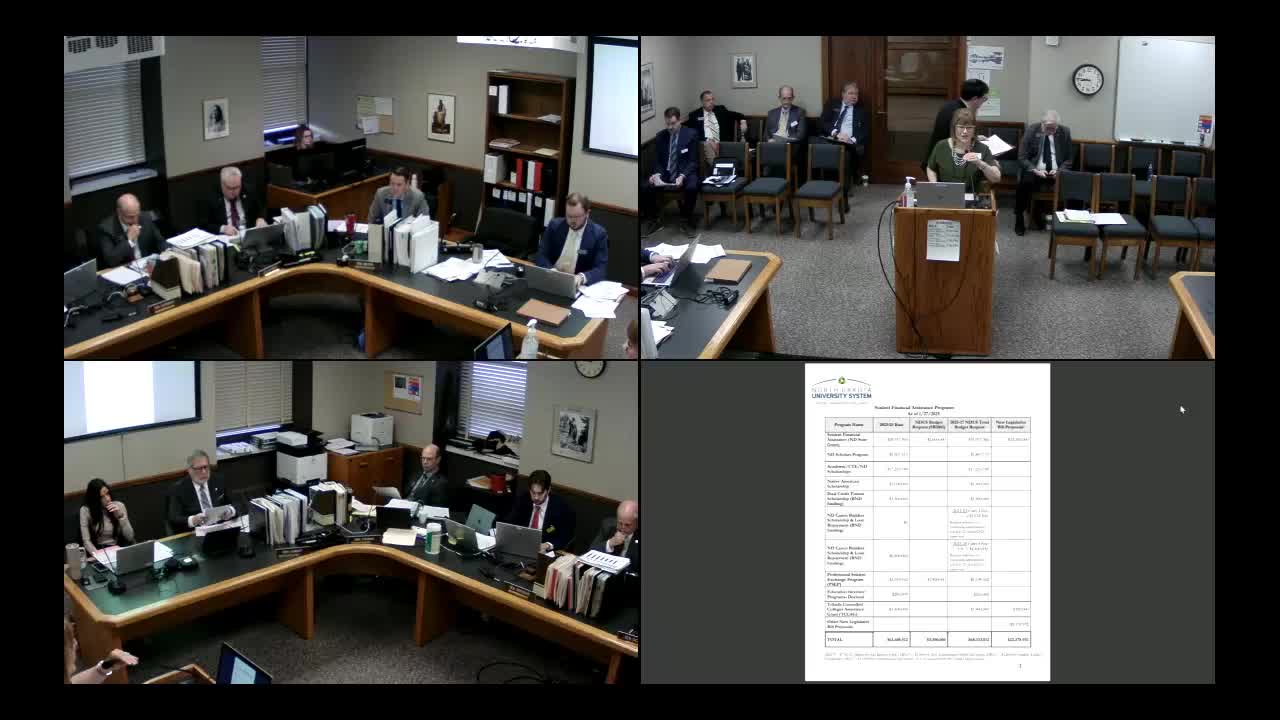
Summary
NDUS staff described need‑based grants, merit scholarships, dual‑credit tuition awards, the Native American scholarship, the Career Builders workforce scholarship/loan‑repayment program and the Professional Student Exchange Program, including eligibility, recent expenditures and requested increases.
Brenda Zastepo, director of financial aid at the North Dakota University System, told the appropriations committee the system’s financial‑aid portfolio includes need‑based grants, merit scholarships, targeted workforce awards and programs that pay resident rates for North Dakota students in out‑of‑state professional programs.
Nut graf: Committee members received program rules, recipient counts and expenditure projections for 2023–25, and staff described several requests in the NDUS base and add‑on budget: a $1 million ongoing increase to the need‑based student financial assistance program, continuation of the dual‑credit tuition scholarship (previously funded by Bank of North Dakota profits) and funding for workforce development scholarships and loan‑repayment matches.
Zastepo summarized the largest programs: - Student Financial Assistance (state need‑based grant): Requires North Dakota residency and qualifying high‑school credential; awards are determined from FAFSA data; the program funds up to the equivalent of eight full‑time undergraduate semesters. NDUS staff reported roughly 6,300 students could be served and requested a $1 million increase to maintain current service levels and to allow residents without high‑school credentials to qualify. - North Dakota Scholars (merit): Limited (about 30 awards per year); awards require ACT/SAT thresholds and a 3.5 GPA to maintain funding; current appropriation supports approximately 30 awards and the 2025–27 request is unchanged. - North Dakota Scholarship (broad merit program administered by Department of Public Instruction for eligibility and NDUS for payments): Covers semester, quarter, clock‑hour and apprenticeship terms with a $6,000 lifetime cap and a 2.75 GPA requirement; projected expenditures and level funding were reported. - Native American Scholarship: Requires enrollment in a federally recognized tribe; statute sets a $2,000 maximum; staff reported average awardee counts and that demand is increasing (approx. 289 awardees annually; recent figures show about 340 qualifying last year). - Dual‑Credit Tuition Scholarship: Established in 2021 and historically funded from Bank of North Dakota profits (about $1.5 million). Awards are tiered by number of dual credits completed (e.g., $250 for one course, $500 for two, $750 for three or more). NDUS reported cumulative awards of 3,669 students totaling about $2.1 million since inception; the Armstrong budget removes ongoing general‑fund support for the program. - Career Builders (skilled workforce scholarships and loan repayments): The program pairs state funds with private/public matches to provide up to $17,000 per recipient (half from employers or qualifying match, half from state funds). Loan repayment awards are paid over three years and require residency and state employment in an in‑demand occupation; NDUS supplied participation numbers and donor counts and noted the program now includes bachelor’s degrees for late‑stage students as of the last session. - Professional Student Exchange Program (PSEP): NDUS contracts for out‑of‑state slots in veterinary medicine, optometry and dentistry and seeks to buy down out‑of‑state tuition for North Dakota residents. Staff reported per‑student cost ranges (e.g., WICHE vet med ~ $35,400; Minnesota vet med through MOU ~ $12,100–$13,200; dentistry and optometry rates vary) and said return‑to‑state rates for graduates in these programs are monitored (e.g., reported 54% veterinary med return rate).
Committee members asked how outside scholarships affect state awards; Zastepo said institutions and NDUS consider a student’s total cost of attendance and avoid awarding state funds beyond cost of attendance, and payments can be prorated or shifted to other semesters to avoid duplication. Members also asked for the in‑demand occupations list used by Career Builders; Zastepo said the workforce council and Job Service produce that list annually and it is posted online.
Ending: Committee members requested further data on utilization rates, marketing of the Career Builders program, and projections for the scholars and dual‑credit programs. No formal vote was recorded during the briefing.