Get Full Government Meeting Transcripts, Videos, & Alerts Forever!
Get email alerts on the Sb2143 State Energy Research Center topic
No spam. Unsubscribe anytime.
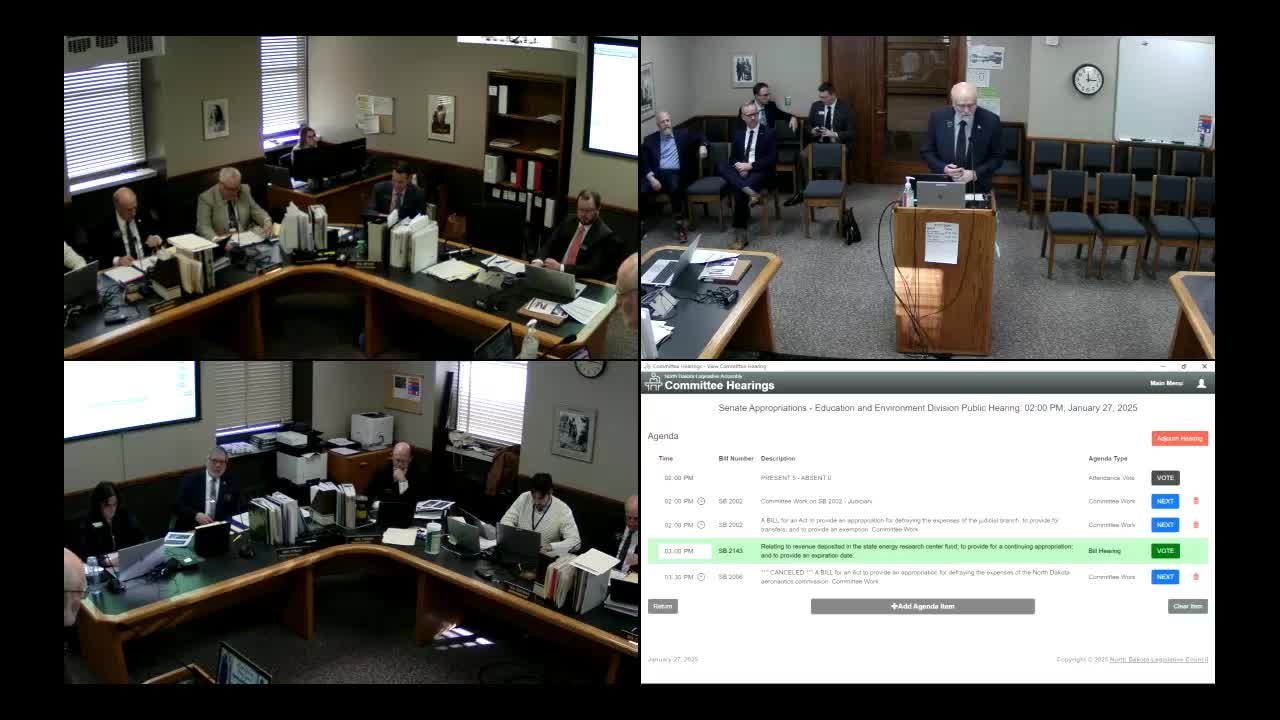
Senate hearing: bill would boost State Energy Research Center funding, extend sunset
Summary
Senate Bill 2143 would increase biennial funding for the State Energy Research Center from $7.5 million to $10 million and extend the center’s continuing appropriation to June 30, 2033.
Senate Bill 2143, introduced Jan. 21 by Sen. Dale Patton, seeks to raise biennial funding for the State Energy Research Center to $10 million and to extend the center’s continuing appropriation from June 30, 2029, to June 30, 2033.
Patton, R‑District 26, told the Appropriations - Education and Environment Division the bill is “very simple” and does two things: extend the continuing appropriation and increase biennial funding from $7,500,000 to $10,000,000. “We also have a couple of members from the EERC here that are available to answer questions related to their programming and so forth,” he said.
Tom Erickson, director of the State Energy Research Center at the Energy & Environmental Research Center (EERC) in Grand Forks, described how the center uses state funding to support early‑stage innovation. Erickson said the program emphasizes exploratory research and allows the EERC to accept and test many early ideas that would not otherwise move forward. “Fail early,” he said, summarizing the center’s approach to quickly assessing ideas and discontinuing those that don’t show promise.
Erickson told senators the center has funded roughly 60 projects to date and leveraged the state appropriation to pursue additional external funding: the center sought about $71 million in follow‑on funding, won roughly $33 million and has about $24 million pending. He cited 11 U.S. patents and multiple other patents as outcomes of the center’s work and noted at least one commercial license, with Carbon Blue, and another near completion with a Dickinson firm, Stephis, focused on reducing flaring in the Bakken.
Erickson described one project, “Polar Bear,” that began with a roughly $90,000 state investment to adapt small‑scale compression technology for economically capturing gas that would otherwise be flared. He said a compressor manufacturer has invested $1 million and a commercial deployment is underway with Stephis. “We have a second one who’s trying to compete with them to do the same thing,” he said, and said the project is moving toward broader demonstration and commercialization.
Committee members asked how federal grants and other funding sources interact with the state fund. Erickson said roughly one‑third of EERC funding still comes from federal sources but that federal programs are more oriented to applied research and demonstration than to the early innovation the state fund is designed to support. Charles Garecki, the EERC chief executive, confirmed the state fund creates discretionary capacity the Industrial Commission can direct to priorities such as grid resiliency, and that project‑specific appropriations remain an available vehicle (for example, past funding for salt caverns).
On the sunset extension, supporters said longer authorization helps the center enter multi‑year, cost‑shared projects with the U.S. Department of Energy. Erickson said DOE‑linked projects can span several years and require state funding availability for the duration of the federal engagement.
No opposition testimony was offered before the committee closed the hearing. Senators asked for additional detail about fund carryover and prior allocations; Erickson said the prior $7.5 million appropriation was fully allocated within months and that remaining balances are tied to ongoing project expenditures and returned funds from early terminations. Supporters asked the committee to consider $10 million as a cap on the center’s biennial appropriation to preserve flexibility for demonstration and commercialization funding.
Ending: The committee received the testimony, asked clarifying questions about project selection and fund interaction with federal programs, and closed the hearing on SB2143 with no recorded opposition.