
Committee hears bill to pilot K–3 foreign-language stipends; tables measure for further drafting
Get AI-powered insights, summaries, and transcripts
Subscribe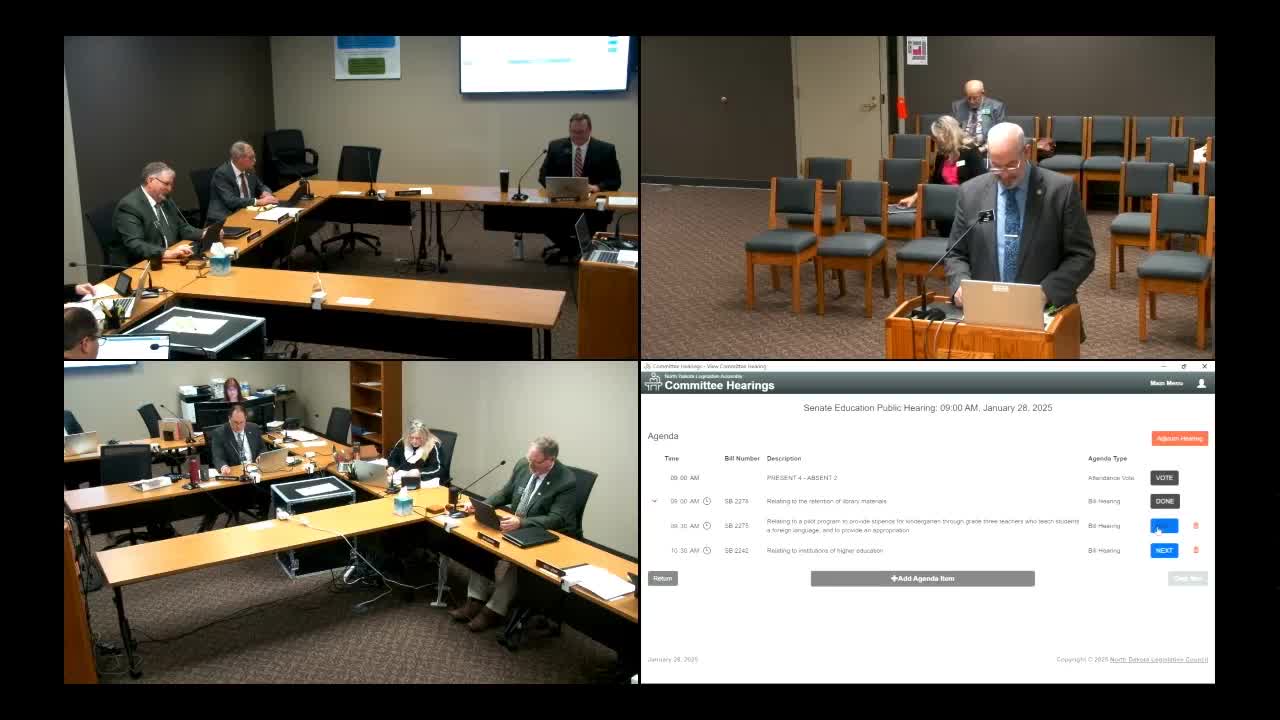
Summary
Senate Bill 2275 would create a pilot stipend program—up to $2,500 per teacher—for kindergarten through grade 3 teachers who teach students a foreign language. DPI data show 10 schools offered K–6 language instruction in 2023–24. The committee did not vote and agreed to revisit the bill with drafted amendments.
Senate Bill 2275, proposing a pilot stipend program for kindergarten through grade 3 teachers who provide foreign-language instruction, received testimony and detailed discussion at the Senate Education Committee but was not voted out; the committee agreed to work on amendments and revisit the bill at a later committee work session.
Sponsor Senator Larry Lueg told the committee the bill would replicate a measure he filed in the prior session that passed the Senate but failed in the House; the bill is voluntary for districts and is intended to encourage earlier foreign-language exposure. Lueg said the $2,500 figure is intended as a teacher stipend to encourage districts to try programs where local teachers or outside instructors would provide language lessons for young students.
Anne Ellefsen, director of academic support at the Department of Public Instruction, testified that DPI pulled data for the 2023–24 school year showing 6 schools offering indigenous language courses at the elementary (K–6) level and 4 schools offering Spanish in some form at the K–6 level, for a total of 10 schools offering elementary world-language instruction. Ellefsen said standing up a pilot program and grant structure is feasible for DPI and that existing world-language content standards (updated in 2022) supply guidance for elementary instruction.
Committee members and witnesses discussed whether stipends should be paid directly to individual teachers or to districts, whether the funds should be labeled a "stipend" or a flexible "grant" that could cover supplies or outside instructors, and how to handle eligibility (public, nonpublic, BIE schools) and distribution if demand exceeds available funds. DPI staff explained the bill language "not to exceed" provides flexibility to reduce individual awards if many applicants apply and that program design would determine eligibility and distribution rules.
Senators raised policy questions including whether already-established programs should be eligible, whether the program should prioritize new pilots, the adequacy of $2,500 per teacher, and whether limits or minimum awards should be specified if many schools apply. Committee members discussed the potential value of supporting communities with a mix of needs (districts that want to expand instruction versus those that already operate programs).
After extended discussion about eligibility, administration, and possible amendment language (including clarifying public vs. nonpublic eligibility, converting or permitting the stipend as a grant for materials, and potentially adjusting the dollar amount), the committee did not hold a final vote. Chair Beard suggested committee members work with Senator Gearhart to draft one amendment package. The committee agreed to reconvene in committee work to consider the proposed amendments.
DPI and witnesses emphasized program design choices that the bill does not currently specify: whether awards would be first-come, discretionary grants, or subject to competitive review; whether awards would go to districts or individuals; and whether existing programs would be eligible. DPI noted logistics such as whether payments should be routed through districts to avoid handling individual Social Security numbers.
Committee members suggested options including allowing awards to go either to districts or teachers, clarifying eligibility for public/nonpublic/BIE schools, and retaining the pilot’s modest appropriation level so DPI can evaluate outcomes. The committee concluded to develop and present consolidated amendment language at the next committee work session rather than make multiple separate motions during today’s hearing.