Get Full Government Meeting Transcripts, Videos, & Alerts Forever!
Get email alerts on the State Energy Research Center topic
No spam. Unsubscribe anytime.
Senate hears bill to extend, raise funding for State Energy Research Center; EERC testifies on commercialization progress
Summary
Senate Bill 2143, introduced by Senator Dale Patton, would extend the State Energy Research Center’s continuing appropriation to June 30, 2033 and increase its biennial funding from $7.5 million to $10 million; the Energy & Environmental Research Center told the Appropriations - Education and Environment Division it has funded dozens of exploratory projects and attracted additional awards and patents.
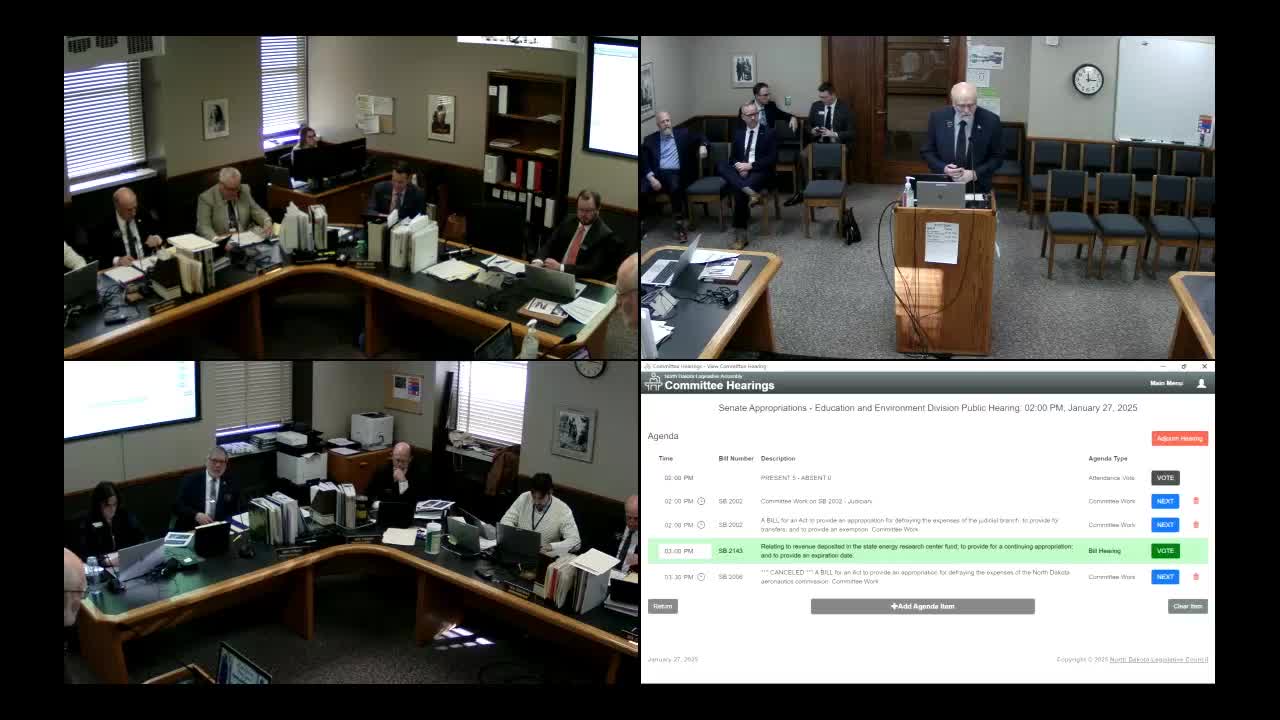
Senate Bill 2143, introduced in the Appropriations - Education and Environment Division by Senator Dale Patton, would extend the State Energy Research Center’s continuing appropriation and increase its biennial funding from $7.5 million to $10 million. The committee held a bill hearing and received supporting testimony from the Energy & Environmental Research Center (EERC).
The bill and scope Senator Dale Patton (District 26) opened the hearing, describing SB 2143 as “very simple” and saying the bill would do two things: extend the center’s continuing appropriation from June 30, 2029, to June 30, 2033, and raise biennial funding from $7,500,000 to $10,000,000. He said members of the EERC were present to answer questions on programming.
EERC testimony and accomplishments Tom Erickson, director of the State Energy Research Center, and Charles Garecki, CEO of the EERC, testified in support. Erickson summarized the center’s mission as funding early-stage “invention and innovation” research that federal programs typically will not support, explaining the State Energy Research Center’s role is to take many exploratory ideas and “fail early” on those that do not advance.
Key program details offered to the committee included: - Projects and funding leverage: The center has funded about 60–63 exploratory projects since it was established and has attracted approximately $33 million in outside awards to advance ideas beyond the exploratory stage; $24 million in additional awards were listed as pending. - Patents and commercialization: The EERC reported 11 U.S. patents and 21 other patents associated with projects begun under the program, one completed commercial license to a company named Carbon Blue and another near-complete license with a Dickinson-based company described in testimony as Stephis. - Examples: The committee heard two project examples. “Polar Bear,” a small-scale compressor technology to capture and reuse gas and reduce flaring, was described as moving toward commercial deployment with private-sector compressor manufacturers investing and at least one company preparing a larger pilot deployment. Another project converts North Dakota lignite into a graphene-like carbon material used in lithium-battery anodes; that work is in development with potential future commercialization. - Program structure and use of funds: Approximately 80% of the State Energy Research Center funding has been used for exploratory research, 10% is directed at the Industrial Commission’s request for projects that serve state needs, and 10% funds education and outreach activities (including the EnergyHawks student program). Erickson said the center uses a “Tiger Team” internal review to vet and rank proposals.
Questions from committee members Committee senators asked about federal funding interactions, ownership of intellectual property, regional impacts and program oversight: - Federal funding: Committee members were told the EERC continues to receive federal funds (about one-third of current funding) concentrated on applied research, but that federal agencies rarely fund the exploratory innovation work the State Energy Research Center supports. - Intellectual-property ownership: Erickson explained the EERC Foundation holds intellectual property; its single member is the University of North Dakota president, and revenue to date has been re-invested in EERC work rather than returned to the state general fund. - Fund use and carryover: The EERC said the prior $7.5 million allocation was obligated quickly and that discretionary funds are largely committed; the center argued an increase to $10 million would allow it to fund a larger share of promising exploratory ideas without shifting more to applied R&D or commercialization funding.
Program outreach and workforce Erickson described EnergyHawks, a student outreach program that brings up to 14 university students each year from multiple institutions to learn about North Dakota energy operations and explore technical and nontechnical solutions. He said the program helps create a pool of energy-literate future employees and advocates for the state.
Committee action No committee vote was taken on SB 2143 at the conclusion of the hearing. Supporters signed in; no opposition testimony was offered during the session. Committee members asked for material and stated they would discuss the bill and any related budget allocations during later deliberations.
Ending The committee closed the hearing on SB 2143 without action and moved on to other scheduled committee items. Supporters asked that the center’s progress and demonstrated leverage of state funds be considered in budget deliberations that may run parallel to or replace the bill’s provisions.