Get Full Government Meeting Transcripts, Videos, & Alerts Forever!
Get email alerts on the Health Insurance Reinsurance topic
No spam. Unsubscribe anytime.
Senate OKs changes to state reinsurance pool that backstops large health claims
Summary
The North Dakota Senate passed Senate Bill 2091, giving the Reinsurance Association of North Dakota (RAND) limited flexibility to change coinsurance percentages for very large individual health-insurance claims while keeping statutory attachment points in place; final vote was 46-1 and the bill carries an emergency clause.
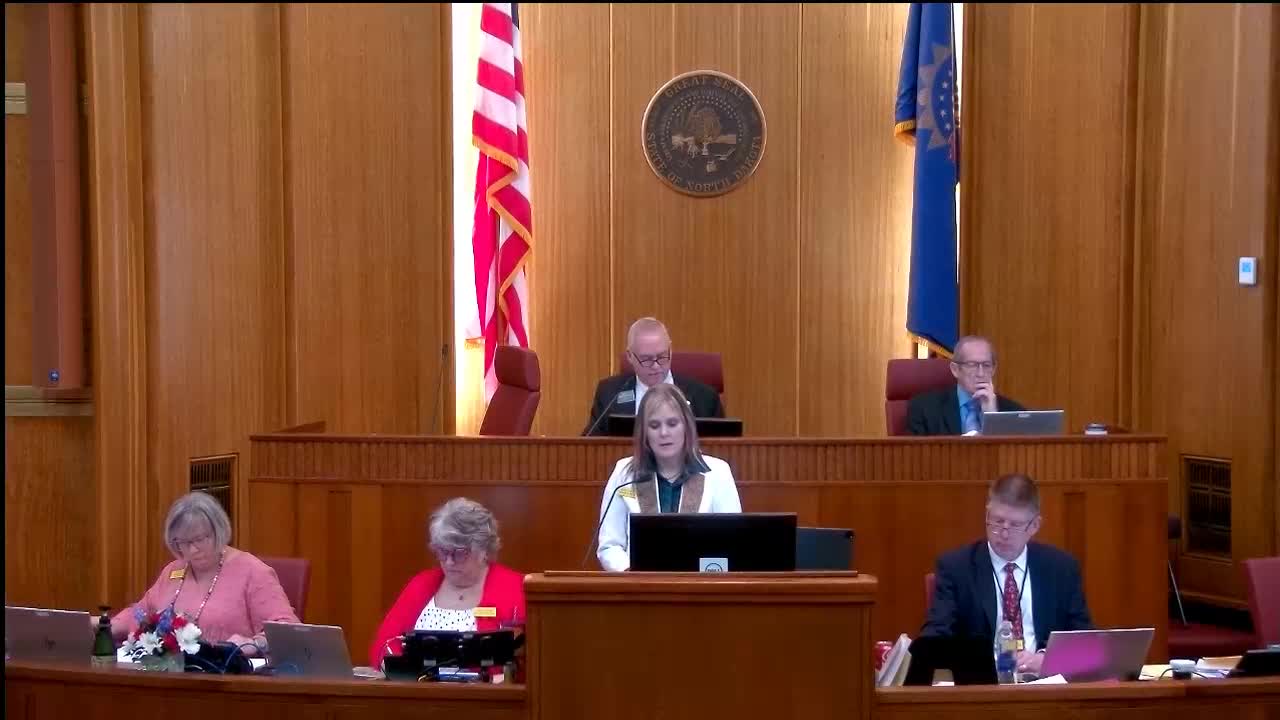
The North Dakota Senate passed Senate Bill 2091 on final passage after debate and questions about how federal coverage interacts with the state reinsurance pool. Final tally on Senate Bill 2091 was 46 ayes and 1 nay; the bill passed and the emergency clause carries.
Senator Brad Barta, sponsor and member of the Senate Business and Industry Committee, told the Senate the Reinsurance Association of North Dakota, known as RAND, was created by the 66th Legislature and is an insurance pool that helps carriers share the risk of very large health claims. "When a claim on an individual health insurance policy is over $100,000 an insurance company is allowed to submit the claim to the insurance department and RAND will cover 75% of the coinsurance of the claim over this $100,000 attachment point," Barta said.
The bill preserves the statutory $100,000 attachment point and the $1,000,000 ceiling at which federal programs may become involved, but gives RAND or the RAND board discretion to change the coinsurance percentage provided it does not exceed 75 percent. Barta said the insurance department estimated the change could produce as much as a 20 percent premium reduction for some individuals.
Senator Davison questioned how a RAND decision to lower the maximum that triggers federal involvement would affect federal payments. "If the RAND board approves a maximum of less than $1,000,000, let's just say $800,000, and leaves the attachment point at $100,000, does the federal government still pick up anything of any claims above the $800,000 or is that just for the $1,000,000?" Davison asked.
Barta replied, "As I understood it, it is just reducing that, it doesn't change the, lowers that obligation. So, I don't know if any of my other committee members recall a conversation regarding that. But I think, it was just giving us that ability to reduce the amount should they feel that it wasn't but the federal obligation remains the same."
The bill was reported out of the Business and Industry Committee on a 6-5 due-pass vote and was presented for final passage on the Senate floor. The secretary opened the voting key for a roll call; after the tally the clerk announced the final result as recorded above.
The bill as introduced would amend and reenact North Dakota Century Code section 26.1-36.7-08 to adjust RAND's claims requirements and declare an emergency.
Votes and formal actions recorded in the transcript: final passage recorded with 46 ayes, 1 nay; emergency clause carries.
Background: RAND operates as a reinsurance mechanism to limit carrier exposure on very large individual claims by covering a percentage of costs above a statutory attachment point. The bill keeps the attachment point at $100,000 and the $1,000,000 threshold at which federal programs intervene, while allowing the board to vary the coinsurance percentage up to the 75 percent statutory cap.
Looking ahead: The bill will proceed to any remaining steps required by law to take effect, consistent with the emergency clause declared on the floor.