Get Full Government Meeting Transcripts, Videos, & Alerts Forever!
Get email alerts on the Motor Carrier Liability Amendments topic
No spam. Unsubscribe anytime.
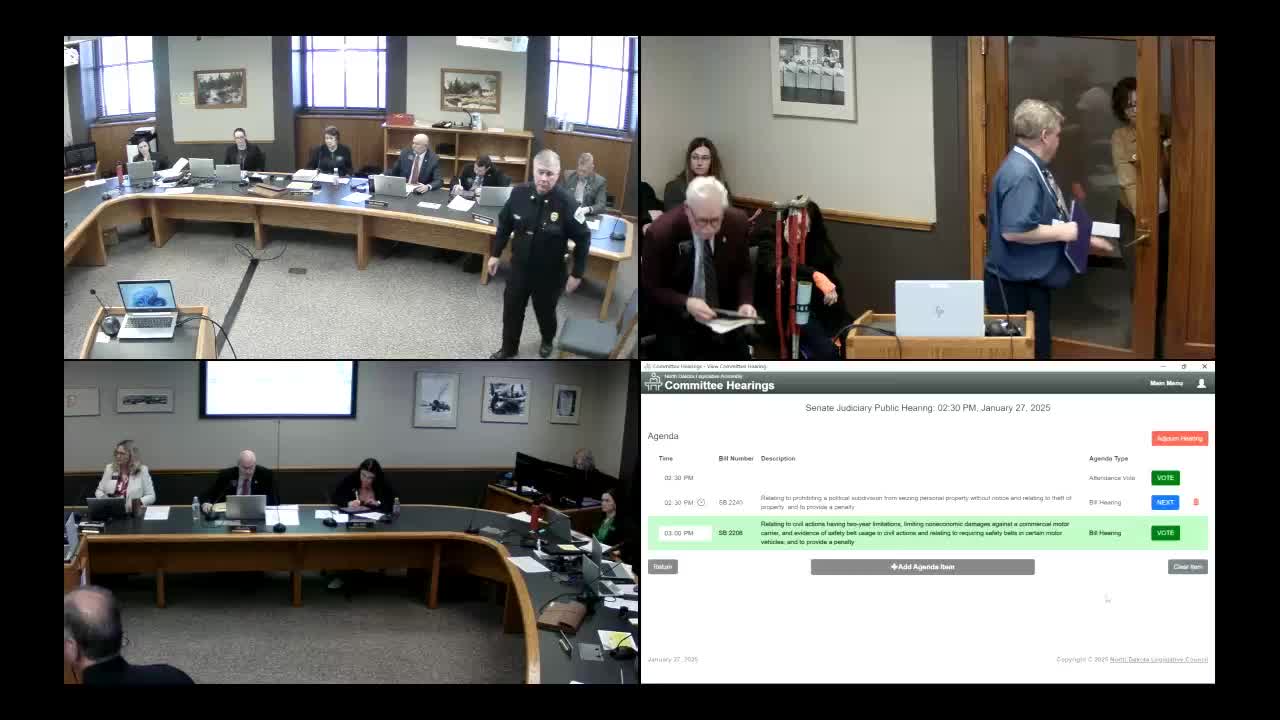
Committee considers amendments to motor‑carrier liability bill; no vote taken
Summary
The Senate Judiciary Committee heard proposed amendments to Senate Bill 2206 from the North Dakota Motor Carriers Association and testimony from the North Dakota Association for Justice. Proposed changes include replacing the word “carrier” with “vehicle,” extending a statute‑of‑limitations proposal to three years, removing seat‑belt evidence
The Senate Judiciary Committee reviewed proposed amendments to Senate Bill 2206, a bill addressing motor‑carrier liability and related civil damages. Scott Meske, representing the North Dakota Motor Carriers Association, presented several amendment requests aimed at narrowing language and aligning statutory definitions.
Meske proposed replacing the word “carrier” with “vehicle” in one section to mirror the statutory definition in chapter 39; increasing a proposed statute‑of‑limitations period from two years to three years; deleting seat‑belt evidentiary provisions; and raising a proposed non‑economic damages cap from $500,000 to $1,000,000. Meske said the three‑year limit would align North Dakota with most other states that have similar statutes of limitation and argued a $1,000,000 cap would be a reasonable compromise if a cap is adopted.
Jackie Hall, executive director of the North Dakota Association for Justice, opposed lowering the current six‑year civil statute of limitations and opposed damage caps. Hall argued that many civil statutes provide six‑year periods to allow time to determine fault and damages, particularly in complex trucking cases where causation and liability can take time to develop. She also said non‑economic damages often reflect life‑long impacts — such as a child with permanent injuries — that juries should assess without an arbitrary cap.
Committee members asked clarifying questions about whether caps would apply per injured individual or per incident and about how economic and non‑economic damages are distinguished. Witnesses explained that economic damages generally cover quantifiable losses such as medical and rehabilitation costs or lost earnings, while non‑economic damages include pain and suffering, loss of consortium, and impairment. Meske and Hall disagreed on whether a three‑year limit would fairly balance plaintiffs’ and defendants’ interests.
The committee did not act on the amendments during the hearing. Members said they would take time to consider the proposed changes; the hearing on the amendment portion was closed with no final motion recorded.