Get Full Government Meeting Transcripts, Videos, & Alerts Forever!
Get email alerts on the Human Trafficking Training topic
No spam. Unsubscribe anytime.
Committee hears bill to require trafficking training for law enforcement; police association raises curriculum and language concerns
Summary
Senate Bill 2220, a proposal to require guidelines and training for law enforcement and state attorneys on human trafficking and exploitation of children, drew support from anti‑trafficking organizations and concerns from the North Dakota Peace Officers Association about mandatory curriculum language.
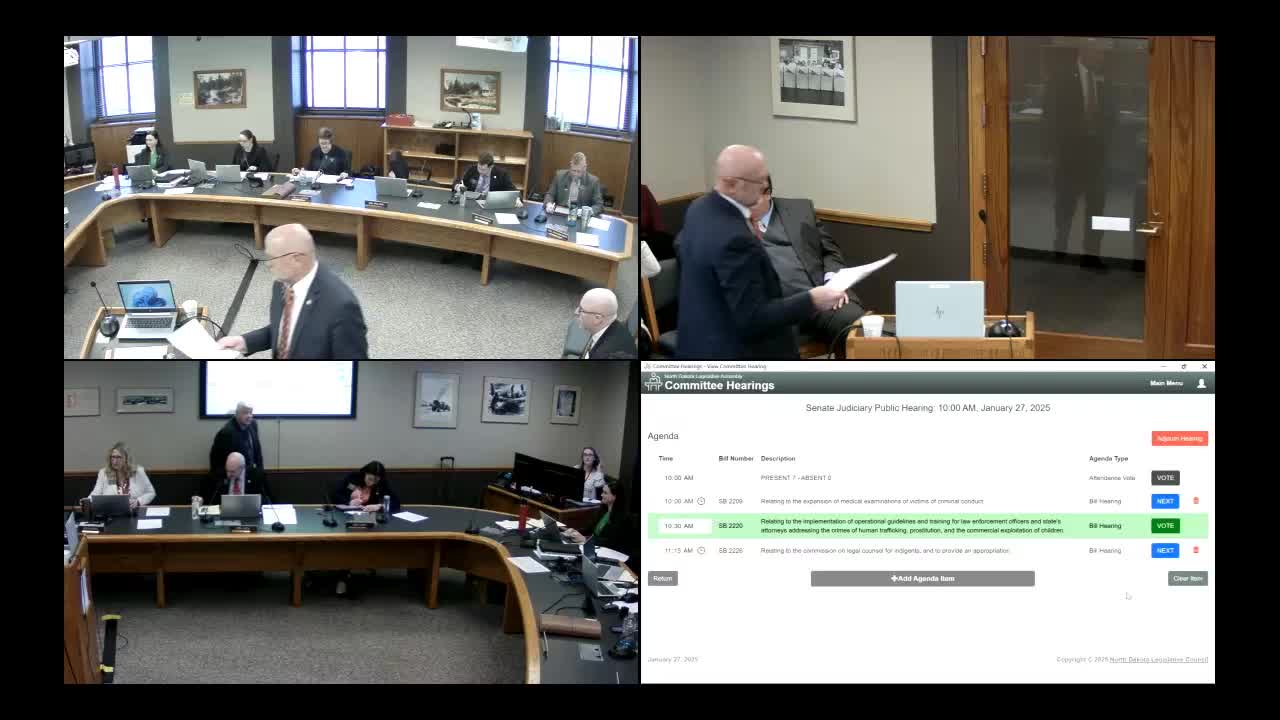
Senate Bill 2220, a proposal to require guidelines and training for law enforcement and state attorneys on human trafficking, prostitution and commercial sexual exploitation of children, was presented to the Senate Judiciary Committee but received no final vote after testimony and questions.
Senator Bob Paulson introduced the bill, saying law enforcement is often a victim's first contact and that training would improve identification and response. “Since law enforcement officers are often the first point of contact for victims, that is the purpose of this bill,” Paulson said when introducing the measure.
Supporters included Mark Jorotsma of the North Dakota Family Alliance Legislative Action, who urged a due‑pass recommendation and said training would help victims obtain appropriate help and strengthen investigations. “The ability of law enforcement to appropriately address these situations is important to ensure that the victims obtain adequate and appropriate help,” Jorotsma said.
Stacy Schafer, founder and executive director of 31‑A Project, described her organization's statewide education and survivor‑service work and said about 85% of her group's 2024 cases involved trafficking within North Dakota. Schafer told the committee that both law enforcement and medical professionals are key contact points for victims and argued additional training is necessary to identify cases that can go unnoticed, including labor trafficking tied to visa programs.
Christopher Dodson of the North Dakota Catholic Conference indicated support but did not submit online testimony during the hearing.
Calvin Benson, representing the North Dakota Peace Officers Association, testified in opposition to the bill in its current form. Benson said the association supports the bill’s purpose but is concerned about specific language in the draft: mandatory requirements for agencies to “develop and implement specific operational guidelines,” detailed curriculum requirements and a stated number of training hours. Benson told the committee those details could impose unfunded mandates and urged committee members to work with the association on amendments.
Committee members asked whether a fiscal note was needed. Senator Paulson and proponents said some relevant training materials already exist at the law enforcement academy and post‑training programs and that a new fiscal appropriation might not be required, but committee members requested input from the Attorney General's Office and other stakeholders before moving forward. Senator Meerdahl said he was not ready to vote and offered to work on language changes.
The committee closed the hearing without taking a vote and asked staff to seek additional information from the Attorney General’s Office about implementation and the bill's operational responsibilities.
No formal action was recorded in committee at the hearing; the bill remains under committee consideration pending follow‑up with stakeholders and potential language amendments.