Get Full Government Meeting Transcripts, Videos, & Alerts Forever!
Get email alerts on the Finance topic
No spam. Unsubscribe anytime.
Alaska revenue forecast: permanent fund remains core source as oil revenues fall short of spring outlook
Summary
Department of Revenue told the Senate Finance Committee the fall 2024 forecast projects slightly lower oil revenue and modest growth in permanent-fund transfers; lawmakers pressed for short-term (3–5 year) sensitivity analysis and clarity on liquidity and constitutional budget reserve targets.
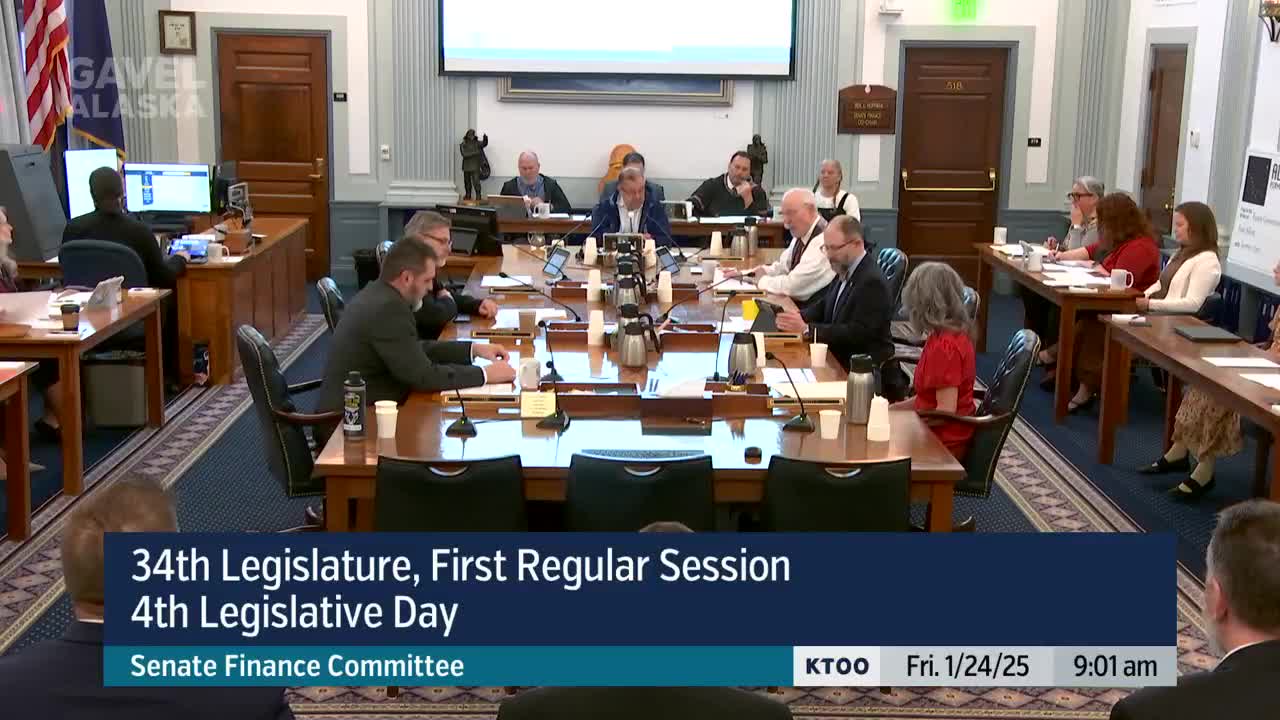
Juneau — On Jan. 24 the Senate Finance Committee heard the Department of Revenuepresent its fall 2024 revenue forecast, which lowers near-term oil revenue projections and shows the Permanent Fund transfer continuing to supply the largest share of unrestricted general fund revenue.
Dan Stickel, chief economist for the Department of Revenue, told the committee the fall forecast projects $16.8 billion in total state revenue for fiscal 2025 and $15.7 billion for fiscal 2026, with federal receipts, investment earnings and petroleum revenue accounting for the bulk of receipts. "Each dollar change of oil price equates to about $35,000,000 of unrestricted general fund revenue," Stickel said when summarizing sensitivity to price movements.
The nut graf: the forecast reduces the oil-price assumption and production outlook from the spring forecast, shifting several hundred million dollars from the unrestricted general fund in the near term and increasing attention among committee members on liquidity of the Permanent Fund and the Constitutional Budget Reserve (CBR). That matters because state spending decisions this year will rely heavily on these estimates.
Most important details
- Oil and production assumptions: The Department used an Alaska North Slope oil price of $73.86 per barrel for fiscal 2025 and $70 per barrel for fiscal 2026, down roughly $4 per barrel from the spring forecast. The department reported a near-term production reduction to about 467,000 barrels per day in fiscal 2025 and roughly 469,500 barrels per day in fiscal 2026.
- Revenue totals and changes: Total state revenue was $16.3 billion in fiscal 2024; the forecast is $16.8 billion in fiscal 2025 and $15.7 billion in fiscal 2026. Stickel told the committee the change to the unrestricted general fund forecast was a reduction of roughly $220 million for fiscal 2025 and about $232 million for fiscal 2026, with the oil-price outlook the primary driver.
- Permanent Fund and investment assumptions: The forecast includes actual investment returns through Oct. 2024, a 7.9% assumed remainder-of-year return for fiscal 2025 and a 7.65% long-term annual return thereafter. The department said the percent-of-market-value (POMV) transfer (the 5% mechanism used to move Permanent Fund earnings to the general fund) will remain the largest contributor to unrestricted revenue over the next decade.
Lawmakersraise budget and liquidity concerns
Committee members, led by Co-chair Senator Stedman, pressed the department on short-term risks and liquidity: Sen. Stedman asked whether a 3- to 5-year projection could be provided so legislators can evaluate whether current spending proposals are sustainable if oil prices decline. "We gotta have a balanced budget," Sen. Stedman said, urging analysis focused on the 3- to 5-year horizon rather than only a 10-year outlook.
Commissioner Adam Crum, who also serves as a trustee on the Permanent Fund Corporation, acknowledged the liquidity concern and said trustees and staff discuss the tradeoffs between long-term return and short-term liquidity. "...the liquidity risk of the 5% draw is a constant point of discussion amongst the trustees and amongst the staff," Crum said.
Sen. Kiel (who asked several technical questions about corporate income tax) and others pressed for clarity about how federal tax changes might influence Alaska collections; department staff and Director Dale Yancey replied that Alaskaconforms to many federal definitions and that changes to the federal tax base can affect state corporate-income tax collections, but that the department still has "a decent amount of confidence" in the near-term corporate tax forecast.
Key technical points described by the department
- Sensitivity and heuristics: Stickel said the revenue model uses futures-market prices (sampled through late November 2024) and a heuristic tying oil price changes to revenue: roughly $35 million of unrestricted general fund revenue per $1 change in price around current levels, with larger dollar impacts at higher prices.
- Production tax complexity: The North Slope production tax is a net-profits tax with a gross minimum tax floor and multiple per-barrel credits (including an $8-per-taxable-barrel sliding-scale credit and a separate $5-per-barrel credit for certain new production). Stickel warned that aggregate per-barrel calculations can differ substantially from company-level tax outcomes because some producers will pay down to the minimum floor while others will pay above it.
- Project timing and cash flows: The department reiterated that major new projects (examples: Willow, Pikka) create large near-term capital expenditures and that state cash receipts from those projects can lag, producing a long tail of revenues even after production begins. Commissioner Crum pointed to a Willow analysis posted on the Departmentof Revenue website as an example of project-specific cash-flow timing.
Committee directions and follow-ups
- Commissioner Crum and staff offered to provide the committee with current daily production values and to work with the Office of Management and Budget (OMB) on an aggregated 3- to 5-year sensitivity analysis that would combine the departmentforecasts with spending assumptions.
- The committee scheduled the next meeting for Monday, Jan. 27, when the OMB will present the governor's proposed FY2026 budget.
What the department did not do
No formal votes or policy decisions were taken at the Jan. 24 meeting. The presentation was informational and focused on forecast assumptions and sensitivities.
Ending
The department framed the fall forecast as one plausible central path within a range of outcomes and emphasized that several near-term variables—notably oil prices, production volumes and Permanent Fund liquidity assumptionsremain the largest sources of uncertainty for the state's fiscal outlook. The committee requested follow-up materials to help assess the state's finances over a 3- to 5-year horizon prior to major budget decisions.