Get Full Government Meeting Transcripts, Videos, & Alerts Forever!
Get email alerts on the Legislation Introductions topic
No spam. Unsubscribe anytime.
Alaska Senate convenes with 18 members, introduces 23 bills and refers gubernatorial appointments and executive order
Summary
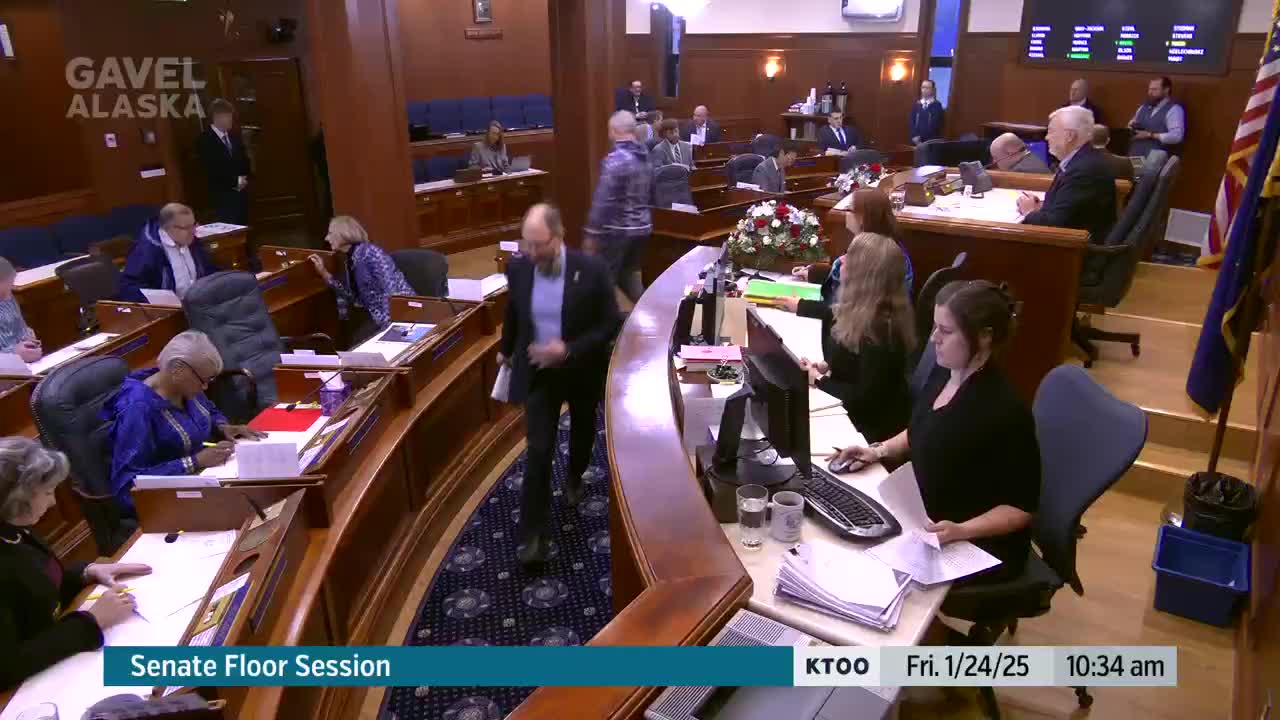
The Alaska Senate convened Jan. 23 in Juneau with a quorum of 18 members present, introduced 23 bills and numerous resolutions, received gubernatorial messages including nominations to the University of Alaska Board of Regents and Executive Order No. 136 establishing a Department of Agriculture, and adopted a special citation honoring Dorothy Brownie Thompson.
JUNEAU, Alaska — The Alaska Senate convened Jan. 23 in Juneau with a quorum of 18 members present, introduced 23 bills and numerous resolutions, received gubernatorial messages including two nominations to the University of Alaska Board of Regents and Executive Order No. 136 establishing a Department of Agriculture, and adopted a special citation honoring Dorothy Brownie Thompson.
The roll was announced by the secretary, who said, “The role shows 18 members present. Senator Tobin is excused from a call of the senate today.” The session opened with an invocation from the Reverend Gordon Blue of Holy Trinity Episcopal Church and the Pledge of Allegiance recited by Senator Clayman.
Why it matters: the introductions and referrals set the Senate’s early-session work plan. Several measures introduced today were referred to committees that will schedule hearings, and messages from the governor will move through committee review; these steps determine which proposals are vetted for possible floor action later in the legislative session.
The Senate secretary read a message dated Jan. 23 from the governor nominating Karen Perdue of Fairbanks and Christine Ressler of Anchorage to the University of Alaska Board of Regents; the secretary said those nominations were referred to the Education Committee. The secretary also read Executive Order No. 136, described in the message as establishing a Department of Agriculture and transferring certain functions from the Department of Natural Resources; the order was referred to the Resources and Finance Committee.
A package of agency reports was placed on file, including an economic viability assessment and economic value analysis for the Alaska LNG project from the Alaska Gasline Development Corporation, multiple annual financial and audit reports (including reports from the Alaska Industrial Development and Export Authority and the Alaska Retirement Management Board), a carbon offset program annual report from the Department of Natural Resources, and reporting from the Department of Public Safety and the Department of Labor and Workforce Development, among others.
Senate bills introduced (numbers and primary descriptions read into the record) were Senate Bill 51 (establish the Sunrise Review Board), SB 52 (absentee and early voting rules), SB 53 (law enforcement accreditation standards), SB 54 (registered interior designers and related registration/board provisions), SB 55 (employer contributions to the teachers’ retirement system), SB 56 (appropriations for operating and loan program expenses), SB 57 (appropriations including capital appropriations), SB 58 (appropriations for the integrated comprehensive mental health program), SB 59 (supplemental appropriations), SB 60 (May 12 recognition day for ME/CFS), SB 61 (electronic product stewardship program), SB 62 (board of parole), SB 63 (local boundary commission), SB 64 (election-related measures including pre-registration for 16- and 17-year-olds and synthetic media rules), SB 65 (legal representation of public officers in ethics complaints), SB 66 (demonstration state tribal education compacts), SB 67 (procurement preferences for Alaska-harvested agricultural and fisheries products), SB 68 (employment and rules for minors), SB 69 (sexual assault examination kit tracking system), SB 70 (regional educational attendance area elections and related election administration provisions), SB 71 (pretrial services supervision agreements), SB 72 (authorize Alaska Railroad revenue bonds for Seward passenger dock replacement), and SB 73 (marijuana establishment registration and related tax provisions). Committee referrals were announced for each bill as they were read (for example, finance; state affairs; labor and commerce; education; resources; judiciary; community and regional affairs, per the reading).
During unfinished business Senator Rae Jackson moved to be shown as a cosponsor on eight bills (listed on the record as SB 15, SB 18, SB 21, SB 22, SB 23, SB 28, SB 45 and SB 34); those cosponsor requests were accepted without objection. Senator Dunbar was shown as a cosponsor on Senate Joint Resolution No. 6 (relating to Washington, D.C. statehood); that request was also approved without objection.
The Senate adopted a special order of business citation honoring Dorothy Brownie Thompson by unanimous consent. The chamber also heard introductions of the Senate Records Office staff, pages and sergeants at arms; Senator Kiel and Senator Wilkowski (who introduced multiple staff and pages) presented the group and asked the Senate to welcome them.
Several routine motions were handled by unanimous consent: the journals for the second and third legislative days were certified and approved, the prayer was ordered spread upon the journal, and a request to excuse Senator Olson from the day’s session was granted. The session concluded on unanimous consent when the majority leader moved that the Senate stand adjourned until 11 a.m. Monday, Jan. 27, 2025; the president closed the session by saying, “Hearing no objection, the senate is adjourned.”
Minutes and committee referrals announced today establish the formal starting point for public hearings and legislative vetting of introduced measures. Committees will schedule those hearings and post materials and staff reports ahead of any policy debates or floor votes.
Next steps: referred bills will be set for committee hearings; the nominations to the University of Alaska Board of Regents will be considered by the Education Committee; and the agencies’ annual reports remain on file for committee or floor review as required by statute.