Get Full Government Meeting Transcripts, Videos, & Alerts Forever!
Get email alerts on the Telecommunications Universal Service Fund topic
No spam. Unsubscribe anytime.
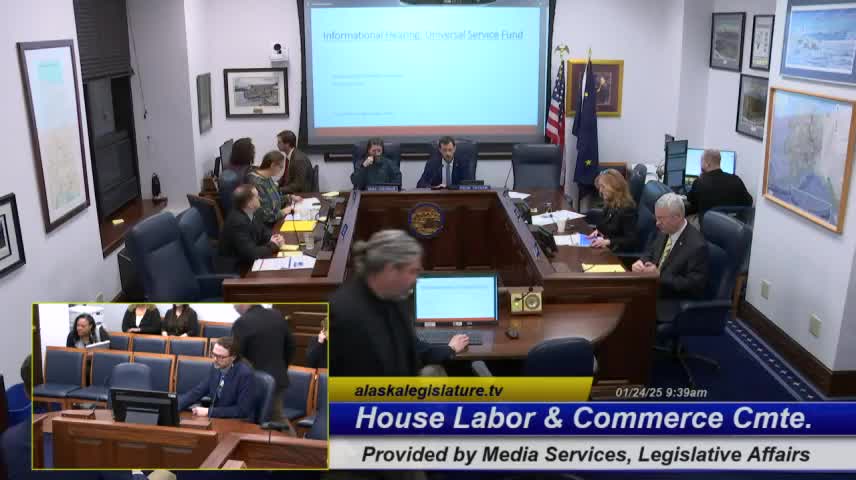
Alaska lawmakers told Supreme Court challenge to Universal Service Fund could disrupt rural broadband, schools and health care
Summary
At a House Labor and Commerce Committee hearing April 6, telecom and municipal officials warned that a pending U.S. Supreme Court review of a Fifth Circuit ruling puts Alaska’s federal Universal Service Fund-supported programs at risk, potentially threatening broadband, telemedicine and school connectivity in rural communities.
Alaska telecom leaders and municipal representatives told the House Labor and Commerce Committee on April 6 that a U.S. Supreme Court review of a lower-court ruling could imperil federal Universal Service Fund (USF) support relied on by rural communities for broadband, mobile and voice service, affecting schools, health care facilities and ongoing federal broadband projects.
Christine O’Connor, executive director of the Alaska Telecom Association, said the challenge before the Supreme Court “poses an existential threat to telecommunications services in Alaska.” She told the committee that the USF underpins multiple programs — including E‑Rate for schools, the Rural Health Care program, Lifeline and the High Cost fund (Alaska’s version of a high-cost support program) — and helps maintain affordability and network maintenance once one-time build grants are spent.
O’Connor and others described several interlocking concerns: a Fifth Circuit decision found procedural problems with how the Federal Communications Commission delegated aspects of USF implementation to the Universal Service Administrative Company (USAC), and the pending Supreme Court review could produce outcomes that interrupt funding flows. Committee members were told Alaska is unusually exposed because of its geography and rural service costs; testimony cited roughly $500 million in USF-supported spending in the state and more than $1 billion in recent or pending federal broadband grants and BEAD (Broadband Equity, Access, and Deployment) funding for Alaska.
Carol Tremont, intergovernmental affairs manager for the Alaska Municipal League, told legislators the USF-supported programs are “lifelines” in remote communities, where E‑Rate funds and other program support can equal a municipality’s local contribution for school district connectivity in some places. She urged the Legislature to consider resolutions or other measures to protect and modernize the fund.
Committee members asked technical and legal questions about the scope and mechanics of the risk. O’Connor summarized the court issue: the Fifth Circuit said the FCC’s two-step delegation — Congress to FCC and FCC to USAC — raised constitutional problems when taken together, though neither delegation alone had been held unconstitutional by the panel. O’Connor said procedural fixes by Congress or the FCC could address the delegation concerns, but the Supreme Court’s broader review creates uncertainty about timing and interim disruptions.
Panelists emphasized likely short-run consequences if funding were suspended: interruption of operations and maintenance for networks built with one-time federal grants, halted rural construction projects, and possible insolvency or severe strain on some providers. O’Connor cautioned that even if Congress or regulators eventually restructured the funding mechanism, the intervening gap could cause “catastrophic damage” to Alaska’s telecommunications systems.
The committee did not vote on legislation. Members said they would monitor the case, consider a legislative resolution supporting continued USF funding or modernization, and stay coordinated with Alaska’s congressional delegation and industry stakeholders.
Ending: The committee closed the hearing after questions and said it will track the Supreme Court case and related federal and state responses.