Get Full Government Meeting Transcripts, Videos, & Alerts Forever!
Get email alerts on the Public Assistance It topic
No spam. Unsubscribe anytime.
Public Assistance reports progress on Alaska Connect portal, ESAP and same‑day service amid IT modernization plans
Summary
The Division of Public Assistance briefed senators on operational improvements: the Alaska Connect client portal, an elderly simplified assistance project (ESAP), text reminders that boosted response rates, same‑day office service in many locations, and planned IT migrations off a mainframe through 2028.
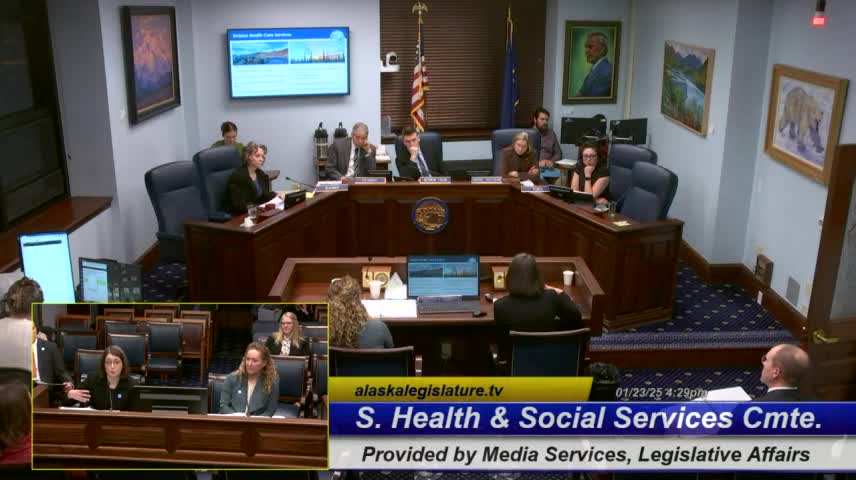
Deputy Commissioner Emily Ricci and Commissioner Heidi Hedberg reported to the Senate Health and Social Services Committee on Jan. 23 that the Division of Public Assistance has implemented several customer‑service and IT changes aimed at reducing backlogs.
The division launched the Alaska Connect Portal (accessible via myAlaska) to allow clients to apply for benefits, renew, report changes and upload documents. Ricci said text messaging reminders substantially improved interview answer rates (61% response) and the division implemented an Elderly Simplified Assistance Project (ESAP) on Dec. 1, 2024, extending certification periods for certain SNAP households from 24 to 36 months and reducing interim reporting for that group.
Nut graf: The department said its snap timeliness rate rose from around 28% in March 2023 to 71% in January 2025 (with a 95% goal), all offices are open and clients can now receive same‑day service in many locations; the department also outlined a phased IT modernization plan to migrate systems off a mainframe through 2028.
IT modernization and automation: Hedberg and Ricci described modular modernization (smart forms, provider enrollment portals, advanced capture for email documents, and integration of document management and workflow systems) to reduce manual handling. Ricci said health‑care claims and provider enrollment automation are priorities; a provider enrollment portal appears in the governor’s capital budget and a patient mobile app is planned for later in 2025.
AI and safeguards: Senator Hughes asked about automation and AI bias risks. Ricci replied that limited AI use in test environments is under strict human oversight and that automation currently checks whether data exist rather than making eligibility decisions.
Ending: The department said it expects to complete mainframe migrations for non‑MAGI categories and SNAP by 2028, continue to refine client self‑service features in 2025, and further reduce timeliness backlogs.