Get Full Government Meeting Transcripts, Videos, & Alerts Forever!
Get email alerts on the Workforce Staffing Training topic
No spam. Unsubscribe anytime.
Alaska Department of Labor reviews training programs, flags staffing and succession risks to House committee
Summary
Department officials told the House Labor and Commerce Committee on April 6 that Alaska’s Department of Labor and Workforce Development runs statewide job centers and training programs but faces rising vacancies, an aging workforce and near-term retirement of institutional knowledge.
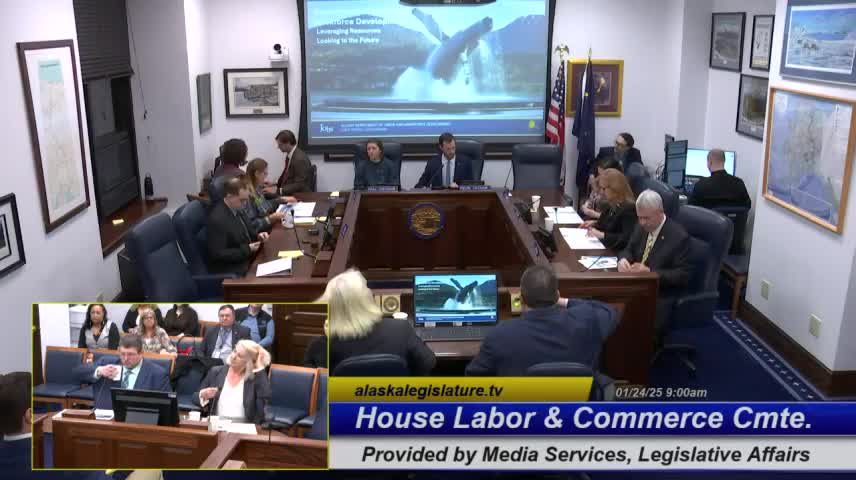
The Alaska Department of Labor and Workforce Development briefed the House Labor and Commerce Committee on April 6 in Juneau about statewide workforce programs and mounting staffing challenges, saying the department’s network of job centers and training initiatives have expanded even as long-term vacancies and retirements have reduced capacity.
Commissioner Munoz told the committee the department “oversees 14 job centers, including a recent opening of a satellite job center in Kotzebue” and manages programs ranging from the Alaska Vocational Technical Center in Seward to vocational rehabilitation and workers’ compensation. She said the department increased training support through the Alaska job center network by about 85% comparing calendar 2024 with the prior year and opened an Office of Citizenship Assistance in December to help legal immigrants with employment and credential translation.
The staffing picture drew sustained attention. Dan DeBartolo, the department’s administrative services director, told the committee he reviewed the department’s workforce over a 15-year span and found budgeted positions fell from about 939 in fiscal 2009 to 718 in the most recent budget cycle. He said filled-position counts also declined: 818 positions were filled in one recent year versus 571 in FY 2024, producing a vacancy rate near 20.6% at the end of FY 2024 and a 22.2% vacancy rate as of the December snapshot DeBartolo cited.
“The pandemic has exacerbated those issues,” DeBartolo told the committee, noting the department’s average employee age is several years older than the statewide average and that about one in five employees are eligible to retire within five years. He warned that faster promotion of less-experienced staff — a pattern he described as “rapid promotion” driven by the tight labor market — can leave the department short on journey-level experience and institutional knowledge.
Committee members asked for details about specific initiatives. Munoz said the Office of Citizenship Assistance, which the committee learned was authorized by prior legislation but reactivated recently, has one staffer on board and is recruiting two more positions; the office will track clients and provide credential-translation assistance. Munoz also described several program changes and partnerships:
- A first-in-the-country Alaska Occupational Safety and Health Diversionary Program that allows certain businesses cited for safety violations to pursue consultation and training in exchange for waived financial penalties; the department said the program has eliminated more than $600,000 in penalties in the past year.
- A SkillBridge partnership with the Department of Defense that lets the department advertise jobs to service members transitioning out of active duty and, if they accept hire, has the Department of Defense cover the first six months of wages.
- Expansion of reciprocity and provisional licensing for electrical and plumbing certificate-of-fitness (COF) holders, including work on a regulatory package to recognize qualifications from other states and military experience and to implement a provisional licensing law passed by the legislature last year allowing provisional acceptance of out-of-state licenses for up to one year.
DeBartolo also described internal steps the department is taking to address workforce risks, including succession planning and targeted class studies (he said a class study is under way in the Division of Vocational Rehabilitation). Committee members noted the department’s retention strengths — a culture employees cite as a reason they stay — but pressed for follow-up data on client counts for the new citizenship office and the status of a CDL implementation bill passed last year.
The committee did not take formal action; members asked staff for follow-up briefings and data on program uptake, vacancy trends and implementation timelines for provisional licensing and CDLs.
Ending: The department asked legislators to refer constituents with workforce or licensing issues to its legislative liaison, and committee leaders suggested scheduling future briefings — including deeper dives on apprenticeship funding and childcare-related workforce supports — as the session continues.