Get Full Government Meeting Transcripts, Videos, & Alerts Forever!
Get email alerts on the Transportation topic
No spam. Unsubscribe anytime.
Alaska DOT reports ~15% overall vacancy rate in maintenance ranks; calls for CDL and training solutions
Summary
DOT officials told the Senate Transportation Committee that workforce shortages — especially equipment operators and heavy-duty mechanics — are constraining operations and project delivery; the department outlined vacancy rates by region and federal training funds and described pilot off-road CDL and university cohort programs.
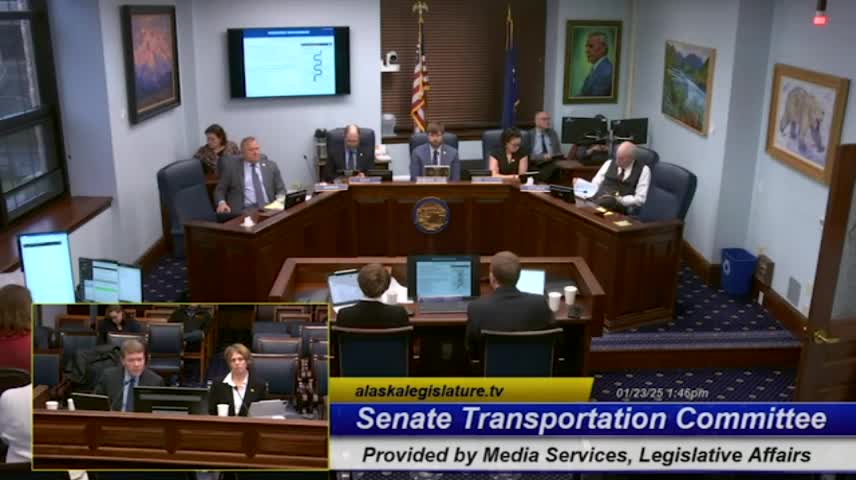
At a Jan. 23 Senate Transportation Committee hearing in Juneau, Ryan Anderson, commissioner of the Alaska Department of Transportation and Public Facilities, and Deputy Commissioner Catherine Keith described workforce vacancies across DOT&PF and the department’s efforts to recruit and train workers.
Anderson said the department employs about 3,445 positions statewide and provided regional vacancy snapshots for maintenance and operations staff: Northern Region about 15% vacancy across 215 full‑time positions (with some camps exceeding 20% and specific sites like Cordova, Thompson Pass and Valdez exceeding 40%), Central/Anchorage area about 6% across 145 positions, and South Coast about 8% across 86 positions. He also said Anchorage International Airport roles show an 11% vacancy rate and Fairbanks 13%.
The statewide equipment-fleet mechanic positions drew specific concern: DOT reported roughly a 24% vacancy rate for mechanics (heavy-duty mechanics highlighted as hard-to-fill). The Division of Facility Services reported a 19% vacancy rate.
Department responses and programs
Deputy Commissioner Keith outlined several workforce responses: DOT programmed about $19 million of 100% federal funds in the 2024–2027 STIP for employee technical training, construction industry training, mechanics training, CDL training and maritime workforce programs. Anderson said the department has run pilot programs for an off‑road CDL in rural communities and supports the off‑road CDL approach where appropriate.
DOT also said it is working with the University of Alaska Fairbanks to build student cohorts that will receive coursework and internships tied to DOT work and project delivery. The department participates in the Army PAYS program and is evaluating veteran-focused programs such as VIPER for potential partnership.
Why it matters: DOT said vacancies affect winter operations, equipment readiness and the ability to deliver capital projects. Senators asked for an overall vacancy number for the entire department; Anderson said he believed it to be roughly 15% and agreed to provide a confirmed figure to the committee.
Ending: DOT told the committee it will supply a department-wide vacancy number, a list of training-funded programs, and follow-up details on pilot CDL efforts and the UAF cohort initiative.