Get Full Government Meeting Transcripts, Videos, & Alerts Forever!
Get email alerts on the Infrastructure topic
No spam. Unsubscribe anytime.
County hearing on Rural Access Infrastructure Fund: county staff asks commissioners to press association and lawmakers for more support
Summary
A state program that helps townships pay to repair culverts and small bridges was the focus of an extended presentation. State staff asked Codington County commissioners to contact the South Dakota Association of County Commissioners and legislative sponsors to support a $25 million, three-year reauthorization and to increase township outreach.
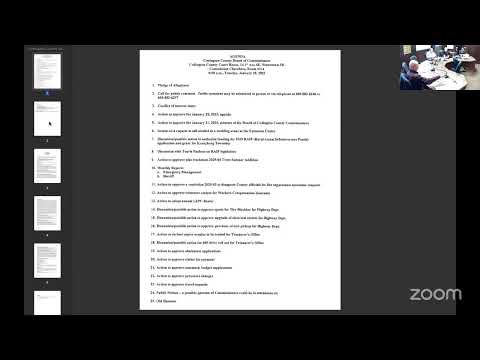
Travis Paulson, a presenter on the Rural Access Infrastructure Fund, told the Codington County Board of Commissioners on Jan. 28 that the program’s funds are winding down and that state officials plan to ask the Legislature for another $25 million over three years.
Paulson said the program’s last statutory allocations were made in 2024 and that counties and townships have until 2029 to spend existing awards. He asked commissioners to help by encouraging the South Dakota Association of County Commissioners to lend public support and by contacting legislative sponsors.
Paulson outlined the scale of need the Department of Transportation has identified: 9,185 culverts and 494 small bridges on maintained township roads and county secondary roads, of which 1,284 culverts and 163 small bridges are rated in critical-to-poor condition. He said the administration will present the 25 million-dollar ask to the Legislature and has identified sponsors—Sen. Sydney Davis (District 17) and Rep. Barney Overweg—and local allies, but needs broader county-level support.
Brian Zogg, identifying himself as a township resident, told commissioners that some culverts at his site were in such poor condition they had to be replaced immediately. He asked whether a township could reapply the following year if work had to proceed before funding was approved; Paulson and county auditors said emergency clauses exist and that reapplication or local options could be considered, but that some statutory eligibility requirements apply.
Auditor Hatton read legal guidance from the county’s State’s Attorney regarding SDCL 31-34-6, saying that the statute requires a township requesting these funds to have either a secondary road levy or a tax-levy opt-out; without one of those options in place the statute prohibits allocation of RAIF dollars. Hatton and Paulson advised townships to use their 2025 annual meetings to adopt any levy or opt-out needed to meet statutory eligibility.
Paulson asked the commissioners to consider direct outreach to the South Dakota Association of County Commissioners’ directors to request active support. He said his office had previously sought association help and received a reply indicating the association “would not oppose” the continuation but that its legislative priorities and resources were focused elsewhere because of funding constraints.
Why it matters: the program is intended to pay for many small but safety-critical repairs—culverts and small bridges—on township and county roads. County support and clearer township understanding of statutory eligibility affect whether local repair projects can access state RAIF dollars.
What was not decided: the board did not vote on a formal resolution to endorse or lobby for the RAIF reauthorization on Jan. 28; Paulson’s presentation was a request for assistance and guidance only.