Get Full Government Meeting Transcripts, Videos, & Alerts Forever!
Get email alerts on the State Retirement Funds topic
No spam. Unsubscribe anytime.
Appropriations committee reviews Retirement and Investment Office budget; agency tables larger internal-investing expansion
Summary
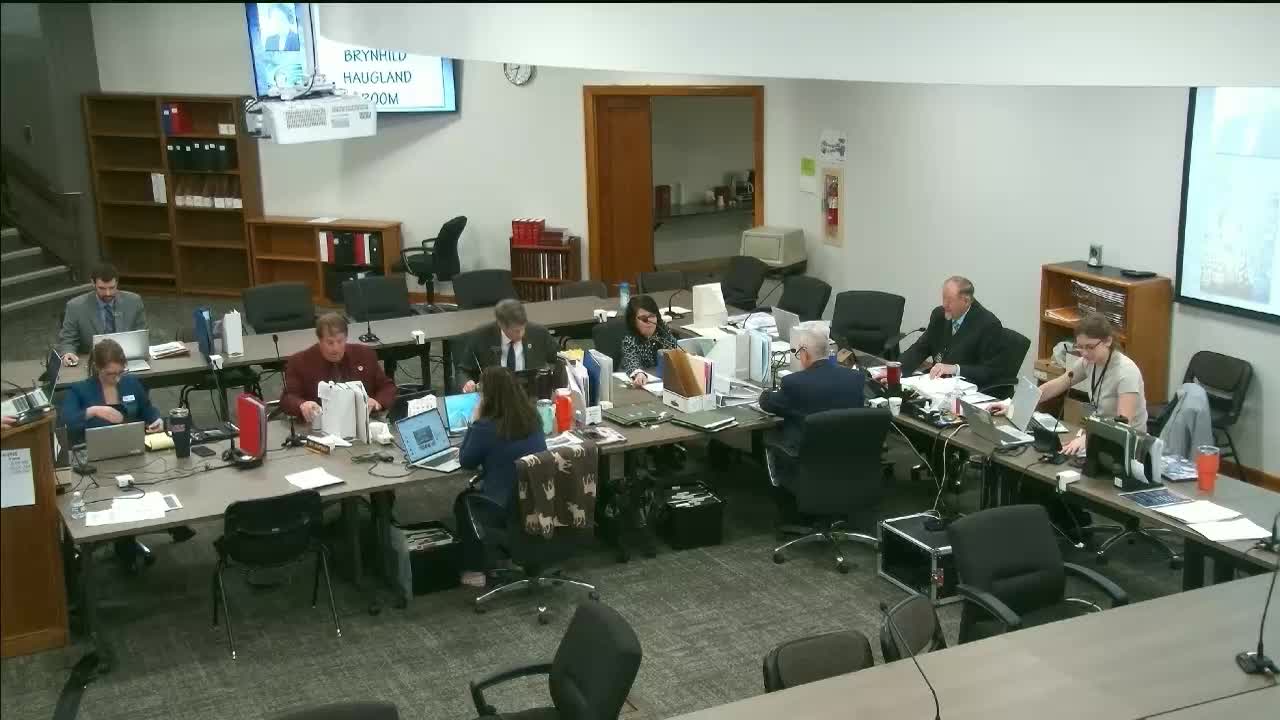
Chairman Munson and members of the House Appropriations Government Operations Division reviewed the Retirement and Investment Office’s budget on Oct. 22, focusing on staffing for in-house investing, IT hosting for a new pension system, a proposed legacy-fund disclosure website, and a retirement-education initiative.
Chairman Munson and members of the House Appropriations Government Operations Division reviewed the Retirement and Investment Office’s (RIO) budget request during the October 22 hearing, discussing staffing, information-technology hosting for a new pension administration system, and two bills that could affect the agency’s investment strategy.
Interim executive director Jody Smith told the committee, "My name is Jody Smith and I'm the interim executive director for the Retirement and Investment Office. I have a brief presentation just to kind of review." She reviewed five optional decision packages and the agency’s recommended base budget, saying the agency had increased assets under management by about $4,000,000,000 since the last biennium.
The most contested item was the agency’s optional package 5, described as “internal investment 2.0.” Smith said she removed that package from the current request and asked the committee to table it until the next biennium, citing leadership transitions and operational risk: she explained the agency is interim-led, the pension administration system is about to go live, and staff expected to begin internal trading in the spring. "I'd like to table it, and bring it back at the next biennium," Smith said.
Why it matters: RIO has already added an initial in-house investing effort (internal investment 1.0) during the current biennium and sought to expand that work. Agency leaders told the committee they expect cost savings from replacing external managers with state staff, but that expansion requires stable executive leadership, personnel capacity and new systems before it should be widened.
Committee members pressed for operational detail across several packages. Optional package 1 continues staff hired during the last biennium to run internal investments; Smith said without that package the agency would have to let go those staff. Optional package 2 includes IT hosting, with the agency identifying one-time and ongoing hosting and support costs (hosting support around $800,000, IT tech support about $130,000 and additional operating/communications about $21,500). Rachel Kametz, who identified herself to the committee as a member of the agency staff, said portions of the request stem from the pending end-of-life for Microsoft Dynamics GP used for financial statements.
On the operational front, Representative Bosch asked about a fiscal-operations software consultant included in the request; Smith explained the consultant would perform business-process modeling to determine whether an integrated fiscal-investment system is needed, because "everything is being tracked, essentially on spreadsheets" and current systems do not fully communicate with each other.
Optional package 3 seeks to restore health-insurance cost increases, internship funding and cost-to-continue salary authority that the agency cut to meet a required 3% budget reduction. Committee members asked whether past savings from employees not taking state insurance had been absorbed by earlier reductions; agency staff said some of those savings were used to meet governor-requested cuts and to fund second-year increases that do not carry forward automatically.
Optional package 4 asks for two additional FTEs: one communications position and one internal auditor. Smith told the panel those roles would support legacy-fund communications and operational oversight as the agency’s AUMs grow. She said the communications FTE also maps to a fiscal note attached to House Bill 1319, a bill to create a legacy-fund disclosure website; the agency estimated roughly $200,000 in one-time costs to build a public, searchable site and tied the communications FTE to ongoing maintenance and reporting for that site.
On HB1319, Smith said RIO is "100% in support of this" conceptually but would "come in in opposition at this point in time, however, unless we see some amended language to that bill," citing the bill’s specificity and the agency’s need for continuing authority and staff to meet the reporting requirements. She said the communications FTE requested in option 4 is the same FTE that appears in the HB1319 fiscal note.
Committee members also discussed House Bill 1330, a bill drafted to require divestment by the legacy fund from companies tied to China. Smith said the agency analyzed the bill and warned the committee that the current draft could force extensive divestments and be operationally difficult because of the difficulty of separating multinational holdings and indirect exposure. "It'd be pretty significant," she said, and recommended narrowing the bill’s definition if the Legislature moves forward.
Members raised the related topic of incentive compensation and the in-state investing policy. An upcoming bill that would repeal declassification and affect the agency’s incentive compensation plan (discussed as House Bill 1348 in testimony) could, the agency warned, make it impossible to maintain the current internal-investment program and the projected fee savings from replacing external managers. Smith said that if the incentive compensation plan were discontinued, the agency would need to push investments back to external managers and would incur additional costs.
On outreach and education, Smith described an optional retirement-education initiative coordinated with the Department of Financial Institutions and the Bank of North Dakota. She said survey work of RIO’s 25,000 members found poor understanding of retirement planning and that the initiative targets retirees, current teachers and incoming teachers for coordinated financial-literacy programming. Deputy executive director Chad Roberts was named as the coordination lead for that initiative.
Agency timeline and next steps: Smith said the new pension administration system will go live in February (agency plan) and that internal investing trades were hoped to start in March but might slip into April or May. She told the committee she had discussed the request with the State Investment Board and the governor’s office; she said the governor supported adding the two FTEs in option 4 but removed some other requested FTEs previously. Regarding internal investment 2.0, Smith said the State Investment Board supported bringing the package back after proving results from the first in-house investing phase.
Committee direction: Members asked staff to reconcile the agency’s worksheet with the governor’s budget and to return with a revised long sheet that shows which optional items the governor supports versus which are new or carry-forward requests. No formal votes occurred during the hearing; Smith removed option 5 from the agency’s amended request and requested the committee table consideration of that expansion until the next biennium.
Ending note: Members and agency staff framed several of the questions around timing and capacity: the agency emphasized the need to stabilize senior leadership and complete the pension-system transition before expanding in-house investing; legislators emphasized consistent statewide treatment of cross-cutting cost items (IT rate increases, rent, etc.) and asked for more granular reconciled budget worksheets before taking final action.