Get Full Government Meeting Transcripts, Videos, & Alerts Forever!
Get email alerts on the Criminal Justice Public Safety Package topic
No spam. Unsubscribe anytime.
House Republicans unveil 13-part public safety package, call for mandatory 10-year minimum for first-degree trafficking
Summary
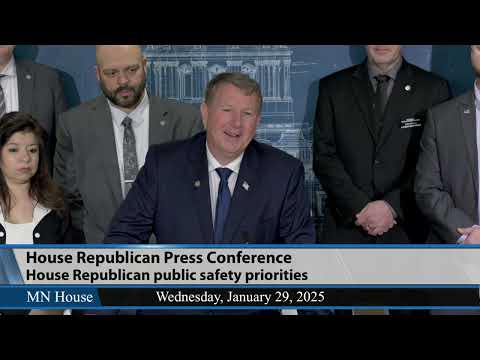
Representative Paul Novotny, chair of the Minnesota House Public Safety Committee, on [date not specified] unveiled a 13-part public safety package that he said focuses on helping law enforcement, keeping violent offenders off the street and holding the criminal justice system accountable.
Representative Paul Novotny, chair of the Minnesota House Public Safety Committee, on [date not specified] unveiled a 13-part public safety package that he said focuses on helping law enforcement, keeping violent offenders off the street and holding the criminal justice system accountable. "Our plan is built on 3 key pillars, helping law enforcement keep our community safe, keeping violent and dangerous offenders off the streets, and holding the criminal justice system accountable," Novotny said.
Novotny said the proposals include a mandatory 10-year prison term for offenders convicted of first-degree trafficking, expanded registration requirements for certain offenders receiving state sentences, new and enhanced offenses targeting public-safety threats, and stronger penalties for assaulting peace officers. "This plan is about putting victims and their families first. It's about giving law enforcement the resources they need to keep their community safe," he said.
Why it matters: sponsors described the package as a response to what they called "soft-on-crime" policies and to recidivism by some violent offenders. The measures would change criminal penalties, reporting and recordkeeping practices, and how sentencing changes are approved. Novotny said the proposals reflect requests from law enforcement partners and constituent frustration with charging and sentencing practices.
Key provisions described by Novotny and discussed during a question-and-answer session included: - A mandatory minimum 10-year sentence for first-degree trafficking convictions (as described by Novotny). - Requirements that certain offenders who receive state sentences be required to register as offenders. - New or enhanced criminal offenses to address blocking freeways and transit routes, reckless flight from police, and conspiring to damage critical infrastructure such as pipelines and water lines. - Elevating assault of a peace officer from a gross misdemeanor to a felony, as an enhanced criminal penalty. - Publicly searchable databases for charging and sentencing information, disclosure of individuals or organizations that post bail for defendants, and a requirement that sentencing changes proposed by the Sentencing Guidelines Commission receive legislative approval.
On transparency and searchable records, Novotny said the information is already collected in many places and "we just want it searchable." He described prior discussions with the Minnesota County Attorneys Association and argued that searchable public access would help victims and residents check charging and sentencing decisions statewide. Novotny said earlier conversations with IT staff estimated a one-time system build cost in the neighborhood of $500,000, with ongoing maintenance costs, and that the bill’s fiscal note had not yet been provided.
On staffing and budgets, Novotny said staffing shortfalls are primarily a budget issue, not part of this top-priority package, and noted the governor’s proposed budget included a cut of $6,000,000 from training funding. He called the resulting training requirement an "unfunded mandate," estimating it at about $800–$900 per officer for some departments.
Novotny said the package was previously circulated as House File 7 and that sponsors plan to resubmit it as their top priority. He said members of his committee have met with Senate counterparts but that formal discussions were limited because of the Senate’s schedule and attendance.
During the event Novotny also addressed federal developments raised by questioners: he said he understood a White House freeze on some law-enforcement funding had been rescinded shortly before the event. He declined to speculate on pardons in federal cases and said he had not reviewed all relevant videos, but he reiterated concern about rising assaults on officers and suggested expanded protections could include corrections staff and EMS personnel.
No formal motion, vote or enactment occurred at the event. Sponsors said they will reintroduce the package in the House for committee consideration and seek collaboration with the Senate. The timeline for hearings or a fiscal note was "not specified."