Get Full Government Meeting Transcripts, Videos, & Alerts Forever!
Get email alerts on the Internal Controls topic
No spam. Unsubscribe anytime.
Senate finance hearing spotlights internal controls after OLA review; MMB outlines tools, limited staff
Summary
The Minnesota Senate Finance Committee on Jan. 9 heard a joint presentation from the Office of the Legislative Auditor and Minnesota Management and Budget on internal controls, oversight and follow-up on audit recommendations.
The Minnesota Senate Finance Committee on Jan. 9 heard a joint presentation from the Office of the Legislative Auditor and Minnesota Management and Budget on internal controls, oversight and follow-up on audit recommendations.
Judy Randall, legislative auditor, told the committee that Minnesota follows the Government Accountability Office——Green Book framework and that "internal controls help an entity run its operations efficiently and effectively, report reliable information about its operations, and comply with applicable laws and regulations." Randall and her team gave examples from recent OLA work showing how weak controls create risk for state funds.
Why it matters: The OLA and several senators framed the discussion as fiscal stewardship for taxpayers and program integrity for Minnesotans who depend on state services. "Prevention is cheapest and it's the most effective," Randall told the committee, noting that once funds are lost to fraud they are difficult to recover.
Key OLA findings and examples: The OLA presenters walked the committee through common control failures and related published reports. Among cited examples were: - Department of Human Services (DHS): audit work found nobody clearly responsible for tracking and recouping provider overpayments; the OLA said DHS had not initiated recovery of more than $40,000,000 in identified overpayments in prior years when the agency did not detect it internally. - Minnesota State Academies for the deaf and blind: the superintendent approved his own travel reimbursements in a manner the OLA described as insufficiently separated in duties. - Minnesota State Lottery: auditors found IT administrators with overly broad privileged access that could allow changes without traceability. - Minnesota Board on Aging senior nutrition program: one area agency had a per-meal reimbursement rate about three times higher than others with no documentation to justify the difference.
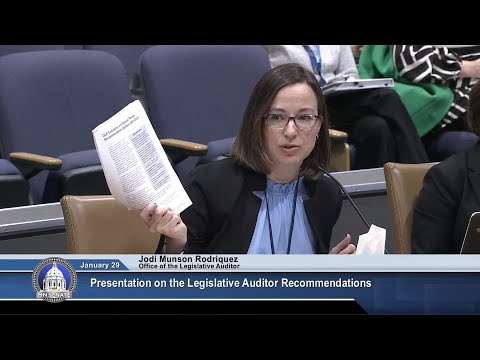
Follow-up and implementation: Jody Munson Rodriguez, deputy legislative auditor, described the OLA's new follow-up product that reviews recommendations released in the last three years and asks agencies for documentation and attestations. "We found that overall, state agencies had implemented or partially implemented close to 70% of our recommendations," Munson Rodriguez said, while noting some recommendations are complex and require additional verification work.
MMB response and enterprise tools: Erin Campbell, commissioner of Minnesota Management and Budget, and Britta Rayton, deputy commissioner, described MMB—tools and oversight processes. MMB has implemented a Control Systems Assessment Tool (CSAT) mapped to the GAO Green Book, requires agency heads to certify their agency assessments, and updated a deeper risk-assessment template used by 39 agencies annually. Campbell said the number of internal audit and internal-control professionals across the executive branch has increased from 42 to 82 since 2020.
MMB tracking and training: Rayton explained that MMB requests corrective-action updates from agencies twice a year and has a standardized response template to improve tracking of OLA recommendations. MMB reported that for audit reports through November 2024, agencies self-attested that 66% of open findings were fully resolved and 30% partially resolved. MMB—also described a rebranded community of practice (ICANN) and enterprise training: in 2023——24 MMB trained 856 supervisors and 418 managers on internal controls and ran a larger fraud-awareness week in 2024.
Capacity limits and next steps: Both OLA and MMB told senators they lack enforcement authority; the OLA said implementation is ultimately the legislature——and agency leaders' responsibility. MMB said its internal controls unit has five specialists and a director and requested three additional positions in the governor's budget to expand training and assistance. MMB officials said they are willing to work with OLA to reconcile differences in reported implementation status and to provide the legislature clearer, joint reporting formats if desired.
Committee discussion: Senators asked about specific cases (including a recent media story about CCAP fraud), OLA follow-up on recommendations, the cost-benefit of adding auditors versus preventing risk through controls, and whether statutes or funding should require more training for grant managers. OLA and MMB representatives emphasized prevention through better controls, improved training, clearer accountability at agency leadership levels and greater use of existing tools. OLA said some recommendations have not been implemented by choice or priority; others remain unconfirmed because verification requires substantial additional work.
Outlook: The hearing did not produce formal committee actions. Both agencies pledged continued cooperation, and MMB signaled openness to adjust reporting to better match OLA follow-ups. The governor—'s budget request for three additional MMB internal controls positions was highlighted during questioning as one potential path to expand capacity. Senators signaled continued interest in follow-up hearings and in clearer lines of accountability between agencies, MMB, and the legislature.