Get Full Government Meeting Transcripts, Videos, & Alerts Forever!
Get email alerts on the Nuclear Moratorium Repeal topic
No spam. Unsubscribe anytime.
Committee hears bills to repeal nuclear moratorium; Prairie Island protections added, partial repeal fails on tie vote
Summary
Senate File 350 (full repeal) and Senate File 468 (partial repeal for units up to 300 MW) were considered together. The committee adopted an amendment adding Prairie Island protections, heard dozens of pro and con witnesses, failed a roll‑call to advance SF468 by a 7‑7 tie, and laid SF350 over for further work.
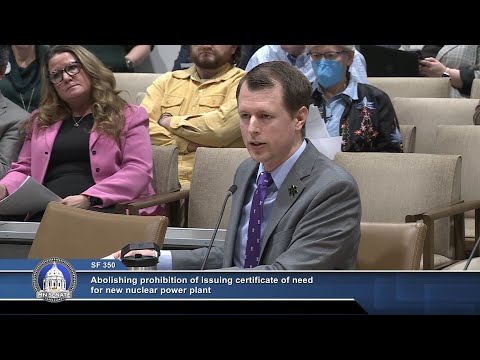
Sen. John Matthews, sponsor of Senate File 350 and co‑sponsor of Senate File 468, presented two related bills to the Senate Energy Committee on Jan. 29 that would lift Minnesota’s 1994 nuclear moratorium either in full (SF 350) or in part for units up to 300 megawatts (SF 468).
Matthews said he brought the bills because Minnesota will need new, reliable baseload generation to meet the state’s 2040 carbon‑free target. “We need clean, reliable baseload generation as our source of generation here in the state,” Matthews said. He said he has been working with the Prairie Island Indian Community and would continue consultations.
The committee adopted an identical A‑4 amendment to both bills that bars new nuclear generation and new on‑site storage of nuclear waste “on or within 10 miles” of the Prairie Island Indian Community; the amendment was presented by Matthews and adopted by voice vote.
Supporters and proponents: A coalition calling itself the Minnesota Nuclear Energy Alliance — including utilities, labor unions, businesses and some environmental organizations — urged repeal so the state can evaluate nuclear in planning and attract federal and private investment. Jenny Glumack (Minnesota Nuclear Energy Alliance) said the alliance formed rapidly and now includes multiple organizations advocating that nuclear be available as a carbon‑free option. Joel Johnson, representing electrical trades, and other labor representatives said nuclear operations provide well‑paid jobs and stability.
Public interest and environmental groups opposed or urged caution. Aaron Klemz of the Minnesota Center for Environmental Advocacy said MCEA was not taking a position but warned that nuclear remains expensive, time‑consuming to build, and lacks a permanent solution for high‑level waste. Margaret Levin of the Sierra Club and other environmental witnesses urged the committee to keep the moratorium and pointed to environmental‑justice concerns for communities downstream and adjacent to uranium mines, mills and waste storage. Lindsay Potter of NukeWatch and Leanne Goose (Rise of Repair Alliance) also opposed repeal, citing cost overruns, canceled projects elsewhere and long‑term waste risks.
Prairie Island perspective: Blake Johnson, government relations representative for the Prairie Island Indian Community and a tribal member, said the tribe cannot support either bill at present. He recounted that the Prairie Island reservation sits less than 700 yards from the Prairie Island plant and that the community has long objected to the siting and to spent fuel storage near the reservation. “We are the closest community, native or non‑native, in the nation to a nuclear plant and stored nuclear waste,” Johnson said. He urged continued, substantive consultation with tribal leadership before any repeal moves forward.
Other technical concerns and examples: Testimony reviewed recent U.S. and international experience. Opponents cited the multi‑billion‑dollar cost overruns and long schedules at new conventional reactors (for example, the Vogtle units) and called out a canceled U.S. small modular reactor (SMR) project where subscribers withdrew after cost increases. Proponents cited advances in technology, examples of states pursuing nuclear options, and federal investments to encourage new nuclear deployment.
Committee action and votes: The committee adopted the A‑4 amendment to both bills. When the author moved SF 468 (the partial repeal) to be recommended to pass and be sent to the Senate floor, a roll‑call vote resulted in a 7‑7 tie; the motion failed and the title was not agreed to. Senate File 350 (the full repeal) was not advanced; the author asked that SF 350 be laid over for possible inclusion so consultations with Prairie Island and other stakeholders can continue.
Ending: The committee concluded a lengthy hearing that included dozens of witnesses and divergent testimony. Senators and witnesses agreed the policy involves complex trade‑offs among reliability, cost, environmental justice, long‑term waste management and water resources; the committee adopted tribal protections in amendment A‑4 and left the bills in committee while consultations continue.