Get Full Government Meeting Transcripts, Videos, & Alerts Forever!
Get email alerts on the Teacher Shortage topic
No spam. Unsubscribe anytime.
Minnesota educators, principals tell Senate committee licensure rules and pay worsen teacher and substitute shortages
Summary
School leaders, teachers and advocates told the Senate Education Policy Committee that tiered licensure changes, slow out‑of‑state licensing, unpaid student teaching and low pay are worsening shortages. Witnesses urged legislative fixes, apprenticeship funding and simpler license pathways.
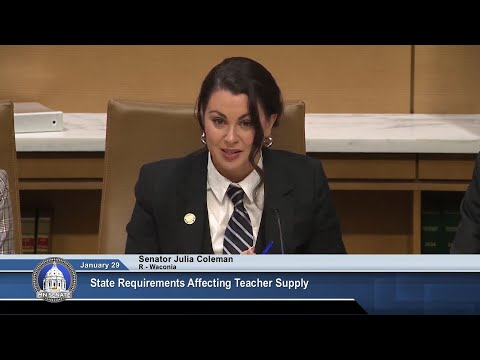
Members of the Minnesota Senate Education Policy Committee heard detailed testimony Feb. 29 from principals, superintendents, special‑education leaders and teacher‑pipeline advocates linking teacher and substitute shortages to licensure barriers, compensation and workload.
The committee’s listening session aimed to surface policy options affecting teacher recruitment and retention. Angela Charbonneau Folch, principal at the Integrated Arts Academy and state coordinator for the Minnesota Association of Secondary School Principals, told the committee that Department of Employment and Economic Development projections show “over 30,000 teacher vacancies within the next 10 years” and that first‑year teacher pay in Minnesota averages $45,630 as of January 2025. “For a 4‑year college student thinking about going into education, these numbers matter,” she said.
Why it matters: Lawmakers heard multiple, concrete barriers that districts say keep qualified people out of classrooms — rigid paths from Tier 1 to Tier 2 licensure, extra paperwork and slow licensing for out‑of‑state candidates, unpaid student teaching that deters diverse candidates, and compensation and benefits that lag comparable public safety retirement timelines.
Committee testimony and examples
Sharon Johnson, community education director for Worthington Public Schools, described the tiered licensure process as a central problem for early childhood staffing. She said recent changes require Minnesota‑based college enrollment to advance from Tier 1 to Tier 2, producing cases in which teachers who earned out‑of‑state graduate degrees could not advance and would be subject to annual nonrenewal procedures. Johnson said in her district “55% of the 11 teachers have a Tier 1 or 2 license,” and that the current rules mean some teachers will be forced through repeated nonrenewals and have their first three years of teaching excluded from tenure calculations.
Ryan Erke, an elementary principal in Saint Charles, described out‑of‑field restrictions that forced experienced in‑district teachers to stop teaching subjects such as music or art because required licensing routes were time‑consuming and costly. “Because of all of the red tape…she decided not to continue on as a music teacher in our district,” Erke said of one teacher who had exemplary evaluations but faced expensive coursework to obtain a subject license.
Val Ray Bow, superintendent of Northeast Metro Intermediate District 916, described ITrack, Minnesota’s first registered teacher apprenticeship program designed to grow special‑education teachers from paraprofessionals. Bow said intermediates serve high‑need settings and that ITrack is a “high impact solution,” asking the Legislature to consider a $3,000,000 annual appropriation to sustain the apprenticeship model.
Nicole Woodward, executive director of the St. Croix River Education District, urged more flexibility for Out‑of‑Field Permissions (OFPs) and Tier 1/Tier 2 timelines and described administrative burdens (annual nonrenewals and 60‑day reposting) that deter candidates from remaining in teaching positions.
Advocates and researchers emphasized data and equity
Matt Shaver, senior policy director at Ed Allies and a classroom teacher, argued the state lacks a clear, consistent definition of “teacher shortage.” He cited PELSB reporting practices and noted one commonly cited figure — 197 — as the number of math teachers without a Tier 3 or Tier 4 license identified last year by state data. Shaver urged the Legislature to adopt a broader statutory definition and better vacancy reporting so targeted investments can be measured.
Haben Gebruggish and other advocates warned that narrowing nontraditional licensure pathways disproportionately affects teachers of color, career‑technical and special‑education candidates who have historically used those pathways into the classroom.
Other proposals and local examples
Several witnesses suggested practical fixes the committee could legislate quickly: restore previously available Tier 2 pathways (the “pick‑two” option), allow provisional or short‑term provisional licensure while paperwork is processed, expand portfolio or residency options with state supports, speed PELSB review windows, and fund stipends for student teachers so unpaid placements do not create a financial barrier.
Dr. Kristin Dahmer, assistant superintendent for Moorhead Area Public Schools, provided substitute‑coverage data her district collects: average daily substitute fill rates of about 60–65% during the 2024–25 school year and single‑day examples in which 18–32 classrooms went unfilled when fill rates dropped to about 50–58%. She told the committee that unfilled classrooms can mean missed special‑education services, doubled classrooms, or administrators covering classrooms.
Union perspective and concerns
Caitlin Snyder of Education Minnesota, which represents 84,000 educators, said the union opposed lowering substitute pay and warned against relying on undertrained substitutes for extended classroom coverage. “Educators are professionals. Care work is real work. It should be compensated appropriately,” Snyder said, and she flagged training and student‑safety questions for long consecutive substitute assignments.
What the committee will decide next
Members cited a range of bills and pilot programs under consideration, including statutory changes to Tier 1/Tier 2 timelines, expedited review of out‑of‑state applications, apprenticeship funding, and efforts to target student‑teacher stipend dollars directly to candidates. Multiple senators urged rapid action this session; several testified that modest statutory changes could be enacted quickly to reduce red tape.
Ending note
Witnesses repeatedly asked the committee to pair regulatory flexibility with funding — for licensure support, apprenticeship programs and student‑teacher stipends — and to prioritize data collection and reporting so the state can measure whether changes reduce vacancies and improve teacher diversity and retention.