Get Full Government Meeting Transcripts, Videos, & Alerts Forever!
Get email alerts on the Labor Force Trends topic
No spam. Unsubscribe anytime.
State demographer: Minnesota workforce growth slowed by aging and low birth rates; international migration now key source of workers
Summary
State Demographer Susan Brower told the Senate Jobs and Economic Development Committee that Minnesota's labor force is growing very slowly because of population aging and falling birth rates, and that international migration has become the primary source of net labor-force growth in recent years.
Susan Brower, the state demographer, told the Senate Jobs and Economic Development Committee on Jan. 29 that Minnesota’s labor force has grown only slowly this decade, driven mainly by population aging and lower birth rates.
Brower said about 58% of the large baby‑boom cohort has moved into retirement and that births have declined, producing “very, very slow growth” in workers unless migration increases. “Without the contribution of migration from other states or from other countries, we can expect this very, very slow growth to continue into the future,” Brower said.
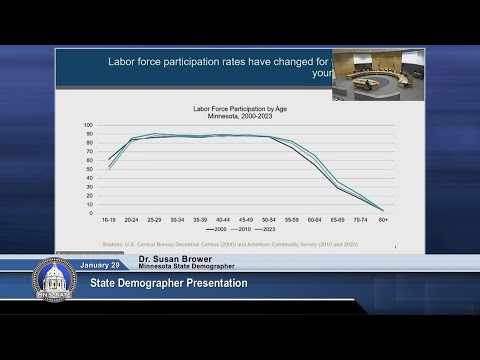
Brower placed recent changes in longer historical context. Teen labor‑force participation fell from about 61% in 2000 to roughly 50% in 2010 and was about 53% in 2023. Participation among people in their mid‑ to late‑20s rose; Brower said labor‑force participation was about 90.5% for people aged 25 to 29 in 2023. Participation by older workers also rose: she said participation for 60‑to‑64‑year‑olds increased from about 55% in 2010 to 66% in 2023.
Those age‑by‑age changes, Brower told senators, have been gradual but steady and suggest that most of the remaining potential to expand the workforce comes from either younger people entering earlier or attracting workers from outside Minnesota. “If we are to continue to see our workforce grow into the future, it's likely going to have to rely on migration from outside of Minnesota’s borders,” she said.
Brower reviewed migration patterns through 2024. She said Minnesota typically records a small net domestic outflow to other states — common for Midwestern states — while international migration has been a continuing source of net population growth. “On net more people move to Minnesota than move away. But most of that comes from international immigration,” she said, and added the Census Bureau’s updated methodology recently captured more international growth than prior estimates.
Committee members pressed Brower on who is moving and why. Brower and senators discussed that the largest losses by age are among teenagers and people in their early 20s — a broadly national pattern tied to college attendance and other early‑life moves. She also said older adults (including so‑called snowbirds) do move out in some years but at lower volumes than the younger losses.
Brower presented estimated counts from the American Community Survey and other sources: about 3.1 million people were counted in the labor force (16 and older) as of December 2024; in the 16–64 cohort she cited 634,000 people not in the workforce (using 2023 ACS characteristics), of whom roughly 184,000 were enrolled in high school or post‑secondary education, about 67,100 were estimated to have retired before age 65, and the remainder were mainly people with caregiving responsibilities, disabilities, health issues or other reasons for not participating.
Committee members and Brower discussed policy implications. Several senators said they want to keep more graduates and young professionals in state and urged closer attention to higher‑education retention, workforce training and employer attraction. Brower emphasized that migration, housing, jobs and family ties are the leading reasons people move; academic research on tax‑driven migration is mixed and tends to show tax effects concentrated among very high‑net‑worth households, she said.
Brower also reviewed racial and ethnic trends in the workforce. She said workers of color make up about 23% of Minnesota’s labor force and that unemployment gaps narrowed since the Great Recession: for example, she cited roughly 5.5% unemployment for Black or African American workers and 11.2% for Native workers in the latest ACS figures she showed. She and senators discussed the value of disaggregated data (by detailed racial/ethnic subgroups and by geography) to target programs and supports more precisely.
The presentation and subsequent questions underscored the committee’s view that Minnesota’s labor shortage is structural and that migration — particularly international migration — and targeted workforce development will be central to future labor‑force growth.