Get Full Government Meeting Transcripts, Videos, & Alerts Forever!
Get email alerts on the Deer Farming Cwd topic
No spam. Unsubscribe anytime.
Senate committee advances two deer‑farm bills after farmers, scientists and legal counsel press changes to DNR rules
Summary
The Senate Agriculture and Rural Broadband Committee sent two bills about deer‑farm regulation to the Environment, Climate and Legacy Committee without recommendation after hearing testimony from deer farmers, a wildlife scientist and an attorney about fencing rules, agency authority and constitutional concerns.
St. Paul — The Senate Agriculture and Rural Broadband Committee voted to send two related measures on deer farms — Senate File 553 and Senate File 659 — to the Environment, Climate and Legacy Committee without recommendation after a two‑hour hearing that featured deer farmers, a veterinary and legal overview, and a wildlife scientist’s review of the peer‑review literature.
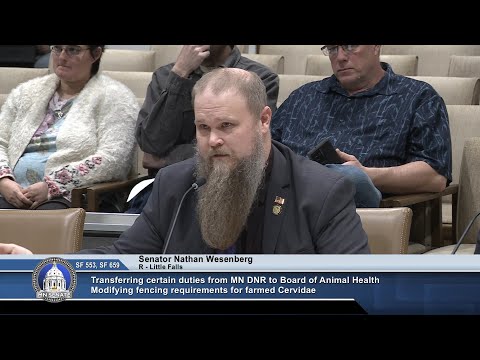
Senate File 553, which addresses fencing requirements on registered deer farms, was moved by Senator Zach Anderson and advanced with an A2 amendment that conditions a new state fencing requirement on state funding to cover the cost of the additional fencing. Senate File 659, which would transfer regulatory authority for deer farms from the Department of Natural Resources (DNR) back to the Board of Animal Health, was moved to the next committee by Senator Weber. Both motions carried by voice vote.
Supporters told the committee the current DNR approach is harming farms, creating legal uncertainty and producing enforcement actions that amount to de facto efforts to eliminate the industry. “Deer farmers are livestock. They should be managed by the Board of Animal Health and not the DNR,” Senator John Wiesenberg said when introducing the measures.
Scott Fear, president of the Minnesota Deer Farmers Association and a longtime deer farmer, said the transition from Board of Animal Health oversight to DNR control has been “nothing short of a disaster,” citing shifting requirements and unclear contacts at the agency. Fear said DNR guidance on exclusionary fences contains a disclaimer that the documents are informational, yet farms have received notices of violation when their fences did not match the guidance.
“Where do we go?” Fear asked. He also gave a farm‑level estimate: one configuration he described as the “best” fence would cost his operation roughly $800,000; a lesser upgrade would still cost about $60,000 for his farm.
Attorney Eric Cardell, representing deer‑farm interests, told the committee the legislature has already recognized deer farming as an agricultural pursuit in statute (he cited Minn. Stat. 17.452). Cardell said recent state statutes and administrative measures — limits on registration transfers, moratoria on new registrations and the double‑fence/exclusionary fencing requirement — pose constitutional questions and give farms a reasonable‑investment expectation that has been undermined. He referenced a pending federal case, Deer Farmers Minnesota v. Straumann, and said the state’s approach risked a regulatory taking.
“In 2022 I advised a Senate committee on a related topic,” Cardell said. “Here the concern is that the legislature has created a legitimate occupation and regulatory steps are being used that appear to work to put people out of business.”
Dr. James Kroll, an emeritus professor with long experience in whitetail research and conservation, told the committee he reviewed the peer‑review literature and found no credible studies demonstrating that nose‑to‑nose fence contact transmits chronic wasting disease (CWD). He said animal‑health oversight and live testing protocols enable alternatives to mass depopulation and that breeding for genetic resistance — a strategy used in other states for related prion diseases — is a viable mitigation path.
“I am very familiar with all the literature on fences. There is not one scientific credible study that has been done about transmission through fences,” Kroll said. “It may happen, but the science is not there.”
Several deer farmers described regulatory inspections by DNR officers as intrusive and emotionally and financially damaging. Former law‑enforcement officer and deer farmer Steve Porter told the committee DNR inspections included body‑worn cameras and that the agency’s enforcement approach had felt like “weaponizing” law enforcement against his farm. He said his herd participates in USDA monitoring programs and that to date herd testing and USDA protocols have shown his animals to be free of CWD.
Multiple witnesses described genetic testing programs and voluntary breeder efforts to increase CWD resistance in breeding stock; one testifier said several Minnesota farms already have herds with high markers for genetic resistance. Several speakers urged an approach that uses breeder herds to accelerate resistance rather than broad culling.
Committee action: Senator Anderson moved Senate File 553 (fencing) to the Environment committee without recommendation; the committee adopted an A2 amendment that conditions any new double‑fence requirement on state funding to cover the additional cost. Senator Weber moved Senate File 659 (transfer to Board of Animal Health) to the Environment committee without recommendation; that motion also passed by voice vote.
What the bills would change: SF 553 would revise regulatory language tied to exclusionary and double‑fence requirements for deer farms; the A2 amendment adopted in committee requires the state to appropriate funding before the second‑fence requirement would be enforced. SF 659 would transfer primary regulatory authority for farmed deer back to the Board of Animal Health, a move supporters said would align deer with other livestock oversight.
Legal and procedural context: Attorney Eric Cardell flagged potential constitutional issues, including claims that the combined effect of moratoria on new registrations, restrictions on selling registrations, and fencing mandates could amount to a regulatory taking because they prevent owners from realizing the value of their farm businesses. Cardell referenced the pending federal litigation and urged temporary relief via the bills while courts and agencies resolve competing interpretations.
Next steps: Both bills now go to the Environment, Climate and Legacy Committee. Committee members signaled they expect additional hearings and may refine funding language in the amendment. No final legislative decisions were taken at this hearing; both measures were advanced to the next committee for further work.