Get Full Government Meeting Transcripts, Videos, & Alerts Forever!
Get email alerts on the Acute Care Transitions topic
No spam. Unsubscribe anytime.
DHS council urges sustained, data‑driven push to reduce avoidable hospital stays and improve complex transitions
Summary
DHS and the Acute Care Transitions Advisory Council asked the committee to support a standing, data‑driven effort to expand regional capacity and reduce avoidable hospital days for people who lack appropriate community supports.
The Department of Human Services and the Acute Care Transitions Advisory Council presented recommendations and preliminary data to the committee, urging sustained investment in regional capacity, a unified measurement system and short‑term policy changes to reduce avoidable hospital stays for people who lack appropriate community supports.
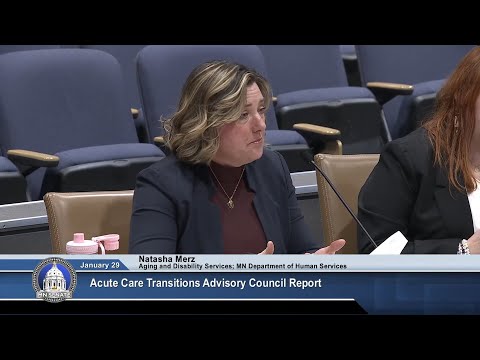
Assistant Commissioner Natasha Mers said DHS used federal funding to stand up a complex transitions team and has established three pilot regions with transition coordinators who follow people for about six months after discharge. "We have been successful in establishing kind of three regions of the state and hiring transition coordinators ... This team will also follow folks for about six months post discharge to make sure that they're not getting readmitted," Mers said.
What the data show
DHS presented preliminary referral data indicating the most common reason hospitals request assistance is the lack of appropriate community supports — meaning no provider or program in the community could safely serve the person. Presenters said avoidable hospital stays after clinical readiness can be substantial; committee members and DHS staff pointed to individual cases exceeding 50 days beyond clinical readiness.
Josh Berg, co‑chair of the advisory council, summarized the council's work and membership, noting participation by commissioners, county and hospital association representatives, unions, tribal governments, mental‑health and public‑health stakeholders and people with lived experience. The council's major recommendations include continuing the council as a standing, funded body; expanding regional care navigation; building statewide data and communication infrastructure; integrating measurement and action plans to address disparities; and identifying immediate policy or licensing barriers that prevent timely discharges.
Drivers and barriers
DHS staff explained recurring causes of prolonged stays: staffing shortages (especially overnight staffing), workforce retention challenges when residents exhibit aggressive behaviors, municipal opposition to siting new group homes ("NIMBY"), and gaps in services for people who need in‑home staffing supports. Assistant Commissioner Mers singled out the intersection of race and disability as a core measurement focus: the council recommended monitoring geographic, racial and ethnic disparities and the intersectionality of disability in outcome metrics.
Federal funding uncertainty
Committee members raised concerns after a federal memo and technical issues with CMS portals prompted questions about temporary disruptions to grant processing. DHS officials said the situation was fluid, that they had prioritized rapid analysis of potential impacts and that Medicaid eligibility and ongoing MA payments were not known to be broadly cut off. "We were surprised by the scope and reach of the original memo ... we were trying to adapt to that as well and just understand impacts," the assistant commissioner said. DHS also told the committee it would follow up with specifics about any federal grants or payments potentially affected.
Council next steps and fiscal considerations
Council leaders and DHS staff urged legislative support to keep the council operating and to fund the data infrastructure and regional teams. Josh Berg and other presenters warned that expanding capacity could incur costs and that moving people out of hospitals into appropriate community services may increase some short‑term spending even as it reduces avoidable hospital utilization.
Ending
The committee received the report and engaged in extended questioning. Members asked DHS to provide technical assistance and follow‑up materials, including the council's recommendations in bill form, fiscal estimates, and further detail on the preliminary data and regional pilot outcomes.