Get Full Government Meeting Transcripts, Videos, & Alerts Forever!
Get email alerts on the Legislative Organization topic
No spam. Unsubscribe anytime.
Alaska Senate swears in members, elects leadership and adopts committee roster; two special committees approved
Summary
On Jan. 21 the Alaska Senate opened its 34th Legislature, administered oaths of office, elected Senator Gary Stevens as Senate president, confirmed committee assignments and approved two special committees — Arctic affairs and world trade — with recorded votes.
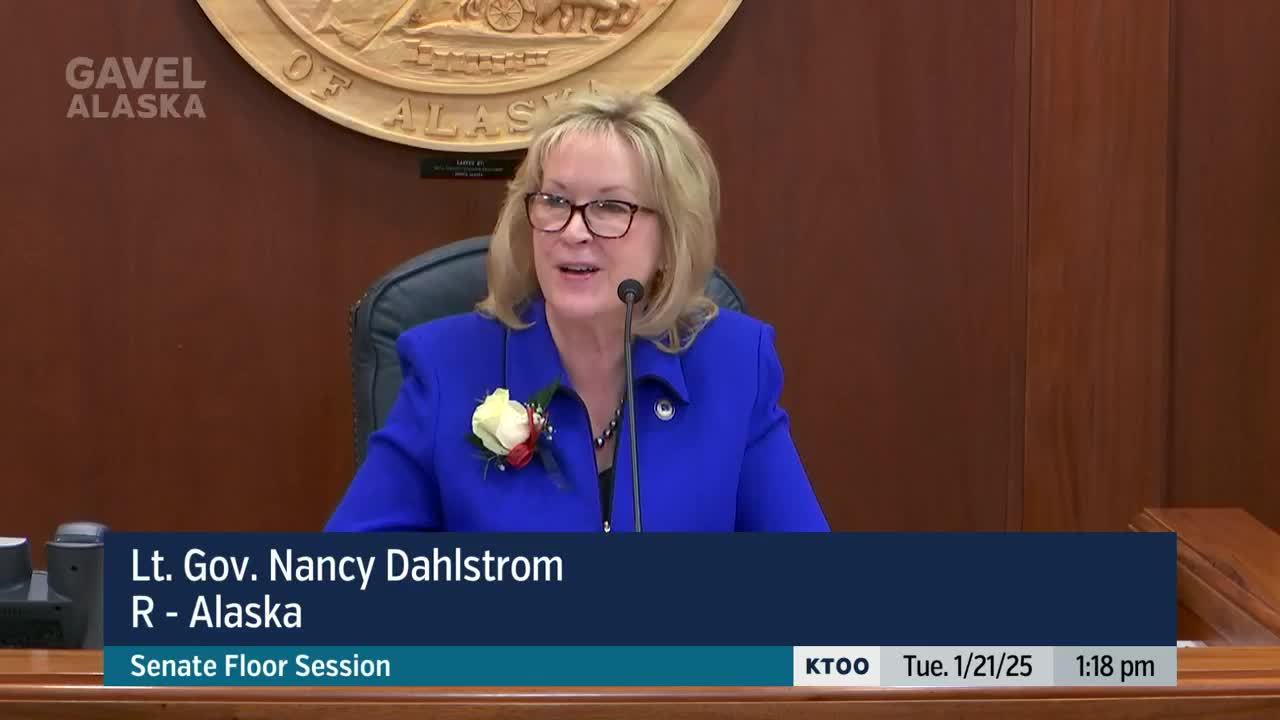
The Senate of the State of Alaska convened Jan. 21 in Juneau to open the 34th Legislature, administer oaths of office to newly elected and returning senators, elect chamber leadership and adopt its committee assignments for the session.
Carol Beecher, director of the Division of Elections, certified the Nov. 5, 2024 general election results in writing before the chamber, naming winners for multiple districts, including Jesse Kiel in Senate District B and Robert Yant in Senate District N. Senators then individually took the oath of office.
The organizing session continued with nominations and elections for leadership. Senator Lyman Hoffman was chosen as president pro tempore by unanimous consent after a nomination was made from the floor. Senator Gary Stevens was nominated and, without objection, elected president of the Senate for the 34th Legislature. In brief remarks after his election, Senator Stevens said he accepted the role “with humility and dedication to this institution,” and noted the chamber’s 14-member majority and six-member minority.
Senators then met as the committee on committees and submitted a report listing chairs and members for 10 standing committees and several special and joint committees. The Senate adopted the committee on committees report by unanimous consent. The adopted roster names chairs and vice chairs for committees including Community and Regional Affairs, Education, Finance, Health and Social Services, Judiciary, Labor and Commerce, Resources, Rules, State Affairs, and Transportation.
Senate Resolution 1, establishing a Senate Special Committee on Arctic Affairs, was taken up and passed on a roll-call vote of 14 yays and 6 nays. Minority members raised concerns on the floor that the special committee initially lacked a minority representative; Senator Lance Pruitt (minority leader) noted the minority caucus would have preferred to be represented and asked that the record reflect that preference. The resolution passed despite that objection.
Senate Resolution 2, establishing a Senate Special Committee on World Trade, passed unanimously, 20 yays, 0 nays.
The chamber also ratified appointments to the Select Committee on Legislative Ethics and alternates by unanimous votes, and the Senate president named additional members and alternates to the legislative council, legislative budget and audit committee, Joint Armed Services Committee, the special committee on Arctic affairs, and the special committee on World Trade. The secretary was tasked with notifying the governor and the House that the Senate was organized and ready to do business.
The Senate referred the introduction and referral of other Senate resolutions and bills to the next legislative day by unanimous consent and adjourned until 11 a.m. the following day.
Votes at a glance: - Senate Resolution 1 (establish committee on Arctic affairs): Passed, 14 yays, 6 nays. - Senate Resolution 2 (establish committee on World Trade): Passed, 20 yays, 0 nays. - Committee on Committees report (adoption of standing committees and membership): Adopted, unanimous consent. - Ratification of Select Committee on Legislative Ethics members (Senator Stevens and Senator Yundt): Ratified, 20 yays, 0 nays. - Ratification of alternates to Select Committee on Legislative Ethics (two alternates): Ratified, 20 yays, 0 nays.
Why this matters: The organizational steps taken by the Senate — oaths, leadership elections and committee assignments — determine which senators lead agenda-setting panels and which members will shape hearings and bills over the 120-day session. The creation of special committees on Arctic affairs and world trade signals the chamber’s stated priorities for the session.
What’s next: Committees named during the organization period were assigned meeting times; the Senate adjourned to meet again at 11 a.m. on Wednesday, Jan. 22.