Get Full Government Meeting Transcripts, Videos, & Alerts Forever!
Get email alerts on the Urban Forestry topic
No spam. Unsubscribe anytime.
Committee hears House Bill 1153 on state model urban-forestry ordinances; testimony sharply divided
Summary
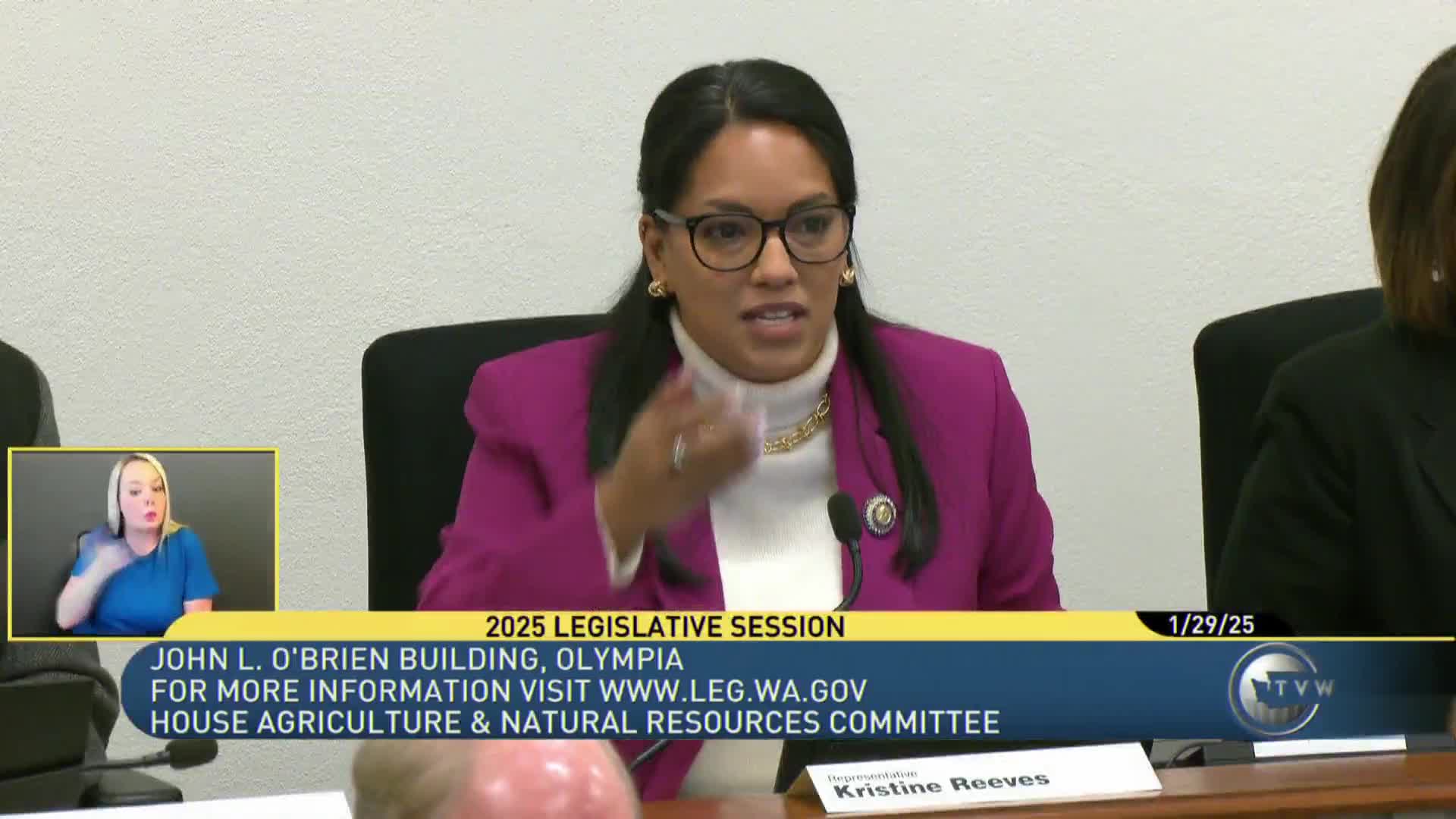
Representative Divina Duer introduced House Bill 1153 on Jan. 29 to the House Agriculture and Natural Resources Committee and described the measure as an attempt to balance tree retention and housing production.
Representative Divina Duer introduced House Bill 1153 on Jan. 29 to the House Agriculture and Natural Resources Committee and described the measure as an attempt to balance tree retention and housing production. "This bill is my attempt to find that balance between development and housing and tree retention," Representative Duer said.
The bill would require the Department of Natural Resources (DNR) to develop model urban-forestry ordinances and provide technical assistance to jurisdictions that adopt them. Staff summarized the measure to the committee, saying it includes provisions on tree banks (planting or fee-in-lieu programs to compensate for tree removal), criteria for identifying trees critical to retain during development, a prohibition on requiring retention of special trees outside a trees critical area if doing so would, for example, reduce allowed density, incentives for developers to retain trees and a grant program to support local implementation subject to appropriation.
Why it matters: The proposal seeks to create a single state-backed set of options for cities and counties to manage trees during housing development. Proponents argued a common model could reduce uncertainty across jurisdictions and help implement state housing laws, while opponents said some bill elements would encourage removal of mature, on-site trees and shift canopy to remote "tree banks" that do not provide immediate neighborhood benefits.
During the public hearing, industry and builder groups voiced support for the billas written or with modest changes. Dylan Schluter of the Master Builders Association of King and Snohomish County said the association "rises today in general support of House Bill 1153" and praised the bipartisan, stakeholder-driven drafting. Jan Heimbach of the Building Industry Association said the measure could be a "creative" way to preserve canopy and advance housing if the statute clarifies how on-site requirements interact with tree banks and incentives.
Opponents argued the measure, in its current form, would accelerate removal of mature trees in neighborhoods. Sandy Schettler of Tree Action Seattle testified: "Treebank trees planted far away simply can't help people breathe the clean air they need right now." Natasha Hayes (testifying for an organization identified in the record as Friends of Trees) and multiple witnesses from conservation and urban-tree coalitions urged the committee to require stronger on-site retention, insist on replacement trees of comparable mature canopy, and avoid incentives that reduce setbacks, minimum lot sizes or landscape requirements.
Committee members asked clarifying questions of staff and the prime sponsor. Committee staff noted the bill includes a "null and void" clause and a fiscal note is available. Representative Duer said she worked with DNR and developers for about three years to craft language that would allow tree retention without undermining middle-housing density goals.
Outcome and next steps: The committee concluded the public hearing on HB 1153 and the chair said additional work would be needed before the measure is scheduled for executive action. Committee leadership encouraged interested parties to continue negotiations with the sponsor.
Ending: The testimony revealed stark differences about whether a statewide model should prioritize flexible compliance tools such as tree banks and incentives or instead require stronger on-site protections. The committee did not take a vote on HB 1153 during the Jan. 29 meeting; the chair indicated further drafting and outreach would continue before any executive session.