Get Full Government Meeting Transcripts, Videos, & Alerts Forever!
Get email alerts on the Recycling Policy topic
No spam. Unsubscribe anytime.
Committee Hears Split Views on Bill Requiring Ecology-Led Recycling Needs Assessment and New Recycled‑Content Rules
Summary
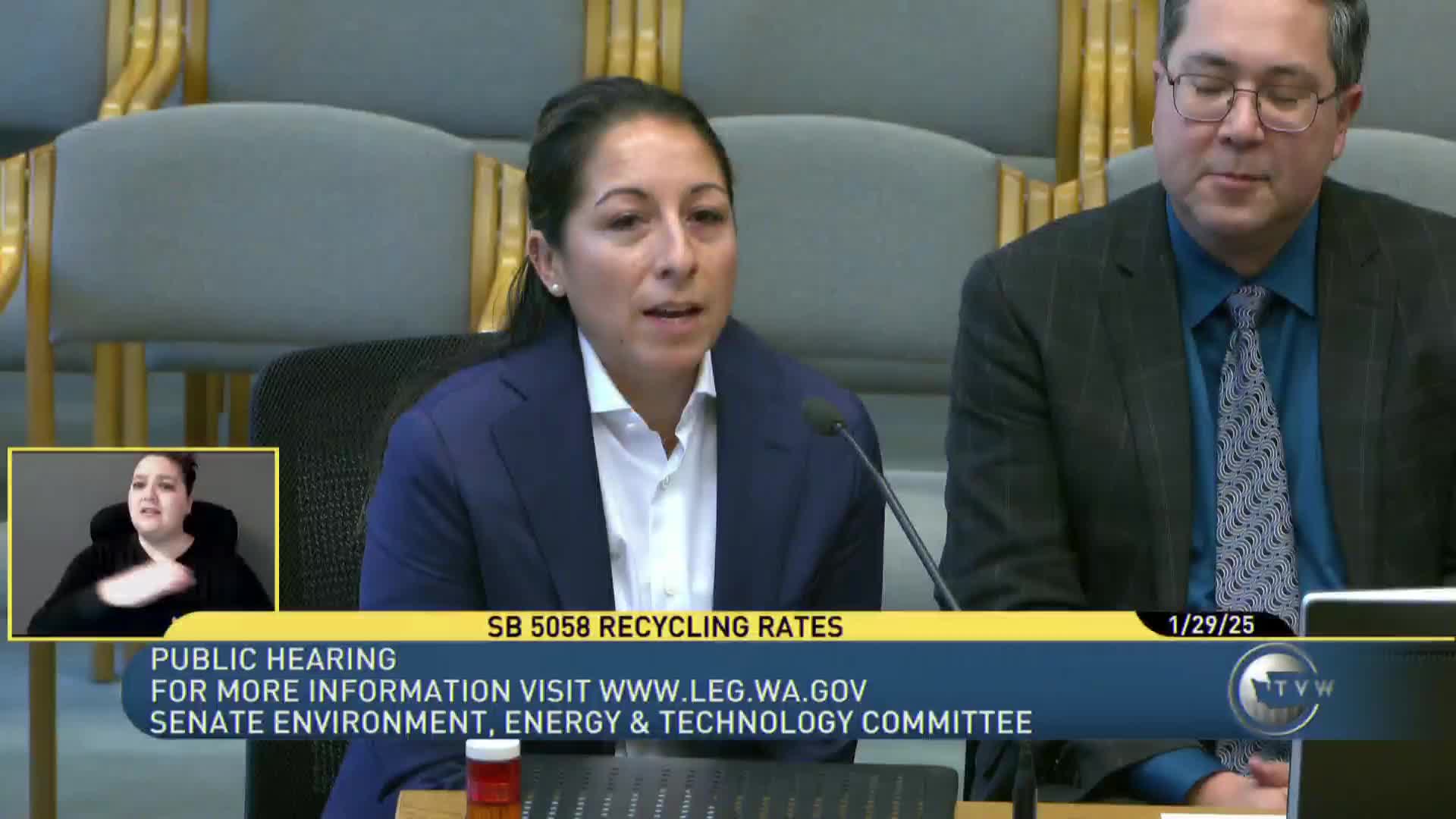
Senate Bill 5058 would require the Washington Department of Ecology to develop statewide lists of recyclable materials (curbside and drop‑off), complete a statewide needs assessment, and expand post‑consumer recycled content requirements for several plastic products.
Senate Bill 5058 would require the Washington Department of Ecology to develop statewide lists of recyclable materials (curbside and drop‑off), complete a statewide needs assessment, and expand post‑consumer recycled content (PCRC) requirements for several plastic products. Ecology would also register producers directly and set fees to fund the work.
The bill’s supporters from the waste-hauling and retail sectors told the committee the measure takes a practical, Washington‑specific approach and that a county‑by‑county needs assessment is the correct first step. Vicki Kristofferson, executive director, Washington Refuse and Recycling Association, said the assessment should identify “what it is we need to collect, what kind and how many of new collection services we need around the state,” and cited equipment and workforce constraints such as truck lead times and costs.
Opponents — including environmental groups and several recycling‑industry organizations — said the bill stops short of holding producers accountable through a full EPR system and could duplicate or delay work already underway. Dylan DeThomas, state policy lead for The Recycling Partnership, said the bill “does not create the change needed to drive the circular economy” and called a separate needs assessment duplicative of existing processes. The Association of Plastic Recyclers and packaging trade groups urged a program design that ensures funding, transparency and proper producer definitions.
Key provisions in the bill
- Ecology must develop two statewide recycling lists: one for curbside residential collection and a second for residential drop‑off. The bill specifies an initial list of materials. - A statewide needs assessment must evaluate capacity, costs, gaps and needs to meet recycling goals; Ecology must consult every solid waste planning district and contract with a neutral third party for the assessment. - Producers of covered products, packaging and paper products must register with Ecology and pay fees directly to the agency; Ecology sets fees and oversees reporting and implementation rather than a producer responsibility organization (PRO). - The bill amends PCRC requirements and adds categories such as polypropylene tubs, single‑use polypropylene cups, PET and polystyrene single‑use cups, and PET thermoform containers. Ecology may extend PCRC compliance dates by up to five years if recycled material supply is insufficient. Producers may apply for waivers by paying a fee if compliance is technically infeasible or conflicts with federal law. - The bill creates an advisory committee and a subcommittee (truth‑in‑labeling task force) to guide lists, the needs assessment and producer registration implementation. It also modifies a solid‑waste low‑income discount program administered by the Utilities and Transportation Commission.
Technical and implementation concerns
Peter Lyon, program manager for Ecology’s solid waste program, provided technical input and cautioned that implementation would be labor intensive. He estimated Ecology currently spends about 330 staff hours to register 200 producers under existing PCRC law, and that registering an estimated 2,000 additional producers under SB 5058 would require roughly 3,000 staff hours annually. Lyon also flagged a conflict between the bill’s directed fund account and the existing PCRC account and recommended timeline adjustments to allow adequate rulemaking, advisory‑committee input and agency staffing.
Where supporters and opponents align and diverge
Many haulers and local solid‑waste officials endorsed the needs assessment and a consistent statewide list, saying those elements would reduce consumer confusion and help plan infrastructure investments. Jay Velasquez, representing Basin Disposal and Consolidated Disposal Services, said PCRC requirements “actually do change plastic manufacturers’ behavior in a much quicker manner than the producer responsibility organization contemplated in other proposals.”
Environmental groups, national recycling NGOs and packaging industry representatives argued the bill lacks the funding and producer accountability features of a comprehensive EPR program and could constrain outcomes. The Recycling Partnership and the Coalition for High Performance Recycling said EPR combined with deposit‑refund systems or other measures would be more effective in raising collection and closed‑loop recycling rates.
Concerns about materials designations and glass
Several industry groups urged caution about statutorily designating curbside materials before a needs assessment is complete. Scott DeFeiff of the Glass Packaging Institute warned that placing glass on a drop‑off‑only list would reduce curbside glass access for many residents and could lower glass recycling rates. Packaging makers represented by AmeriPen and others requested clearer producer definitions, arguing an overly broad statutory definition could misallocate responsibilities.
Next steps and context
Committee staff closed public testimony on SB 5058 and the hearing record will be used for further drafting. Ecology and multiple stakeholders signaled willingness to work with the sponsor on clarifying timelines, fund accounting and producer definitions. No formal committee vote was recorded at this hearing.
The hearing also highlighted a broader policy debate in Washington: whether to pursue a state‑led, needs‑assessment pathway that places implementation responsibility with Ecology, or to adopt a full extended producer responsibility model that assigns program design and financial administration to a producer organization. The committee indicated it would consider stakeholder amendments and technical fixes before any further action.