Get Full Government Meeting Transcripts, Videos, & Alerts Forever!
Get email alerts on the Juvenile Justice topic
No spam. Unsubscribe anytime.
Committee hears bill to expand juvenile diversion, remove completed diversions from youths' criminal history
Summary
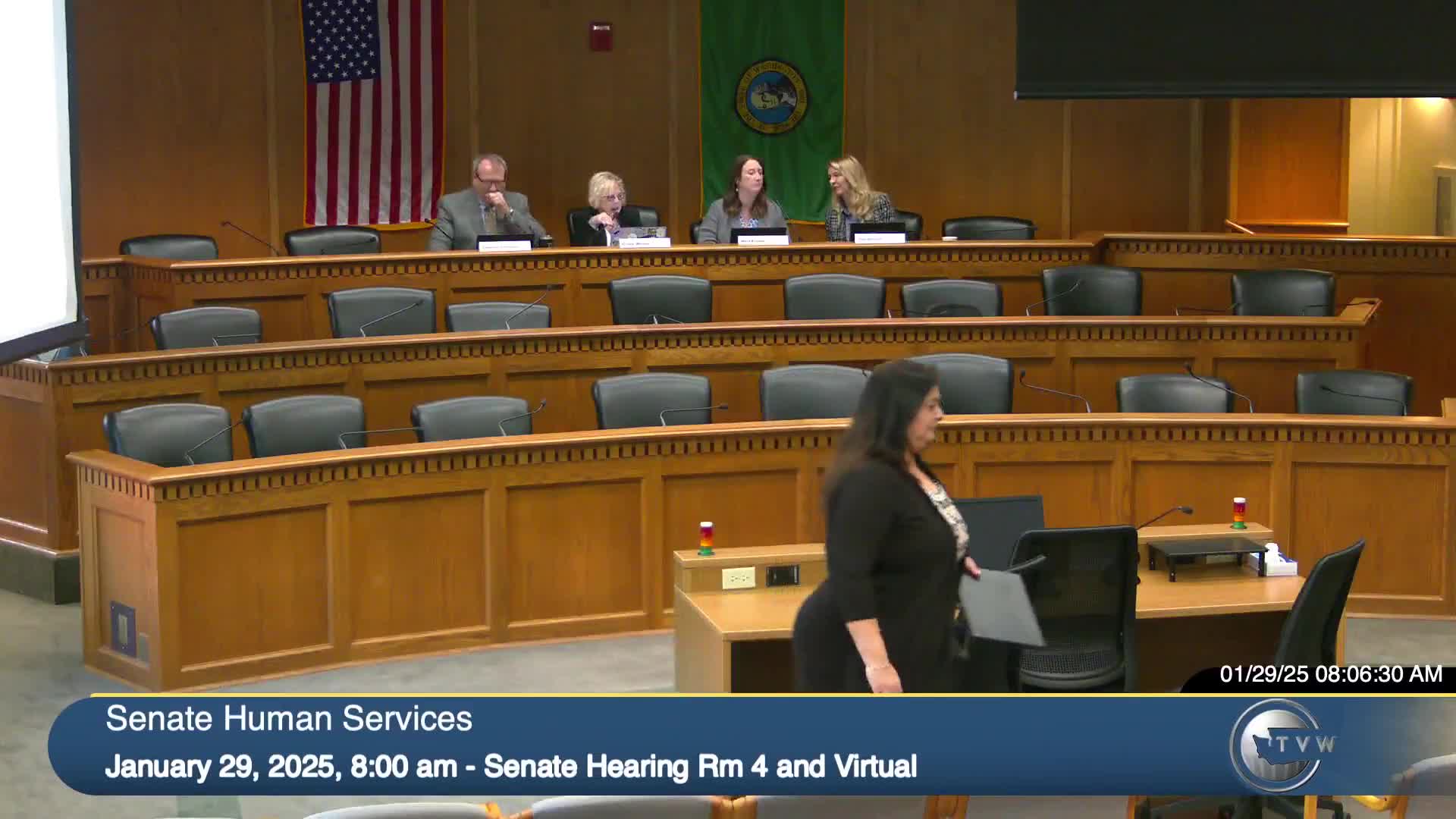
The Senate Human Services Committee heard testimony on Senate Bill 5426, which would expand diversion options for youth, prohibit successful diversions from counting as criminal history, allow restorative justice in diversion agreements and create a DCYF grant program to support community-based diversion programs.
Senate Human Services Committee members heard testimony Jan. 29 on Senate Bill 5426, sponsored by Sen. Claire Wilson, which would expand developmentally appropriate diversion options for youth, prevent successful diversions from being treated as part of a juvenile's criminal history and create a grant program to support community-based diversion services.
The bill would clarify that completed diversion agreements are not part of a juvenile's criminal history, allow restorative justice components in diversion agreements, permit courts to extend diversion completion periods, and expand the opportunity to complete diversions to age 21 for offenses committed before age 18. It would also require the Department of Children, Youth, and Families (DCYF), subject to funding, to establish a grant program to support community-based diversion programs and direct the Administrative Office of the Courts to deliver an annual statewide report on diversion use and demographics. A preliminary fiscal note identified roughly $164,000 for the current biennium for grant-reporting and administrative work.
Sponsor Sen. Claire Wilson, chair of the Human Services Committee, said the bill is “solution focused and prevention focused,” describing diversion as cost-effective and associated with lower recidivism and higher educational attainment for youth. “Anything that we can do that would keep young people out of that system and provide them with the support that they need and they deserve is well worth our attention and our time and also our investments,” Wilson said.
Supporters described local programs and data that back broader diversion use. Roxanna Gomez of Legal Counsel for Youth and Children said juvenile court administrators reported diversion as some of their most successful work and that many counties lack dedicated diversion funding. “We urge the state to prioritize and invest in upstream early interventions like diversion,” she said. Liz Trautman of Stand for Children cited a 2015 Washington State Institute for Public Policy analysis finding diverted youth had less than half the recidivism rate of adjudicated youth and said the bill would align statute with current local practices regarding criminal history.
Community providers and program alumni also testified. Ladessa Croucher of Resolution Washington said dispute resolution centers offering juvenile diversion had strong results in local evaluations. Jameesa Sanchez of Choose 180 described a 92% success rate for participants in her program. Young people who had participated in diversion — including Morning Large and Gisela Gonzales — described diversion as life-changing and urged passage.
Court and administrative officials said the bill would fill data gaps. Julie Perkins of the Administrative Office of the Courts said the bill would fund a full-time researcher to create a statewide dataset on diversion, noting current statewide data are inconsistent or not systematically tracked. Linea Anderson, representing the Washington Association of Juvenile Court Administrators, said diversion practice varies by county and the bill helps align statute with local practice and create funding pathways.
Committee members pressed proponents on data and safety concerns. Ranking Member Christian asked how removing diversion from criminal history would affect a judge’s ability to consider prior conduct; witnesses responded that removing diversions from the technical definition of criminal history would not erase records and that the Administrative Office would still collect data so courts and stakeholders could evaluate patterns and outcomes. Supporters said prosecutors retain discretion about which cases to divert and that serious violent offenses are unlikely to be diverted.
The hearing closed with committee members indicating interest and little formal committee action during the public portion. No final committee vote on SB 5426 was recorded in the transcript of this meeting.
The bill drew support from juvenile justice advocates, court administrators and community diversion providers; witnesses asked for funding and data collection to make diversion options more uniformly available across Washington.