Get Full Government Meeting Transcripts, Videos, & Alerts Forever!
Get email alerts on the Quantum Technology topic
No spam. Unsubscribe anytime.
Senate hears bill to create Washington advisory committee and grant program for quantum economic development
Summary
SB 5451 would create an advisory committee to coordinate state efforts to advance quantum technologies, direct the Department of Commerce to staff the committee, and establish a state grant program to help applicants pursue federal quantum research funding.
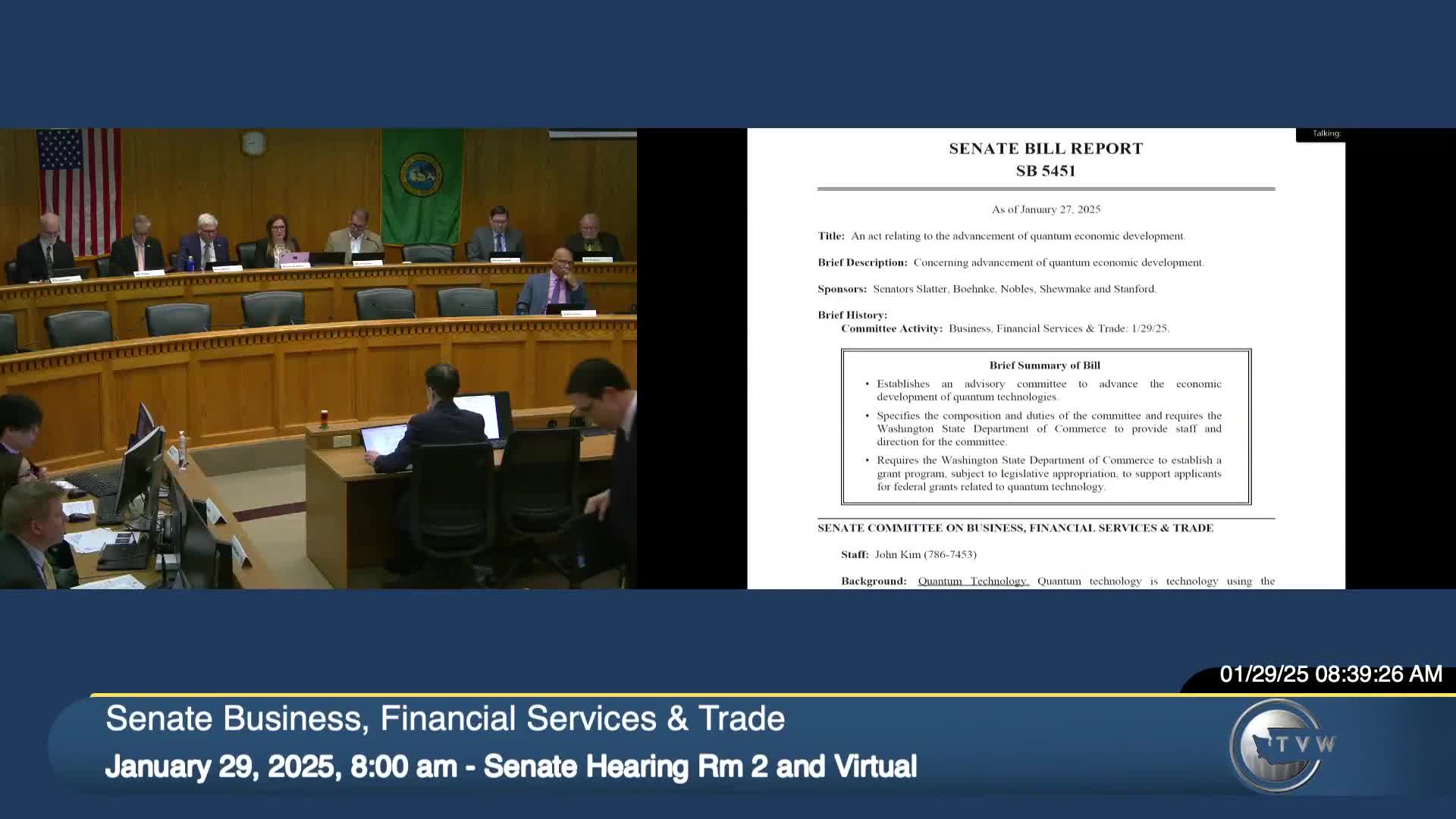
The Senate Committee on Business, Financial Services and Trade heard testimony Jan. 29 on SB 5451, a bill to create a state advisory committee and a small grant program to support commercialization and federal grant applications for quantum technologies.
Staff briefing described the bill as establishing an advisory committee appointed by the Department of Commerce director and including the lieutenant governor (or designee), one statewide elected official, the Commerce director, and representatives from higher‑education institutions, private companies and the Pacific Northwest National Laboratory. Commerce would staff the committee and the group would produce an annual report to the Legislature with recommendations to promote the state’s quantum ecosystem.
Sponsor Sen. Vandana Slatter, citing activity in Microsoft‑area companies and university research, said the measure would help Washington “lead on [quantum] and actually be able to shape it and understand the impacts.” She noted federal investment in quantum research and the need for coordination to seize grant opportunities.
Joseph Williams, ICT sector lead at the Department of Commerce, told the committee the state has strong research assets but needs better coordination to pursue anticipated federal funding tied to the National Quantum Initiative. He referenced lessons from the CHIPS Act, saying Washington missed out on larger CHIPS Act awards in part because the state was not sufficiently organized to apply for and harvest federal funds.
Committee members asked about commercialization opportunities, competitiveness with other countries and whether Washington can position itself to obtain federal dollars. Williams said the U.S. private‑sector plus federal investment exceeds China’s aggregate funding, but that China’s government investment is large and that coordination is needed to compete.
The bill, as described by staff, would also create a Commerce‑administered grant program to help eligible applicants pursue federal quantum grants; the program would be subject to legislative appropriation.
No formal committee vote was recorded; the measure advanced through public hearing testimony and will return for further legislative action as the committee and sponsor determine next steps.