Get Full Government Meeting Transcripts, Videos, & Alerts Forever!
Get email alerts on the Small Business Lending topic
No spam. Unsubscribe anytime.
UW study finds higher interest rates, collateral and cosigner requirements for minority- and women‑owned businesses
Summary
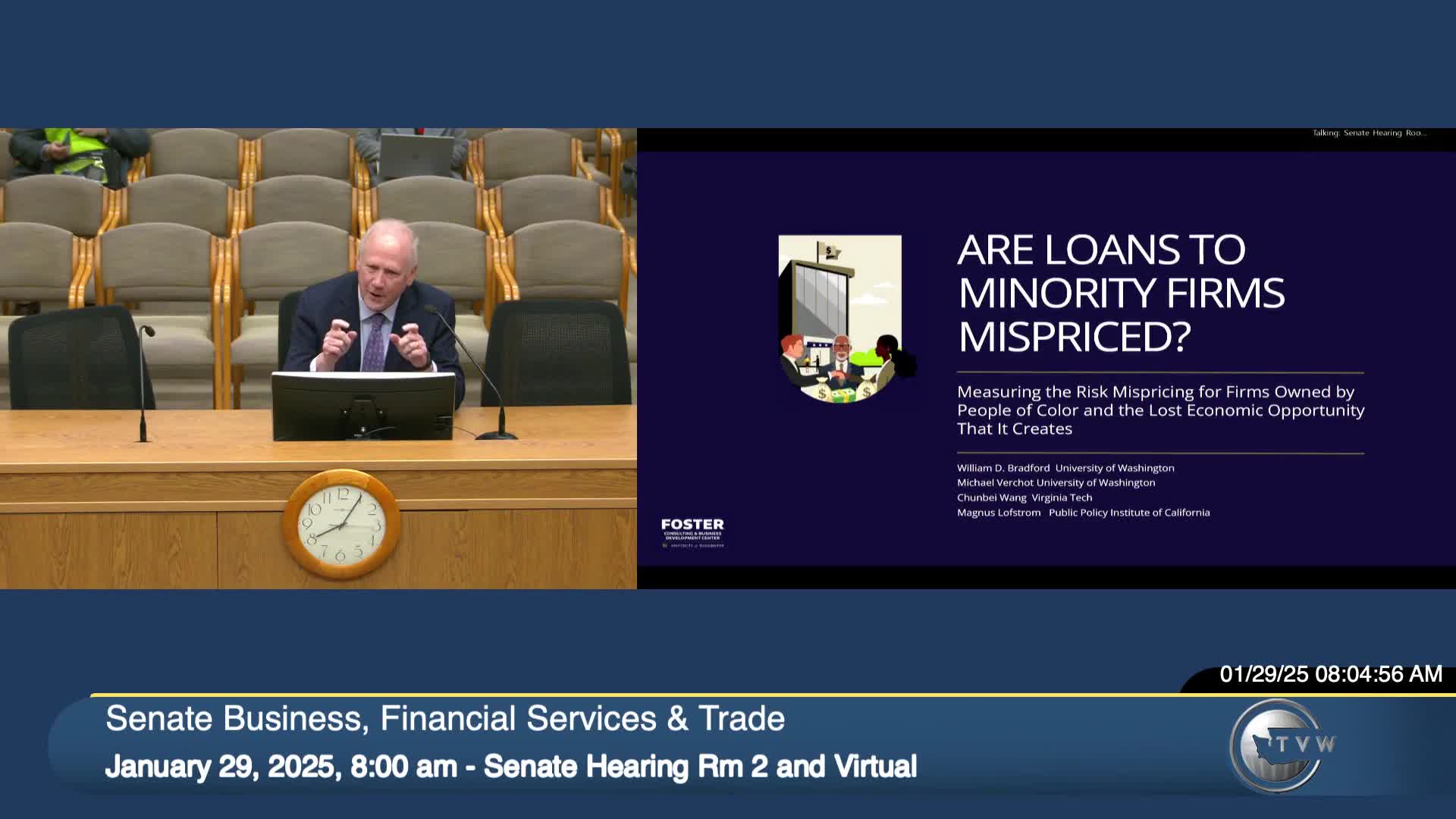
A national University of Washington study presented to the Senate Committee on Business, Financial Services and Trade found statistically significant higher interest rates and collateral requirements for Asian American, Black, Hispanic and women‑owned firms, and more frequent cosigner demands for businesses of color.
A University of Washington study presented Jan. 29 to the Senate Committee on Business, Financial Services and Trade found that Asian American, Black and Hispanic business owners and women‑owned firms paid materially higher interest rates and faced stricter collateral or cosigner requirements than similarly situated white and male counterparts.
The report, led by Michael Virchow, director of the Consulting and Business Development Center at the UW Foster School of Business, used a national dataset of roughly 300,000 business owners and analyzed loans completed between January 2022 and May 2023 to isolate differences in pricing by race, ethnicity and gender after adjusting for conventional credit‑risk factors.
The study matters because higher financing costs directly affect firms’ ability to hire and expand, the researcher told senators. “The real life importance of this is that this is about jobs,” Virchow said. “If the cost of doing business is higher, there’s fewer jobs that are going to be created.”
Virchow said the analysis controlled for a broad set of observable risk factors such as credit scores, firm age, revenue changes and ownership percentage. After controlling for those factors, the study found roughly 2.8–3.0 percentage point higher interest rates for Hispanic, Black and Asian business owners compared with otherwise similar white business owners; native American firms did not show a statistically significant difference in the fully adjusted model. Women‑owned firms paid about 2.1 percentage points more than comparable male‑owned firms, the presenter said.
The researcher also reported pronounced differences across lender types. For example, Hispanic borrowers faced nearly 3.6 percentage points higher rates at the largest banks (those with $10 billion or more in assets), while Black borrowers did not show a statistically significant penalty at large banks but did at small banks, credit unions, FinTech lenders and nonbank finance companies. The one consistent collateral finding, Virchow said, was that businesses of color were more often required to provide an external party to cosign loans.
Using public sources — the U.S. Census Bureau’s business counts and Federal Reserve small‑business survey data on application and approval rates — the team extrapolated that minority‑owned firms pay an estimated $8 billion per year in excess interest compared with similarly situated white firms.
Committee members asked about the mechanism behind the disparities and whether lenders can observe race in modern, largely online application processes. Virchow said the study is not able to identify the precise back‑office processes that produce the effect. “What this data can tell us is that there is that difference,” he said. He pointed to other research — including work from the Consumer Financial Protection Bureau — showing differences in treatment during in‑person interactions, and noted geographic location and names can serve as imperfect predictors of race or gender.
Several senators asked about policy options. Virchow said he avoids prescriptive public‑policy recommendations but suggested further oversight or study of non‑bank lenders, credit unions and FinTech firms because those institutions fall outside the Community Reinvestment Act frameworks that cover many commercial banks. "There are certainly oversight ways of institutions that are chartered by Washington State that could make a difference," he said.
The presenter flagged areas for follow‑up research, including why longer lender relationships and renewals in some cases correlated with widening interest differentials, a result he called "puzzling." He also noted the study’s limits: it analyzes observable factors and cannot by itself identify all sources of pricing differences in lenders’ internal decision systems.
The committee received the presentation and engaged in questions but took no formal action.
The UW team’s public slides and the Federal Reserve and Census sources cited in the presentation provide the numerical basis for the study’s extrapolation, the presenter said.
Looking ahead, Virchow said the research team intends to pursue additional work to probe the mechanisms behind the differences and to measure whether policy or oversight actions reduce the gaps.