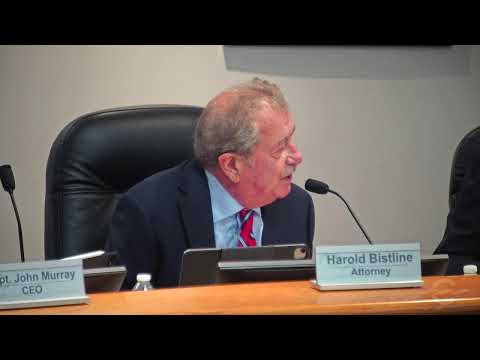
Port Canaveral board approves 2025 legislative priorities, new asset‑management system and design work for terminals
Loading...
Summary
Port Canaveral Authority commissioners on Jan. 29 approved the port’s 2025 legislative priorities, advanced design work on multiple cruise terminals and voted to implement a new enterprise asset‑management system, while accepting quarterly financial results and approving a 5% salary increase for the chief executive.
Port Canaveral Authority commissioners on Jan. 29 approved the port’s 2025 legislative priorities, advanced design work on multiple cruise terminals and voted to implement a new enterprise asset‑management system, while accepting quarterly financial results and approving a 5% salary increase for the chief executive.
Diane Lunsman, speaking as port staff, opened the substantive portion of the meeting with the legislative priorities she will advance in this year’s Florida legislative session. "This is an annual occurrence where I come before the board with our legislative priorities for the session," Lunsman said, outlining categories that include safety and security, supply‑chain stability, seaport resiliency, energy security, environmental protections for waterways such as the Indian River Lagoon, and support for Florida’s space‑operations activities.
The commission approved Lunsman’s proposed 2025 legislative priorities as part of the consent agenda. Commissioners did not amend the priorities during the meeting.
Why it matters: Port officials said the priorities are aimed at protecting the port’s role in the maritime transportation system and preserving its capacity to move cruise passengers, fuel and other commodities that feed Central Florida and the Space Coast economy. The board and staff repeatedly cited the port’s recent operating performance and regional role in fuel resilience and disaster response as background for the priorities.
Operational and financial highlights
Captain Murray, the port’s chief executive officer, reported record activity in recent months and described Jan. 29 as a management update punctuated by operational milestones. "We had the busiest day ever in this port last Saturday," he said, citing a single busy day that included six cruise vessels, one gaming vessel, nine ships total in port, six cargo vessels and multiple bunker barges including two LNG barges. For the first fiscal quarter the port reported about 2,000,000 multi‑day passengers moved through the port and 245 cruise calls; December alone set a monthly passenger record with 838,000 movements, the CEO said.
On cargo and infrastructure, the meeting noted the U.S. Army Corps of Engineers’ $41,000,000 federally funded sand‑bypass project under way to move sand around the jetties and replenish Cocoa Beach; port officials said no port funds are required for that work and federal funding will not be interrupted.
Awards and disclosure
The commission recognized staff for financial and disclosure achievements. Pat Poston, identified as the port’s senior director of finance, accepted a Digital Assurance Certification (DAC) award recognizing two decades of continuing disclosure reporting. The board also presented a Government Finance Officers Association (GFOA) Certificate of Achievement for Excellence in Financial Reporting for the port’s fiscal 2023 annual comprehensive financial report; the port reported it has earned that certificate for 33 consecutive years.
Capital projects and design work
The board approved moving forward with design and permitting work on several cruise‑terminal projects: staff asked to negotiate with Jacobs and Atkins on marine design work for Cruise Terminal 2, and to proceed with design for Cruise Terminal 5 with BEA Architects Inc. BEA’s negotiated fee for CT‑5 design and renovations was presented in the meeting materials as $3,600,000 to support about 50,000 square feet of expansion, renovation of the existing facility (mechanical, electrical and building envelope), a larger first‑floor luggage laydown, and a relocated and expanded Customs and Border Protection screened arrival area. Staff said BEA will also develop a design criteria package for additional parking options amounting to roughly 1,500 spaces (locations to be evaluated include an older north‑side garage and a separate lot).
Staff also described a planned pedestrian canopy at Cruise Terminal 1 to cover west‑side walkways and support passenger drop‑off; port staff said the canopy cost will be reimbursed under a future commercial agreement with the cruise line operator and that the design will meet current hurricane wind‑load codes as verified by the port’s building official.
Asset‑management system approved after dissent
The commission voted to implement an enterprise asset‑management platform (IBM Maximo) and associated implementation services under a five‑year arrangement. Staff described the total project at $3,750,000, which includes software subscription, implementation and asset inventory/tagging services; the subscription component noted in staff remarks was $2,440,000 over five years. Staff said the project will be implemented beginning in March with an anticipated completion around December and will include IBM‑assisted on‑site inventory work and floor‑plan mapping to place assets into the system.
Steve (VP of facilities optimization) described expected operational benefits: "Maximo will empower our organization to optimize facilities operations, reduce costs, improve services delivered, and increase our operational sustainability." Staff projected reliability increases and workforce productivity gains based on the vendor’s and staff’s analysis.
One commissioner voiced a formal objection. Commissioner Marking said, "I'm actually gonna be a nay vote on this and take the opposite stand. I think it's too much money," adding concern that the ongoing cost could recur when the contract is renewed.
The board approved the Maximo project over that objection.
Votes at a glance
- Approve proposed 2025 legislative priorities — motion to approve "the proposed 2025 legislative priorities" (mover/second not specified in record). Outcome: approved. - Accept financial memo and approve disposals, legal bills and commissioner minor expenses for Nov.–Dec. 2024; accept statistical and aging reports and list of bills — Outcome: approved. - Approve consent items 1A, 1B, 1C, 2A (includes authorization to negotiate design contracts for Cruise Terminal 2 and design award/fees for Cruise Terminal 5) — Outcome: approved. - Authorize implementation of enterprise asset‑management system (Maximo) including subscription and implementation services (5‑year) — motion passed; one commissioner registered a nay vote. - Accept CEO evaluation and approve contractual 5% salary increase per contract (evaluation score stated in the meeting materials) — Outcome: approved.
(Individual roll‑call vote names and exact tallies were not recorded in the minutes read aloud; motions and outcomes above reflect actions stated on the record.)
Discussion, context and next steps
Commissioners and staff framed the approvals around recent growth in cruise and cargo activity and the port’s role in regional fuel resilience following recent storms. Staff emphasized coordination with Florida agencies (FDOT, FSTED) and federal partners (Army Corps) on funding and permitting. For the Maximo implementation, staff said the substantial upfront data work — inventory, tagging, floor plans — is a necessary step to put preventative maintenance and real‑time data into daily operations.
The meeting closed with routine commissioner reports and a reminder that the next regular commission meeting is scheduled for Feb. 26, 2025.
Ending
The board’s approvals move forward a mix of near‑term operational investments and longer‑term planning: staff will now negotiate and execute consultant agreements for terminal designs, begin the Maximo implementation work plan, continue outreach on the legislative priorities and prepare the next set of financial and project updates for the Feb. 26 meeting.