Get Full Government Meeting Transcripts, Videos, & Alerts Forever!
Get email alerts on the Special Education Funding topic
No spam. Unsubscribe anytime.
Special-education task force urges $160M ECS boost, lower excess-cost threshold and new oversight of private placements
Summary
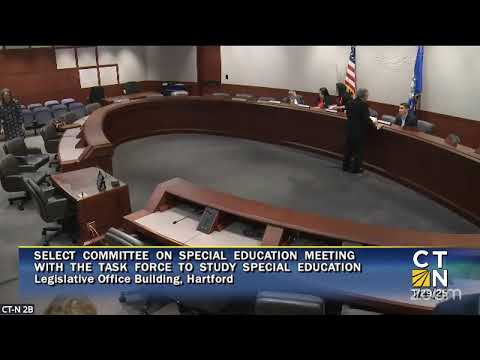
A legislative special-education task force told Connecticut lawmakers Jan. 29 it recommends a large boost to the state's education funding formula, changes to excess-cost reimbursement, steps to shore up the special-education workforce and greater review of private placement costs and practices.
HARTFORD, Jan. 29 — A legislative special-education task force recommended a major change to Connecticut's school funding system and a package of policy and oversight steps aimed at easing staff shortages, improving equity and curbing sharply rising placement costs.
"There were 4 areas that were huge areas for us to really focus in on. Number 1 is the severe staff shortages. Number 2, the lack of resources. Number 3, the lack of equity across the state. And 4, the failure to close the achievement gap," Fran Rabinowitz, executive director of the superintendents organization and a tri-chair of the task force, told the Select Committee on Special Education during a Jan. 29 presentation.
The task force proposed amending the state's Education Cost Sharing (ECS) formula to add a special-education weight that the group said would be equivalent to a 50% weight based on the number of special-education students in each district. The task force said the change would add about $160,000,000 to the next state budget, an estimate the group cited from the School and State Finance Project.
Nut graf: The recommendation aims to put more predictable dollars into districts to cover unusually high per-student costs tied to special education, while also pushing districts to expand in-district programs, increase oversight of private placements and invest in workforce steps for teachers and paraeducators.
The task force emphasized multiple, linked reforms rather than a single fix. Key finance and program recommendations included:
- Adjust ECS: Add a special-education weight to ECS (task force cited a 50% weight proposal) to deliver a substantial, recurring increase in state aid.
- Change excess-cost reimbursement: Remove the existing cap on excess-cost reimbursement so districts could be reimbursed for all excess costs above the current 4.5-times-per-pupil-expenditure threshold, and lower the threshold for reimbursement of extraordinary costs in in-district programs to three times per-pupil expenditure. Task force co-chair attorney Michelle Laban said, "there is no money for special education other than the excess cost grant in the way, school finance works in Connecticut right now." The task force said the change would allow more accurate budgeting by districts.
- Pilot and capital grants to expand in-district programs: Create a grant and bonding program (the task force recommended $20,000,000 for a startup grant program) to help districts build and staff in-district options and reduce reliance on costly private outplacements and transportation.
- Review tuition increases and private-placement fees: Rather than immediately recommending a formal statewide rate-setting mechanism, the task force recommended that the Connecticut State Department of Education (CSDE) investigate private-program tuition increases that outpace CPI for the same student and collate tuition/fee data so districts can compare charges across providers.
- Strengthen eligibility, interventions and oversight: Recommendations include permitting the "developmental delay" eligibility classification through age 8 (Connecticut law then allowed it to age 6; federal rules permit to age 9), updating eligibility guidance and tools every three years, mandating robust multi-tiered systems of support (MTSS) in every school, and auditing restraint and seclusion incident reports for consistent application of law.
- Workforce and certification steps: The task force urged actions to recruit and retain special-education teachers and paraeducators, including micro-credentialing, streamlined cross-certification programs, expanded alternative-route options, improving pay and benefits for paraeducators and targeted training (for example, adding more required coursework in reading instruction). Members noted existing routes for paraeducator entry (an associate's degree/60 college credits or passing the ParaPro exam) and called for review and promotion of those pathways.
Committee members pressed the panel on costs, oversight and implementation. Senator Heather R. Kissel (Senator Kissel), Representative Masha Khan (Chairman Khan) and others asked for more detailed fiscal analysis, and the task force asked staff and outside analysts to provide follow-up numbers; the presenters said district IEP data in Connecticut's centralized IEP system (CT SEDS) could be used to estimate program costs.
Concerns about private placement oversight recurred. The task force reported there are 88 state-approved private special-education programs; representatives told the committee 25 of those are for-profit providers. Lawmakers and presenters said CSDE already requires private programs to submit annual fiscal reports and CPA audits to districts and the state as part of approval, but both committee members and task force presenters said CSDE may need more resources to perform onsite reviews and to analyze fee and tuition data across providers.
On staffing, presenters and committee members described shortages statewide. Task force members said private providers can sometimes raise salaries more quickly than districts and thus pull staff away; that dynamic has pushed up private-placement costs and exacerbated in-district shortages. The task force recommended targeted financial and nonfinancial strategies to recruit and train staff, including micro-credentials, high-school-to-para pipelines and expanded support for paraeducator benefits. The task force also recommended reducing unnecessary paperwork for teachers where possible.
The task force did not present new legislation for immediate enactment at the hearing; rather, members offered a set of recommendations for the legislature and CSDE to consider. "We would like to be as short as possible so that we can answer all of your questions," Rabinowitz said at the start of the presentation, and the panel spent the remainder of the meeting responding to committee questions.
The committee also announced off-campus "listening sessions" for public comment on the task force recommendations. The task force listed three upcoming sessions: Feb. 4 at Three Rivers Community College in Norwich (5 p.m. to 7 p.m.); Feb. 6 at Northwestern Connecticut Community College in Winsted (5 p.m. to 7 p.m.); and Feb. 11 at Housatonic Community College in Bridgeport (5 p.m. to 7 p.m.).
Ending: Committee members asked the task force and CSDE for follow-up fiscal estimates and suggested the group work with OFA and other analysts to produce a clear fiscal note. Several lawmakers said they supported the goal of expanding in-district programs to improve student access and long-term cost predictability, while others cautioned the state must carefully weigh the immediate budget impact of any changes to ECS or excess-cost reimbursement.