Get Full Government Meeting Transcripts, Videos, & Alerts Forever!
State of the Bay briefing: Maryland officials, restoration groups outline progress and gaps ahead of 2025 targets
Summary
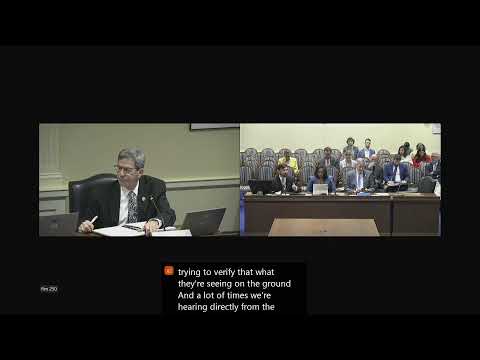
State and nonprofit officials gave the House Environment and Transportation Committee an update Jan. 29 on Chesapeake Bay restoration progress, noting measurable gains in water‑quality indicators while urging action on nonpoint pollution and an update to the Chesapeake Bay Watershed Agreement as 2025 target dates arrive.
State and nonprofit officials gave the House Environment and Transportation Committee an update Jan. 29 on Chesapeake Bay restoration progress, noting measurable gains in water-quality indicators while urging action on nonpoint pollution and an update to the Chesapeake Bay Watershed Agreement as 2025 target dates arrive.
The briefing featured Anna Killius, executive director of the Chesapeake Bay Commission; Mark Hoffman, Maryland director for the commission; Lisonbee Colton, Maryland executive director of the Chesapeake Bay Foundation; and Maryland cabinet secretaries including Josh Kurtz (Department of Natural Resources), Secretary McElwain (Department of the Environment) and Kevin Addicks (Department of Agriculture).
Why it matters: 2025 is a milestone year for many outcomes in the Chesapeake Bay Watershed Agreement. Speakers said the agreement should be amended — not replaced — to reset or refine time‑bound targets and governance for the partnership that includes state and federal agencies, the District of Columbia, scientific institutions and nonprofit partners.
Anna Killius of the Chesapeake Bay Commission framed the briefing by marking four decades of Bay partnership work and the need to “adapt and strategize” beyond 2025. She told the committee the Commission and its partners will emphasize state‑led, bipartisan collaboration while updating time‑bound outcomes. Killius said some outcomes are on track or completed, while others are “off course or uncertain.”
Lisonbee Colton of the Chesapeake Bay Foundation described recent improvements in the Bay Health Index compiled by the University of Maryland Center for Environmental Science, noting the Bay reached a C+ overall — the first time in more than 20…
Already have an account? Log in
Subscribe to keep reading
Unlock the rest of this article — and every article on Citizen Portal.
- Unlimited articles
- AI-powered breakdowns of topics, speakers, decisions, and budgets
- Instant alerts when your location has a new meeting
- Follow topics and more locations
- 1,000 AI Insights / month, plus AI Chat