Get Full Government Meeting Transcripts, Videos, & Alerts Forever!
Get email alerts on the Chesapeake Bay Restoration topic
No spam. Unsubscribe anytime.
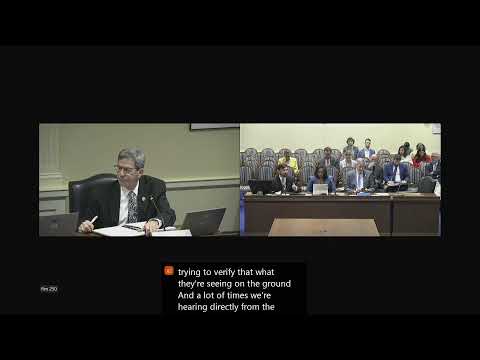
State of the Bay briefing: Maryland officials, restoration groups outline progress and gaps ahead of 2025 targets
Summary
State and nonprofit officials gave the House Environment and Transportation Committee an update Jan. 29 on Chesapeake Bay restoration progress, noting measurable gains in water‑quality indicators while urging action on nonpoint pollution and an update to the Chesapeake Bay Watershed Agreement as 2025 target dates arrive.
State and nonprofit officials gave the House Environment and Transportation Committee an update Jan. 29 on Chesapeake Bay restoration progress, noting measurable gains in water-quality indicators while urging action on nonpoint pollution and an update to the Chesapeake Bay Watershed Agreement as 2025 target dates arrive.
The briefing featured Anna Killius, executive director of the Chesapeake Bay Commission; Mark Hoffman, Maryland director for the commission; Lisonbee Colton, Maryland executive director of the Chesapeake Bay Foundation; and Maryland cabinet secretaries including Josh Kurtz (Department of Natural Resources), Secretary McElwain (Department of the Environment) and Kevin Addicks (Department of Agriculture).
Why it matters: 2025 is a milestone year for many outcomes in the Chesapeake Bay Watershed Agreement. Speakers said the agreement should be amended — not replaced — to reset or refine time‑bound targets and governance for the partnership that includes state and federal agencies, the District of Columbia, scientific institutions and nonprofit partners.
Anna Killius of the Chesapeake Bay Commission framed the briefing by marking four decades of Bay partnership work and the need to “adapt and strategize” beyond 2025. She told the committee the Commission and its partners will emphasize state‑led, bipartisan collaboration while updating time‑bound outcomes. Killius said some outcomes are on track or completed, while others are “off course or uncertain.”
Lisonbee Colton of the Chesapeake Bay Foundation described recent improvements in the Bay Health Index compiled by the University of Maryland Center for Environmental Science, noting the Bay reached a C+ overall — the first time in more than 20 years. “This is the first time in over 20 years that the Chesapeake Bay Health Index has reached a C plus level,” Colton said. She credited upgraded wastewater treatment for large gains and said future progress will require much more action on nonpoint pollution — mainly agricultural runoff and stormwater — which is harder to measure and address.
Maryland officials outlined programs, monitoring and proposed policy changes. Josh Kurtz, Secretary of the Maryland Department of Natural Resources, said the state is coordinating monitoring with modeling and rolling out tools to better match model predictions with field data. “We are meeting the model, and our monitoring also, brings that together,” Kurtz told the committee. He said a steering committee and the Chesapeake Executive Council have asked program staff to prepare targeted revisions to the Watershed Agreement by the end of the year and to simplify governance so the partnership is more inclusive and manageable.
Kevin Addicks, Secretary of the Maryland Department of Agriculture, described progress in agricultural practices and incentives. He said Maryland has generally met or exceeded many practice goals through programs such as the Maryland Agricultural Cost Share Program and new incentives under the administration’s LEAF (Leaders in Environmentally Engaged Farming) program, which will score and reward conservation and climate‑smart practices on farms.
Maryland Department of the Environment officials emphasized three implementation priorities: protecting investments already made, modernizing stormwater regulation to reflect current rainfall and climate realities, and using early‑warning monitoring to address wastewater plant malfunctions more rapidly. Secretary McElwain said the state has decreased nitrogen discharges substantially since 2009 and highlighted an early‑warning system and stronger permit enforcement as key tools.
Speakers and legislators highlighted specific wins and gaps: - Progress and wins: The partnership reports the smallest recorded Bay dead zone in 2023, three consecutive years of increases in underwater grasses in some areas, nearly 1.64 million acres of permanently protected land, and recent state funding boosts for agricultural cost‑share in Pennsylvania (an additional $50 million per year, reported by the Chesapeake Bay Commission). Maryland reported meeting a 30% conservation target ahead of schedule and substantial reductions attributable to wastewater upgrades. - Remaining gaps: Officials said 13 of 31 measurable outcomes tied to the Watershed Agreement are off course or uncertain. Forest buffers remain a priority: partners installed roughly 640 miles of forest buffer in 2023 (the most since 2016), but forest loss still outpaces plantings. Nonpoint pollution from agriculture and increasing stormwater loads tied to development and climate change remain the central challenges.
Policy and program next steps discussed: - The Chesapeake Executive Council charged the Bay program to recommend amendments to the 2014 Chesapeake Bay Watershed Agreement to clarify post‑2025 targets and governance; partners said they will prepare targeted revisions this year focused on outcomes and inclusivity. - Maryland agencies issued competitive calls under the Whole Watershed Act; nine proposals were received and the state management team said it will announce awards in March. - The administration’s Bay Legacy package includes the LEAF incentive program, the Nearshore Farm and Finance Act (to incentivize tidal vegetative buffers), stormwater permitting reform and a 500,000‑tree planting initiative.
Committee members asked about invasive species, monitoring coverage, dead‑zone measurement and microplastics. Presenters said invasive blue catfish and northern snakehead are of growing concern and that monitoring relies on an extensive network of federal, state and academic stations combined with modeling. Kurtz said the state and partners are expanding predictive tools (including a dead‑zone tracker developed with the Virginia Institute of Marine Science) and maintain a public Eyes on the Bay portal for dissolved‑oxygen data. Officials said there are 49 dissolved‑oxygen monitoring stations on the main stem in Maryland’s jurisdiction and additional stations operated by partners.
What was not decided: The briefing did not include formal votes or legislative action by the Committee. Several programmatic directions were described as ongoing or planned, including the Executive Council charge and Maryland’s pending awards from the Whole Watershed Act process.
The presentations underscored a common theme: measurable environmental improvements driven largely by wastewater upgrades and targeted conservation, but continued urgency to scale nonpoint pollution solutions, update stormwater rules for climate realities, protect existing investments, and refine watershed targets and governance beyond 2025.
The committee adjourned the briefing to return for bill hearings at 1:30 p.m.; staff and agency representatives said they will follow up with legislators on monitoring locations, the Patuxent and Potomac river grades on the UMCES report card, and details about planned grant awards.