Get Full Government Meeting Transcripts, Videos, & Alerts Forever!
Get email alerts on the Chemical Weapons Research Aberdeen topic
No spam. Unsubscribe anytime.
Supporters ask committee for favorable report on House Bill 62 to allow testing at Aberdeen Proving Ground; health, oversight questions raised
Summary
Proponents told the Environment and Transportation Committee HB 62 would let Aberdeen Proving Ground test and develop technologies to counter chemical threats; department staff and public-health witnesses urged retained permitting and monitoring steps and flagged concerns about an exemption in the draft bill.
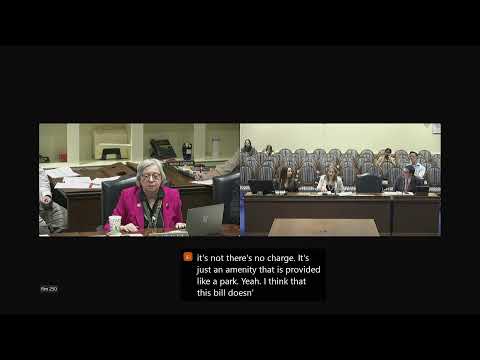
Supporters of House Bill 62 told the Environment and Transportation Committee on Wednesday that the bill is needed to allow the Aberdeen Proving Ground’s Chemical Biological Center to perform small-scale testing and demonstration of technologies that protect U.S. forces and support national security.
Bryson Pop, appearing for the Army Alliance, said the measure “is a national security issue” and that the proposed change reflects a shift from large-scale stockpile destruction toward testing small battlefield-recovery samples from places such as Syria and Iraq.
The bill’s proponents — including Tom Alvaro, who identified himself as a former president of the Army Alliance and chairman of the Maryland Defense Research Coalition, and Rob Malone, an environmental scientist at the CHEM Bio Center — told the panel the center is the only U.S. location where small quantities of chemical agents can be fabricated and stored under the Chemical Weapons Convention for research and development purposes. Malone cited prior operations, including at-sea destruction of Syrian-declared stockpiles, as evidence of the center’s capabilities.
Maryland Department of the Environment (MDE) staff Edward Hammerberg testified that MDE supports the bill as amended and that the agency retains permitting authority: “I don't know that it does curtail our authority. We still have permitting authority over and, actually, with the technical amendment to the bill, it emphasizes our authority to regulate these materials as hazardous waste and to apply hazardous waste permitting standards,” he said.
Committee members pressed proponents on safety, monitoring and alternatives. Proponents said technologies tested at Aberdeen would be subject to an RD&D (research, development and demonstration) permitting process under COMAR and mirrored federal requirements (e.g., RCRA and parts of 40 CFR), including public notice, trial burns, maximum credible event modeling and reporting requirements. Tom Alvaro described layered controls in test chambers (explosive-resistant rooms, cascade ventilation, HEPA and carbon filtration) and continuous monitoring between filter banks designed to detect “breakthrough” and trigger shutdowns.
Physician Gwen Du Bois, testifying unfavorably for Chesapeake Physicians for Social Responsibility, warned the bill “exempts the Maryland Department [of] Environment from oversight” as drafted and said the bill would allow RD&D operations to be exempted if the Department of Defense labels them “research.” Du Bois also questioned the lack of a sunset, public disclosure of quantities and continuous monitoring data.
Committee members repeatedly requested clarity about the bill’s limits and the revised technical amendment; proponents said the language had been changed to reassert MDE authority compared with an earlier draft. Proponents also noted a letter from a deputy assistant secretary of defense (Kingston Reif) and an informational letter from the Maryland Department of Health were in the committee file.
What happens next: The committee did not take a final vote during the hearing. Members indicated continued scrutiny of the technical amendment language and of permit and oversight processes would inform the panel’s recommendation.
Ending — Context and local impact: Aberdeen Proving Ground and the CHEM Bio Center in Harford County were the focus of the hearing. Proponents argue HB 62 preserves a federally required U.S. capability for defense research; opponents and some delegates asked for explicit, statutory protections and public-reporting requirements to ensure that permitting and monitoring remain robust and transparent.