Get Full Government Meeting Transcripts, Videos, & Alerts Forever!
Get email alerts on the Alcohol Regulation topic
No spam. Unsubscribe anytime.
Committee hears bill to expand outdoor alcohol service, authorize shared campus events at Seattle Center
Summary
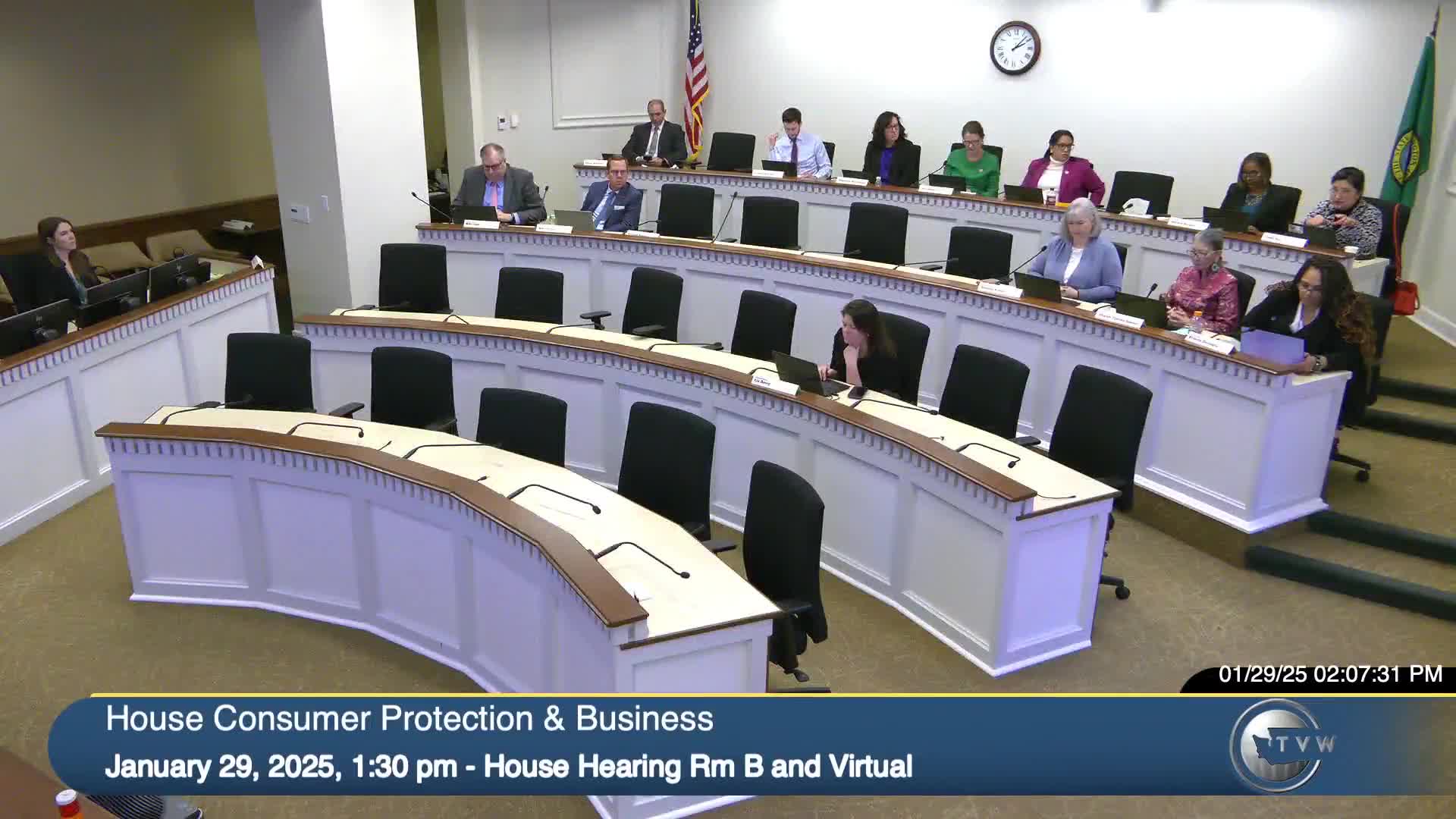
The Consumer Protection & Business Committee on Jan. 29 held a public hearing on House Bill 1515, a measure that would allow cities and counties to ask the Liquor and Cannabis Board (LCB) to approve expanded outdoor alcohol service areas and permit shared indoor and outdoor alcohol service areas on publicly owned civic campuses, with a provision focused on the Seattle Center.
The Consumer Protection & Business Committee on Jan. 29 held a public hearing on House Bill 1515, a measure that would allow cities and counties to ask the Liquor and Cannabis Board (LCB) to approve expanded outdoor alcohol service areas and permit shared indoor and outdoor alcohol service areas on publicly owned civic campuses, with a provision focused on the Seattle Center.
The bill matters because it would change how licensed businesses can serve alcohol in public spaces and would create a pathway for city‑approved, campus‑wide event perimeters where multiple licensees share alcohol service responsibilities. Sponsors said the proposal was intended to support large events such as the FIFA World Cup fan festival and to modernize existing LCB rules.
Peter Klawfelter, staff to the committee, summarized existing LCB rules and the bill’s changes. He told the committee that the bill would let a city or county request LCB approval to permit expanded outdoor service across a jurisdiction or within designated areas, allow fence‑free demarcation and greater opening widths on sloped sites, and permit nonalcohol businesses to share outdoor service areas with licensed sellers. "The first part of House Bill 1515 would allow a city, town, or county to request in the LCB to approve expanded outdoor alcohol service for liquor licensees within the whole jurisdiction or a specific area or areas of this jurisdiction," Klawfelter said during his briefing.
Representative Reed, the prime sponsor, emphasized the bill is intended to be piloted and said she planned to add a sunset clause by amendment. "Our intention is to add a sunset clause and amendment," Reed told the committee, explaining she wants the pilot to run slightly beyond the World Cup so organizers can collect data and test the approach at events such as Bumbershoot.
The bill contains three main sets of changes, as described to the committee: 1) broader authority for local jurisdictions to request LCB approval for expanded outdoor alcohol service areas and relaxed physical barrier requirements (including a permitted fence‑free demarcation and exceptions for sloped site conditions); 2) a Seattle‑focused provision allowing cities with populations above 400,000 to request LCB approval for expanded outdoor and indoor alcohol service during events on a publicly owned civic campus, where participating licensees would submit a joint operating plan and the campus operator would notify the LCB seven days in advance; and 3) two licensing changes: allowing a caterer’s liquor license for certain campus events even if the event sponsor is not a nonprofit, and creating a special community event license for nonprofit organizations for approved city events.
Speakers representing Seattle Center and festival operations described pilot results. Marshall Foster, director of Seattle Center, said the campus has hosted alcohol‑inclusive events in pilot form and argued expanded, shared service areas improved access and safety: "We see about 12,000,000 annual visitors ... This is fundamentally about modernizing and updating the way we manage alcohol service on our campus. It's not about expanding the service." Gloria Alvarez Connors, festival director for Bumbershoot and a representative of the Seattle FIFA Local Organizing Committee, said pilot configurations at Seattle Center produced fewer incidents and more family engagement; she reported zero underage drinking incidents in recent pilots and said staff saw increased attendance in family‑accessible areas.
Public health and neighborhood voices raised concerns. Megan Moore, executive director of the Washington State Public Health Association, testified remotely in opposition and warned about increased "alcohol outlet density," which she said is associated in research with higher rates of violence, impaired driving and health harms. "Although House Bill 1515 and other licensure bills seem small on their own, as a whole, they would expand alcohol in the state," Moore said, citing LCB research and youth survey data she submitted to the committee. Several legislators also asked whether the bill’s Seattle‑focused provisions could or should apply to other fan‑zone communities across Washington; Representative Reeves and others asked whether the 400,000‑population threshold would exclude other cities hosting World Cup events.
Committee members pressed the sponsor and city representatives about neighborhood equity and conflicting municipal policies. Representative Santos asked whether the bill could create inconsistent policies across city neighborhoods, noting Seattle had recently adopted public‑space restrictions in parts of the city. Reed and Seattle Center staff replied that the campus provisions were tailored to Seattle Center’s long‑standing experience running large events and that any broader expansion would be handled through the LCB approval process and, potentially, future amendments.
Several business and trade groups testified in support or to request changes. Mike Stewart of the Ballard Alliance and Sean DeWitt of the Washington Hospitality Association said the bill would help small business outdoor dining and tourism; Daniel (last name recorded in the transcript as Wilson/Olson) of the Washington Brewers Guild and Josh McDonald of the Washington Wine Institute also supported more flexible shared spaces for local businesses while asking for clarifications on liability and population thresholds.
The committee suspended the public hearing to consider additional prime sponsors and testimony, and later closed the hearing on HB 1515. For the record at the close of the public hearing members noted 12 individuals had signed in pro and 1 in other categories for this bill.