Get Full Government Meeting Transcripts, Videos, & Alerts Forever!
Get email alerts on the Public Safety Jurisdiction topic
No spam. Unsubscribe anytime.
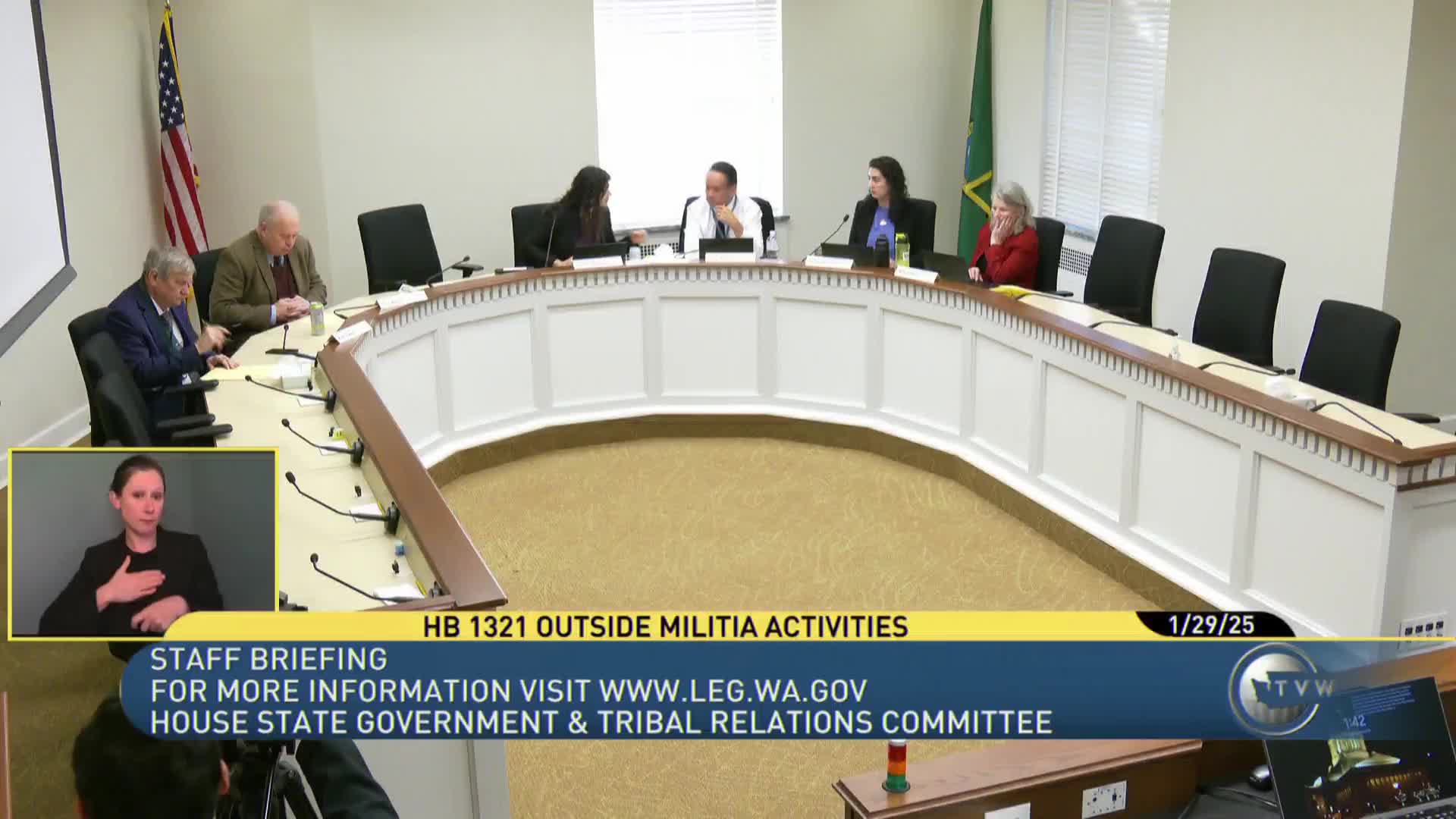
Committee Reviews Bill to Bar Unfederalized Armed Forces from Entering Washington Without Governor's Consent
Summary
House Bill 1321 would prohibit armed military forces from another state, territory or district from entering Washington to perform military duties without the governor’s permission unless federalized. Staff cited Title 10, witnesses included the governor’s office and a military veteran who cautioned about the term "militia."
The State Government & Tribal Relations Committee heard testimony on House Bill 1321, a substitute that would prohibit armed military forces from another state, territory or district from entering Washington for the purpose of performing military duty without the governor's permission unless the force is federalized under Title 10 of the United States Code.
Connor Schiff, counsel to the committee, summarized federal law and the concept of federalization under title 10, explaining that National Guard units operate under state authority unless called into federal service. Schiff said the proposed substitute would bar entry by armed forces from other states for military duty unless the governor permits it or the force is acting under presidential authority.
Representative presenting the bill said the measure is intended to protect Washington's autonomy and cited similar statutory language used in other states. Nathan Bays from the governor's office testified that Governor Jay Inslee (Governor Ferguson in the transcript) strongly supports the bill and that the Washington Military Department expects no adverse effect on training, readiness or mutual‑aid disaster responses. Bays said the bill preserves interstate training and mutual‑aid deployments that occur at a governor's request.
A remote testifier, Jeff Bock, a former U.S. Marine Force Recon member, warned the committee that the term "militia" has a broader historical and constitutional meaning than the National Guard and urged the drafters to use precise language: "Militia does not have the meaning that you folks are using for the for this, this particular wording here." Committee members asked questions about scenarios that prompted the bill; sponsors characterized it as precautionary and pointed to other states that have enacted similar restrictions.
No committee vote was recorded during the hearing. Staff said a fiscal impact was not expected and that the bill is consistent with approaches adopted in several other states; more detailed legal analysis and drafting could be required if members choose to move the bill forward.