Get Full Government Meeting Transcripts, Videos, & Alerts Forever!
Get email alerts on the Student Registration topic
No spam. Unsubscribe anytime.
Bill to give students with dependents early registration draws support and operational questions
Summary
House Bill 1492 would require institutions that offer early registration to provide it for students with dependents; backers cited data showing nearly 23% of community‑college students have dependents, while institutions warned verification will require resources.
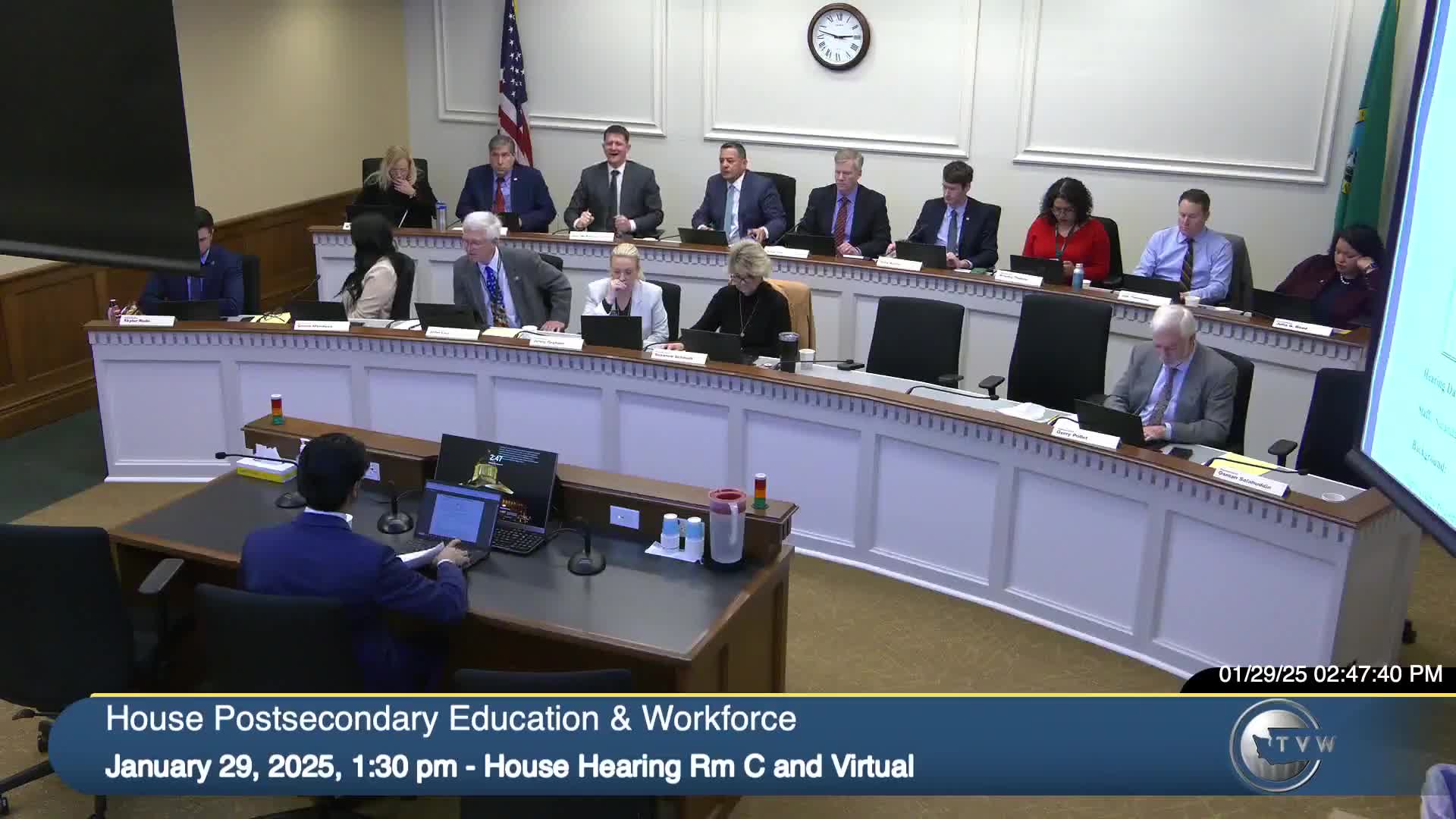
House Bill 1492, which would require colleges and universities that have early registration to extend that priority to students who care for dependents, received largely supportive testimony and some operational caveats during a Jan. 29 hearing.
Committee staff described the bill’s mechanism: Saranda Ross explained that the bill “requires institutions that do offer an early registration period to also offer early registration for students who have dependents, starting with new students who have completed the admissions process, followed by continuing and returning students who have met enrollment requirements.” The bill defines dependents as children 18 or younger in a student’s care and persons who are dependent due to disability or advanced age.
Representative Usman Salahuddin (48th District), sponsor of the bill, cited research from the Institute for Women’s Policy Research that nearly 23% of community and technical college students in Washington—about 46,000 students—are raising dependent children. “Early registration will provide student parents and caregivers with the ability to create a manageable schedule, reducing stress and promoting better mental well‑being and academic performance,” he told the committee.
Supporters from the Council of Presidents, student governments and community colleges spoke in favor. Melissa Beard of the Council of Presidents said institutions already extend priority registration to many groups (veterans, graduating seniors, certain programs) and that verification of dependent status will require resources. Christine McMullen of the State Board for Community and Technical Colleges urged care on whether the bill alone will meet all parenting‑student needs; she noted colleges lack clear data on students with dependents and that priorities already balance multiple categories.
Students described real scheduling constraints. Randy Phillips, a Tacoma Community College student and parent of two, told the committee he has faced childcare and schedule conflicts that made classes difficult to attend.
Implementation questions: committee members asked whether there is evidence linking early registration to outcomes. Sponsor Salahuddin acknowledged direct correlational data was not provided at the hearing but said the measure aims to improve retention and graduation by removing a planning barrier. Institutions noted verification could be time‑consuming and that the bill preserves class‑standing‑based ordering among continuing students to avoid displacement.
Where things stand: the hearing produced broad support and no formal committee vote that day. Staff said there were 228 sign‑ins on HB 1492 (220 pro, four con, four other) and six witnesses testifying in person or online.
Next steps: committee staff and sponsors will continue discussions with institutions to clarify verification processes and potential funding for administrative costs associated with verifying dependent status each term.