Get Full Government Meeting Transcripts, Videos, & Alerts Forever!
Get email alerts on the Religious Recognition topic
No spam. Unsubscribe anytime.
Committee Hears Broad Public Support for Bill to Recognize Eid al‑Fitr and Eid al‑Adha
Summary
Lawmakers heard hours of testimony on House Bill 1434, which would legislatively recognize the two major Muslim holidays; sponsor Rep. Osman Salahuddin said the bill would not add paid holidays but would formally acknowledge the dates. Supporters emphasized inclusion, students' attendance challenges, and the need for better cultural recognition.
The State Government & Tribal Relations Committee held a public hearing on House Bill 1434, a measure to legislatively recognize Eid al‑Fitr and Eid al‑Adha; Representative Osman Salahuddin, the bill's prime sponsor, told the committee the measure does not add paid holidays but seeks formal recognition of the days.
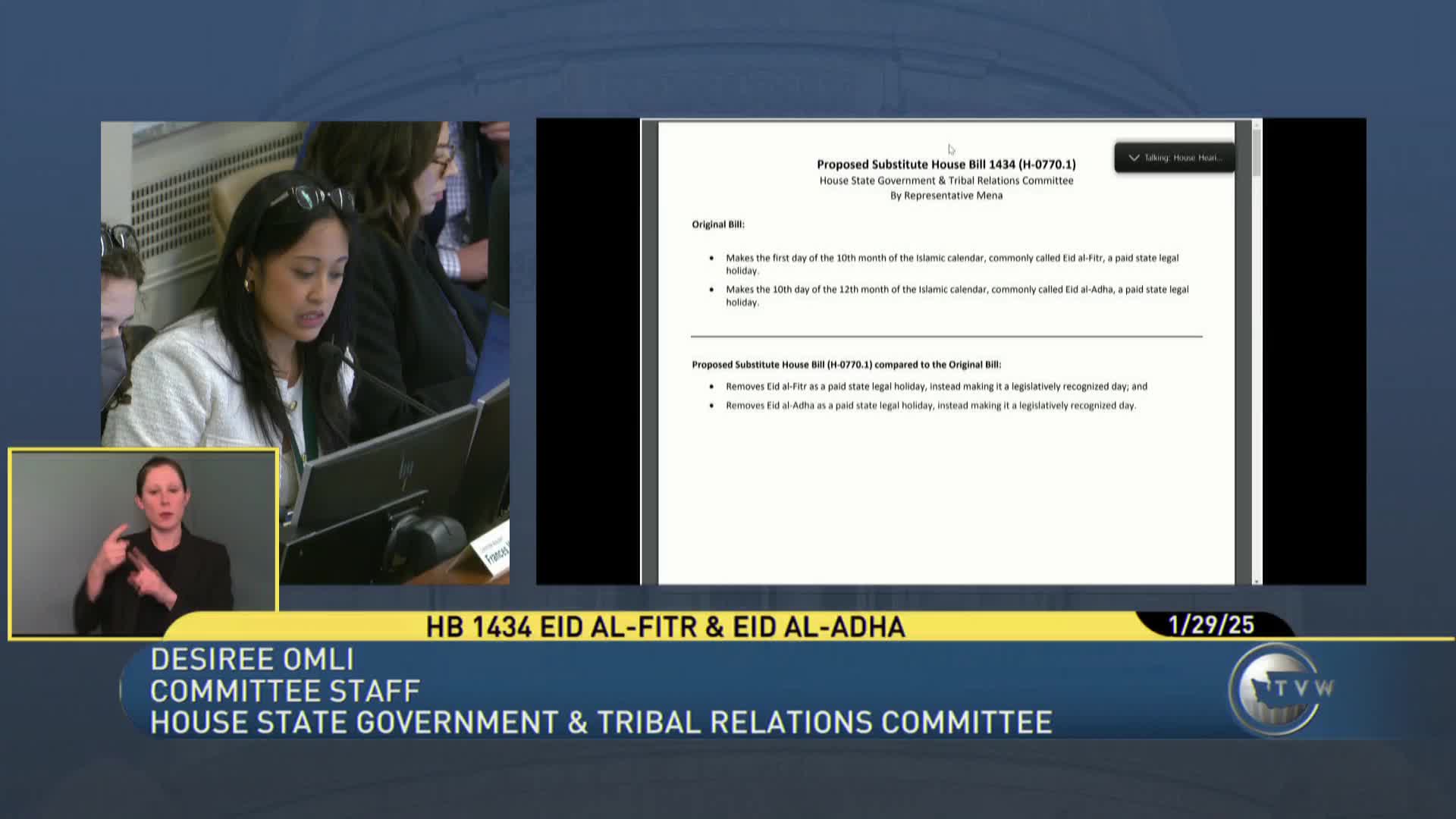
Committee staff summarized the proposed substitute and its calendar-based approach. Desiree Omley of the Office of Program Research told members the substitute designates dates on the Islamic calendar for legislative recognition and noted staff would answer questions about the substitute text. Representative Salahuddin framed the bill as a step toward inclusion, saying the measure recognizes the religious and cultural significance of the two holidays for Washington's Muslim residents and their families.
The committee heard testimony from dozens of residents, educators and community leaders. Several speakers described practical effects on school attendance and workplace scheduling. Ahmed Tirhi, an assistant principal in Federal Way Public Schools, said large numbers of students miss school for Eid observance and that schools respond by limiting testing or changing assignments on those dates: "On a day, we struggle because we don't have a lot of our kids here." Other witnesses — students, parents and educators — said formal recognition would make Muslim students feel seen and reduce the need to choose between religious observance and school or work commitments.
Legal and civic witnesses framed the bill as consistent with religious‑freedom principles. Attorney Mehreen Nadim told the committee recognition aligns with constitutional protections for religious exercise and said the designation would acknowledge Washington's religious and cultural diversity. Rep. Salahuddin noted the bill intends to recognize the holidays legislatively without mandating paid time off: "this bill does not ask for any additional paid state holidays. Rather, it's simply asking for legislatively recognized days." Supporters cited estimates offered in testimony that Washington is home to roughly 80,000–100,000 Muslim residents and emphasized a long history of Muslim presence in the state.
The committee suspended and later resumed the hearing to take testimony from those online; staff recorded that about 300 people had signed up to testify. No committee vote or final action occurred during the session; the hearing record closed after public comment and no fiscal note or final amendment was reported on the floor of the hearing.