Get Full Government Meeting Transcripts, Videos, & Alerts Forever!
Get email alerts on the Pensions And Benefits topic
No spam. Unsubscribe anytime.
Lawmakers review ERS funding plan as health premiums rise and drug costs surge
Summary
At a Senate Finance Committee hearing, LBB and Employee Retirement System officials outlined a funding path that keeps ERS on track toward full funding while warning of rising health-care costs driven largely by new high-cost diabetes drugs; lawmakers pressed ERS on investment returns and sought more detail about pharmacy rebates and benchmarks.
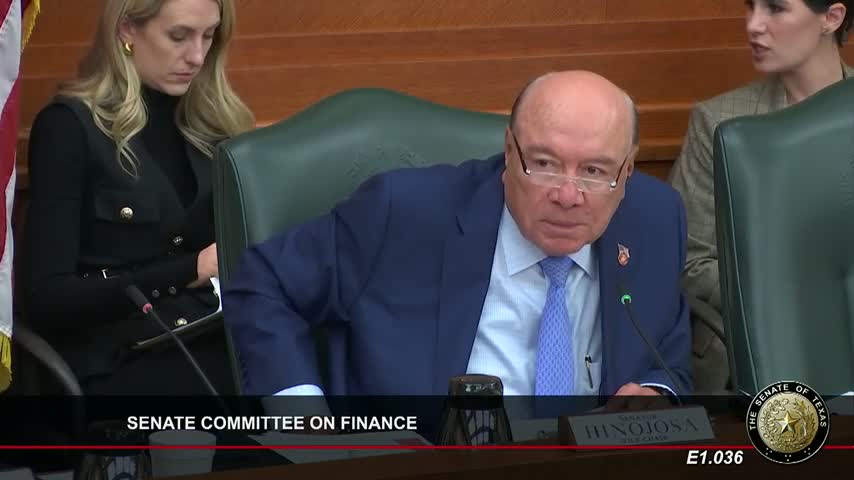
At a Senate Finance Committee hearing, Legislative Budget Board analysts and officials from the Employees Retirement System of Texas (ERS) outlined proposed budget recommendations for the 2026–27 biennium and fielded lawmakers’ questions about pension funding, investment performance and rapidly rising health-care costs.
The LBB presented an ERS bill pattern that would leave the system on a path toward full funding over the next two decades while accounting for payroll growth and recent one-time payments. The LBB recommended $1.8 billion in retirement system costs and $4.7 billion for the Group Benefits Plan for the biennium, and described a proposal that would add a supplemental legacy payment that could accelerate the date the system is fully funded.
The nut graf: Committee members pressed ERS executives about returns on invested assets and the agency’s strategy to control health-care costs for more than half a million covered lives. Senators focused on whether ERS is getting market-competitive investment performance and on a projected 8% annual premium increase for the group benefits plan, which ERS officials say is driven in part by steep pharmacy cost growth from two diabetes drugs frequently named during the hearing: Ozempic and Mounjaro.
Most important facts up front: John Posey of the LBB told the committee ERS appropriations are estimates but the LBB’s recommendations include a roughly $1.8 billion retirement system pattern and a $4.7 billion group benefits pattern for the 2026–27 biennium. ERS officials told the committee the agency will implement an 8% per-year premium increase in the current budget pattern to shore up reserves and avoid larger, later requests from the state. Porter Wilson, ERS executive director, said the agency will continue efforts to contain costs and to engage members on health improvement programs.
On investment returns: Senators pressed ERS over recent net returns. State Senator Charles Schwertner said the three‑year net return of roughly 5.7% (reported by LBB) “is terrible” relative to public equities. ERS staff responded that returns must be viewed against ERS’s diversified asset allocation and long‑term obligations — including the monthly annuities the system pays — and that ERS performance has outpaced many peers when measured against comparable pension plans and benchmarks for each asset class. Porter Wilson told senators ERS has outperformed many peers and that the Board of Trustees and consultants consider the fund’s overall long-term position and payout obligations when setting strategy.
Health-care cost drivers and premiums: LBB and ERS officials told senators the single largest driver of pharmacy cost growth since 2022 has been so‑called GLP‑1 drugs — commonly referred to at the hearing by brand names Ozempic and Mounjaro — used to treat diabetes and widely discussed for their use and cost. John Posey said pharmacy cost trends were the chief reason the LBB included an 8% annual premium increase in the Group Benefits Plan projections. ERS officials reported claims payments around $4 billion per year (about $8 billion on a biennial basis) for the group plan covering roughly 547,000 lives and said pharmacy trend alone was in the double digits in recent years.
Porter Wilson described the 8% premium path authorized in the bill pattern as a deliberate step to replenish ERS’s contingency reserve and avoid a sudden multi‑billion–dollar request later. “We’re starting to deplete our contingency reserve this year,” Porter Wilson said, noting the agency had set the premium increase to achieve a smoother long‑term funding profile.
Pharmacy rebates and transparency: Several senators asked whether ERS’s contracts with pharmacy benefit managers (PBMs) provide sufficient transparency into rebates and true net costs. ERS officials said their PBM contract guarantees that rebates are returned to the plan and that ERS has the contractual and audit access needed. ERS’s liaison to the Texas Pharmacy Initiative (TPI) told the committee the TPI is working with state agencies to obtain and analyze confidential pricing and rebate data and build roadmaps to improve statewide purchasing leverage.
Funding the pension: Committee discussion acknowledged bills and prior payments that have materially improved ERS’s funded status. The LBB reiterated that an additional $1 billion legacy payment — discussed for the supplemental bill — would reduce interest costs over time and speed the date the system achieves full funding from the 2050s to the mid‑2040s. LBB staff estimated an additional $1 billion could save roughly $2.7 billion in interest costs, a calculation the committee referred to when weighing long‑term tradeoffs.
Lawmakers pressed ERS over governance and benchmarking: Senator Schwertner urged ERS to show detailed benchmarks and peer comparisons for each asset class and to demonstrate how net returns were calculated. Porter Wilson agreed to provide the committee with the list of benchmarks, asset class targets, and comparative peer groups and noted ERS already benchmarks performance against public pension funds over $1 billion.
Impact on retirees and staff: The committee heard public testimony from retirees and employee representatives urging a cost‑of‑living increase or a one‑time payment to long‑serving retirees who have seen purchasing power erode. ERS and the LBB noted that pension funding actions over recent sessions enabled the modest, targeted cost‑of‑living adjustment adopted for a small cohort of long‑term retirees; lawmakers and advocates urged broader action as budgetary options allow.
Quotes from the hearing: “For the first time in over 20 years, we’re not here asking for an exceptional item on pension plan,” Porter Wilson told the committee. John Posey of the LBB summarized health‑care drivers: “The pharmacy cost trend is actually 11.4% in 2022, 12.8% in 2023 and projected 11.3% in 2025.” Senator Charles Schwertner told ERS: “Five‑point‑seven percent on a three‑year return is terrible.”
Background and context: ERS manages retirement and health benefits for state employees, retirees and certain higher‑education employees. The Group Benefits Plan covers state employees and many higher‑education members outside the largest systems and has been running high pharmacy cost trends that state leaders have asked ERS and other large purchasers to address. The Pension Review Board also presented its budget earlier in the hearing; that agency requested one‑time IT funding and emphasized its role in actuarial oversight and policy analysis for Texas public retirement systems.
What’s next: ERS agreed to provide the committee a breakdown of benchmarks and peer groups for investment performance, more detail on PBM rebates and contract audit access, and updated projections for premium impacts under alternate scenarios. Lawmakers signaled interest in viewing the supplemental legacy payment as one lever to reduce long‑run interest costs and accelerate full funding of ERS. Committee members also urged continuing work with TPI and other state purchasers to reduce pharmacy costs.
Ending: The committee’s deliberations in the coming weeks will weigh whether to accelerate additional legacy payments to ERS, whether to authorize programmatic transparency steps for PBMs and TPI, and whether to endorse retiree relief beyond the actions already taken by the legislature. ERS officials said they would return requested benchmarking and rebate documents to the committee for follow‑up.