Get Full Government Meeting Transcripts, Videos, & Alerts Forever!
Oregon City Historic Review Board weighs tighter thresholds, ADU options for McLoughlin conservation district
Summary
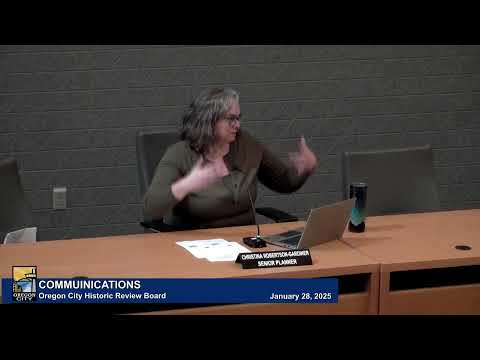
At a Jan. 28 meeting, the Oregon City Historic Review Board continued a months‑long “compatible change” study on how the board reviews additions and new construction in the McLoughlin conservation district, directing staff to run a neighborhood survey and refine code options that focus on footprint, height and age as possible review triggers.
Oregon City — On Jan. 28 the Oregon City Historic Review Board heard a two‑hour presentation and discussion on proposed changes to how the board reviews additions and new construction for non‑designated properties in the McLoughlin conservation district.
The board’s consultant, Kristen Minor, and city planning staff reviewed options to clarify Section 17.1740 of the municipal code and to define a searchable, administrable threshold for when an owner’s alteration or addition should require Historic Review Board (HRB) review rather than routine staff permitting. Christina, a planner with Oregon City’s planning staff, said the city will run a postcard and online survey for McLoughlin residents and property owners in mid‑February, hold an open house March 6 and present preliminary survey results at the HRB meeting on March 25.
Why it matters: McLoughlin contains roughly 1,000 tax lots and about 200 locally designated resources; the remainder are non‑designated properties that can be altered without full HRB review unless changes exceed a defined threshold. The board is trying to balance preserving historic character with allowing modest change — including small accessory dwelling units (ADUs) — and to make review triggers clear and enforceable for staff and the public.
What the staff and consultant recommended and why
Kristen Minor, a historic preservation consultant formerly with the Portland Historic Landmarks Commission, told the board the project seeks “to re‑examine the definition of new construction, which serves as the threshold for which projects get reviewed by the HRB on non‑contributing properties.” She said the district’s survey adopted in 2002 sets the current eligibility period and that the district’s date of eligibility “now extends to 1953.” Minor recommended retaining a footprint (area)‑based trigger and combining it with other measurable factors — most often height or a height/footprint matrix — instead of using project cost or a materials‑loss test, which she said would be difficult for staff to apply consistently.
Key points of the discussion
- Retain footprint as a primary…
Already have an account? Log in
Subscribe to keep reading
Unlock the rest of this article — and every article on Citizen Portal.
- Unlimited articles
- AI-powered breakdowns of topics, speakers, decisions, and budgets
- Instant alerts when your location has a new meeting
- Follow topics and more locations
- 1,000 AI Insights / month, plus AI Chat