Get Full Government Meeting Transcripts, Videos, & Alerts Forever!
Get email alerts on the Affordable Housing topic
No spam. Unsubscribe anytime.
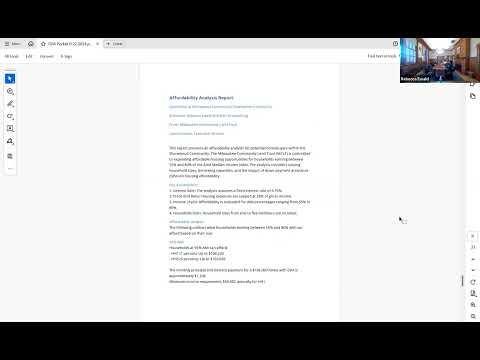
Shorewood CDA reviews land-trust model; presenters estimate roughly $200,000 subsidy to yield $200,000 sale price for duplex units
Summary
Presenters outlined a community land trust approach to create permanently affordable homeownership in Shorewood, modeling two‑bedroom duplex sales and recommending program choices on AMI targets, resale caps and subsidy levels; no formal vote on adopting a program was taken.
Members of the Shorewood Community Development Authority on Wednesday reviewed a proposed community land trust model intended to create permanently affordable homeownership, including an estimate that roughly $200,000 of subsidy would be required to reduce the purchase price of a two‑bedroom duplex to about $200,000.
The land‑trust presenters said the model would separate the land from the dwelling under a ground lease, cap future resale appreciation to preserve affordability and rely on a mix of down‑payment assistance and a buy‑down from municipal funds. The CDA took no formal action on the proposal and asked staff and the group to return with priorities and a draft ground lease.
Joseph, a land‑trust presenter, described the housing comps used for the analysis and the subsidy math. “A pretty fair, hypothetical would be 450,000 or multiples, 2 2 bedroom units,” Joseph said, explaining he had aggregated recent duplex sales to establish a realistic purchase price and then “backed into the payment amount” by adjusting the buy‑down to reach an affordability target. Joseph and Lamont, who joined the presentation, said the model assumes rental income from one unit in a duplex can reduce the subsidy the municipality must provide because the homeowner can collect rent from the second unit.
Lamont, the other presenter, summarized program mechanics and resale limits used in other land‑trust models. “Under the current resale model, they only can appreciate 1.25% simple interest per year,” Lamont said, describing one common formula for limiting how much equity a seller can take when exiting a land‑trust home.
Presenters and CDA members discussed who the program should target. Presenters said the modeling focused on households of three to four and noted the program could be tailored to make offers more advantageous for a family of four (for example by calibrating subsidy amounts to households at about 60–65% of area median income). “We're really gonna be targeting households of 3 and 4,” one presenter said, noting that a family-of-four target produces buying power consistent with a $200,000 purchase price in the example.
CDA members raised several concerns in the discussion: the loss of some future property tax revenue if the land is removed from the tax roll and resale prices are limited; the village’s competing capital needs such as street‑light and water infrastructure projects; whether the village should instead encourage higher‑density development that could increase tax revenue; and staff capacity to manage a new program. One member asked whether the village could legally prioritize families of four; presenters responded that the program cannot legally exclude other household sizes but can be structured to favor certain household types by the level of subsidy and eligibility criteria.
Presenters explained expected sources of additional subsidy and assistance: HUD‑linked homebuyer counseling commonly yields about $7,000 of down‑payment assistance for participants who complete counseling, and banks or housing counselors can sometimes add more to help with closing costs. Presenters also said city or county down‑payment programs had in the past provided larger one‑time allocations (for example, a city filing of $2,000,000 to support down‑payment assistance was mentioned as background).
Participants reviewed other program design details: whether parcels would immediately be split on the tax rolls (presenters said assessors sometimes take a year to issue separate tax keys), how to allow modest homeowner improvements while preserving resale affordability, and whether to tie resale adjustments to a fixed percentage or a market index. Presenters noted a range of acceptable resale formulas used by other community land trusts and stressed the importance of a clear ground lease document.
CDA members and presenters agreed on next steps: the subcommittee should identify priorities (target AMI, resale formula, unit size limits and the extent of municipal subsidy) so presenters can draft a tailored program and a ground lease for the CDA to review. No final funding commitments or program adoption occurred at the meeting.
Votes and routine motions: the transcript records procedural approvals (nominating Mitch to chair in John Cross’s absence and approval of prior meeting minutes) and a motion to adjourn; the CDA did not take a vote to adopt the land‑trust program.
The CDA asked staff to work with presenters and to return with a draft ground lease, refined priorities and clearer cost examples before scheduling any formal vote or recommending use of TID funds or other municipal dollars.